Author Archive
Project complexity redux
In recent years there has been much discussion on complexity in project management (see this book or this standard, for example). Unfortunately, the term “complexity” has been interpreted in all kinds of different ways, creating more confusion than clarity. So, despite all that’s been written and said, project management practitioners are still left wondering what is meant when the words “project” and “complex” (or its variants such as “complexity”) are strung together. This post is aimed at clarifying some of the confusion.
In the natural and social sciences, the term complexity is used to describe systems that consist of several interacting parts. However, there’s more to complexity than just that. Complex systems display several characteristic features including nonlinearity, continuous interactions with their environment (open systems) and complex feedback loops. Many complex systems also display emergent behaviour – i.e. behaviour that is more than a sum of the the behaviour of individual components. The collective behaviour of bird flocks is an example of emergence: individual birds follow a relatively simple set of behaviours or rules based on the movements of their neighbours, giving rise to a stable flying pattern on the scale of the entire flock. This large-scale flocking pattern is an emergent phenomenon, not easily discernable from the simple rules followed by individual birds.
Now, as I’ve mentioned in a prior post, the term complex is used in at least two distinct senses in the project management literature. These are:
- Projects that are difficult or complicated because they are high risk or involve a multitude of management and technical factors. I have used the term in this sense in my post entitled a short note on project complexity. This kind of complexity is relatively easy to measure, at least qualitatively if not quantitatively.
- Projects that are complex in the sense of complex systems as discussed above. This type of complexity is typically hard to measure, even qualitatively.
Although it is possible (and not uncommon) for projects to be complex in both senses described above, it is important to make a distinction between the two for reasons that I discuss below.
For starters, to ensure consistency with other disciplines the adjective “complex” should (ideally) be used to refer to projects that are complex in the second sense. That brings us to the nub of the matter: how are we to know if a project is complex in this sense or not? This question remains open at this time. As yet no one has devised a metric, scale or even a definition by which one would be able to determine whether a project is truly complex or not. Nevertheless, it is worth looking at project complexity from a couple of perspectives in order to get a feel for what a definition of a complex project might look like. I do this in the next few paragraphs, with the caveat that my discussion is more vignette than panorama. Those looking for the latter may want to read the review paper published by Cooke-Davis and others in 2007. If wading through a research paper sounds uninviting, I can recommend my post entitled rumours of a new project management paradigm, which is basically a summary and review of the paper.
Moving on, in a recent paper, Jon Whitty and Harvey Maylor discuss the nature of complexity in projects. They point out that there are two elements to complexity – structural and dynamic. In the context of projects, the structural aspect consists of individual elements that make up the project and its environment – stakeholders, project tasks, etc. – and the interactions between these. In contrast, the dynamic aspect refers to changes in elements, the consequent changes in their interactions, and the further changes in the elements as a result of changing interactions. Whitty and Maylor suggest that a project be termed complex only when it displays both structural and dynamic complexity. By this token, many projects currently classified as complex are incorrectly deemed so, because they display mainly structural, not dynamic, complexity. Put another way, they exhibit complexity in the first sense described earlier, but not the second. For example, many large projects consist of a large number of interacting elements (and hence display structural complexity), but the elements and their interactions are relatively stable (and hence not dynamically complex). At the other end of the spectrum, one could have small projects that do display dynamic complexity. Size by itself is not a good measure of dynamic complexity.
Whitty and Maylor’s discussion suggests that structural complexity maps to complexity in the first sense described above (i.e. complicated projects) and dynamic complexity to the second (i.e. truly complex projects). In what follows below, the term complex should be read as dynamically complex.
Although the definition of a (dynamically) complex project is still an open question, Whitty and Maylor look into what might be meant by “managing a complex project”. In general, it is difficult (and often impossible) to predict long-term emergent behaviour in complex systems. In complex projects this lack of predictability is a consequence of complicated, dynamic interactions between various project elements such as resources, tasks etc. Note that this is lack of predictability, in principle – i.e. it is not a consequence of incomplete knowledge (such as incomplete scope definition) or any other controllable cause. This being the case, many of the tools used in conventional project management, which includes all Big Design Up Front methodologies, would simply not apply to complex projects. For example, how can one build a (long-term) schedule if one doesn’t know what’s going to happen? Further, it is also clear that any methodologies that use short development cycles, which includes all iterative / incremental approaches, would have a much better chance of success here. In this context, the terminology used by the adaptive approach is particularly apt: faced with uncertainty, one doesn’t plan, one speculates. To sum up, although we don’t know what exactly a complex project is, we do know – broadly speaking – which project management approaches might work with them (and, more importantly, which won’t!).
For another perspective on project complexity, let’s turn to a paper entitled, Dilemmas in a General Theory of Planning, published by Rittel and Webber in 1973. The paper focuses on the characteristics of many social problems or issues – such as education, crime etc. – which can’t be solved (or even formulated!) in a conventional, scientific sense. The authors coin the term wicked problem to refer to such problems. In contrast, problems that can be analysed and solved using known techniques are referred to as tame problems. In their paper, Rittel and Webber propose the following as defining characteristics of wicked problems:
- There is no definitive formulation of a wicked problem.
- Wicked problems have no stopping rule.
- Solutions to wicked problems are not true-or-false, but good or bad.
- There is no immediate and no ultimate test of a solution to a wicked problem.
- Every solution to a wicked problem is a “one-shot operation”; because there is no opportunity to learn by trial-and-error, every attempt counts significantly.
- Wicked problems do not have an enumerable (or an exhaustively describable) set of potential solutions, nor is there a well-described set of permissible operations that may be incorporated into the plan.
- Every wicked problem is essentially unique.
- Every wicked problem can be considered to be a symptom of another problem.
- The existence of a discrepancy representing a wicked problem can be explained in numerous ways. The choice of explanation determines the nature of the problem’s resolution.
- The planner has no right to be wrong (planners are liable for the consequences of the actions they generate).
Although these characteristics are qualitative, they are relatively unambiguous – i.e. given a problem, we can figure out whether it is wicked or not. Looking through the list, it is tempting to draw a link between wickedness and complexity. Although I’m out on a limb here, other writers have commented on the similarity between complex systems and wicked problems too.
In an article published in 2002, Mary Poppendieck dubbed a wicked project as a project that tackles a wicked problem as though it were a tame one. I would simplify the definition to: a wicked project is one that tackles a wicked problem. Then, assuming a connection between wickedness and complexity exists, one would have the basis for a qualitative definition of a class of complex projects. I say “a class” because even if it is true that wicked problems are complex, the converse doesn’t necessarily hold – i.e. not all complex problems are wicked.
All the above – some of which is speculation – leaves open the question of how a project is to be deemed complex or not. This, as mentioned earlier, awaits an unambiguous definition (and measure) of project complexity. We’re a long way off from that at present. So, at least for now, one has to be careful when labelling a project “complex” because the term has a very precise meaning in the social and natural sciences. Given this, it may be best to refer to so-called complex projects by other adjectives such as complicated, difficult, hard, intricate, convoluted or even labyrinthine. Any synonymous term would get the point across, whilst sparing the project management community a whole lot of confusion.
Reading project road signs
The metaphor of a project as a journey is one that has been used by others (see this article by Max Wideman, for example). As a consequence, a high-level project plan is sometimes referred to as a roadmap. Now, real roads have signs at appropriate points, informing motorists of potential hazards or other matters. In this post I extend the project-as-a-journey metaphor, looking at how some common road signs might be interpreted in project management terms.
 I start with the stop sign. Project managers, as a part of their day-to-day work, make several decisions regarding their projects. Admittedly, many of these decisions are trivial ones, which don’t really matter one way or the other. But there are others which are major crossroads- and a wrong choice made could have a significant negative effect on the project. At such crossroads it is important to stop and deliberate before deciding which way to go.
 There’s a tricky bit ahead on your project. What do you do? Well, you do exactly as you would when driving on a winding road – slow down and watch the road ahead carefully. Project managers often seek to maintain project velocity (rate at which the project progresses) even when implementing a technically difficult phase. It is important to recognise that some bits of work are harder than others. Recognising this means: a) slowing down and, equally important, b) keeping a close watch on quality, as the tricky bits of work may be more prone to defects than others.
 This one deals with compromises. Have you ever come across a situation where you want something done in a particular way and your counterpart (sponsor, team lead, team member whoever) disagrees? May be you think you’re right. But on the other hand, may be you really aren’t. Is there a large inverted, Give Way (or Yield) triangle hanging above your disagreement? It is always worth checking for it. May be you are being unreasonable. In any case, it behooves you to consider the possibility.
 Round and round we go – or so it seems in some project meetings. This sign is a warning that a meeting is headed nowhere. Metaphorically, I’ve seen it at many meetings that I’ve been in – interminable discussions on irrelevancies. The best thing a project manager can do when he sees this sign is to firmly, but politely, take charge of the meeting and drive it out of the roundabout.
 A canny project manager will realise there are some battles that are simply not worth fighting. It takes some political nous to figure out which these are, and that’s where the No Entry sign comes in. As an example consider the case of a project team member who isn’t up to scratch. He or she may be slowing progress due to shoddy work. You’ve discussed the issue with the person concerned several times, all to no avail. You now go to the team member’s functional manager to discuss a potential replacement. He doesn’t want to hear about it, and starts to get upset with you. That’s a No Entry sign flashing right there. Back track, walk away and have the discussion another day.
 This one has a universal relevance, despite the Australian imagery. I often think of the kangaroo sign when confronted with problems that are created by someone else unintentionally. Here’s an example: I need a data projector for a meeting that’s due to start shortly. I go to the support area to get the projector, only to find that another PM’s already grabbed it. I’m now projector-less, with the meeting coming up in 5 minutes. I’ve been blindsided or “mugged by a marsupial”. I should’ve allowed for the possibility and reserved the projector well ahead of time.
—
There are quite a few unusual road signs out there, and it can be an amusing (if not edifying) pastime to look for project management (or, more generally, management) interpretations to these. So I sign off, leaving the interpretation of the following road sign as an exercise for the reader.

—
Modelling project manager performance
A project manager is typically judged by the success of his or her projects. However, to really understand what makes a good project manager, it is necessary to identify and analyse factors that make a project manager successful. Much research effort has been expended on this over the years, with various factors posited as being the keys to success. Some of these include: project management knowledge (as defined by assorted methodologies), general management skills, leadership skills etc. Interestingly, there are studies that indicate there is virtually no correlation between performance and project management knowledge. Possibly as a consequence, the focus has shifted to management and leadership skills – i.e. the so-called “soft”, or people-related skills. In a recent paper entitled, The Role of Technology in the Project Manager Performance Model, published in the Project Management Journal, Vittal Anantatmula develops a performance model based on people-related factors identified from the literature. He also looks at the role of technology tools in supporting project manager performance. This post presents a summary and a review of the paper.
To begin with, the author describes his main objectives as the following:
- To identify a set of people related factors that influence project success, and to find relationships between these.
- To develop a performance model based on relationships between the factors.
- Based on the model, to identify areas where technology can support project manager performance.
As a background for his work, the author presents a detailed, literature-based discussion on the relationship between technology and project management, and on the role of project managers vis-a-vis the project team. Due to limitations of space, I will not go into this here – referring the interested reader to the original paper for more. My focus is purely on the research itself – i.e. the identification of factors, development of the model and the role of technology in project manager performance. That in itself is going to add up to a pretty hefty word count.
From a review of existing project management literature, the author identifies the following set of people-related factors which influence a project manager’s performance.
- Create clarity in communications: One of the major responsibilities of a project manager is to facilitate clear communications between all stakeholders, particularly at the early stages of the project.
- Define roles and project management processes: A clear definition of roles and responsibilities within the project team is important for project success. The roles should cover the entire gamut of project-related activities, but should avoid overlapping responsibilities. Further, unambiguous definition of project management processes adds clarity by ensuring team members know how the project will be run.
- Communicate expectations: This refers to the need to define and establish expectations regarding project objectives, particularly with customers and end-users.
- Employ consistent processes: The use of formal processes reduces project risks and ensures that a project progresses through a well-defined path. The trick here is to understand and implement only those processes that are really necessary and add value.
- Establish trust: Project team members have to develop a sense of trust in each other. This is critical for sharing knowledge and for working together as a team. Although not often acknowledged, this depends on nebulous factors such as organisational culture which are not in the project manager’s control.
- Facilitate support: This refers to the need to obtain organisational support for the support for the project, particularly from senior management. This is a critical function of a project manager.
- Manage outcomes: A project should deliver all that has been laid out in the objectives. As mentioned in the first line of this post, a project manager is often judged on the basis of how well the project meets its objectives. Managing outcomes is thus an important function of a project manager.
In my opinion this list is somewhat arbitrary because:
- It includes factors that aren’t people related (e.g. employ consistent processes) .
- It misses important factors such as team motivation (see this paper, for example). There are probably good reasons for this- one being that such factors are hard to quantify. However, a comprehensive performance model should attempt to incorporate these in some fashion.
- The author has selected a set of factors with no justification other than that they appear in the literature. Now, there are several other people-related factors that have been studied over the years. So, why were these seven factors chosen over others?
Having identified the above factors, the author develops a performance model using Interpretive Structural Modelling (ISM). ISM enables one to prioritise factors (i.e. rank them in order of importance) and also develop causal relationships between them, based on data collected from a population of respondents. ISM is derived from the technique of pairwise comparison. For each possible pair of factors in the list above, respondents were asked about the relationship between factors in a pair. Specifically, they were asked to choose from one of the following options:
- Does the first factor influence the second?
- Does second factor influence the first?
- Do both factors influence each other?
- Are the factors unrelated (no influence either way) ?
Based on responses received from 54 respondents, the author developed a model using ISM. The resulting model is depicted as a directed graph below (note: the diagram has been adapted from the paper)
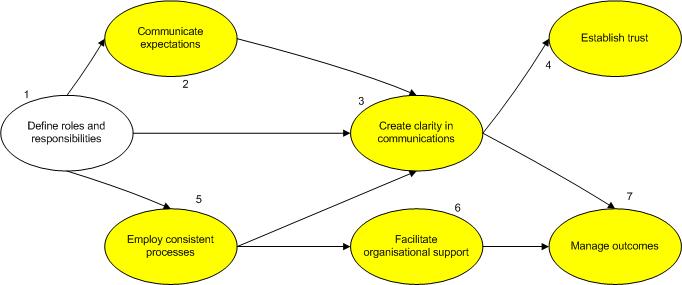
The arrows are to be interpreted as “leads to” (or causal) relationships – i.e the factor at the starting point of the arrow leads to the factor at the end. The numbers next to each factor denote its priority – i.e. how important the factor is, according to the survey respondents. A low priority does not imply that a factor is unimportant, as the factor could be the result of other, more important, factors (a case in point is the low priority accorded to “Manage Outcomes”). I describe the model below, along with some critical comments.
As shown in the diagram, survey respondents attached the highest priority to defining project roles and processes. This is a prerequisite for smooth running of the project. Roles and responsibilities relate to individual team members, and processes relate to what needs to be done in the project. The project will run in an ad-hoc fashion if these aren’t spelt out early in the game. Definition of processes is a precursor to employing them in a consistent manner (bottom portion of diagram). Further, according to the model, clear definition of roles and processes helps the project manager identify and facilitate the required organisational support required for project success. For example, if one knows the skills required on the team, one can set about negotiating with management to get the right people on the team. In my opinion, facilitating organisational support depends on a whole lot more than the use of consistent processes. In fact, one could well have a situation where the organisation uses consistent processes, yet functional managers stonewall when it comes to making resources available for a project. Not an uncommon situation, I think.
The upper portion of the diagram consists of “softer” factors that are hard to quantify. As per the model, one needs to have a clear idea of roles, processes and requirements before one can communicate expectations. Role and process definition is necessary in that it tells the project manager what needs to be communicated. However, it does not say anything about how clear communication can be achieved. Effective communication involves a whole lot more than a knowledge of roles, processes and all that formal stuff. Because the factors enabling effective communication are so hard to pin down, methodology-focused studies (such as the present one) tend to take a very blinkered view. The author states, “…By defining roles and processes, the project manager can establish expectations from stakeholders but also predictability and openness in communication…” In my opinion, this claim (which is stated without any supporting arguments) is, at best, only partially true. Definition of roles and processes does not of itself lead to open and predictable communication. The latter has more to do with to communication skills (at the level of the individual project manager) and organisational culture (at the level of the organisation), both of which aren’t included in the study.
According to the model, managing outcomes depends on all the factor that precede it (excepting establishing trust). That seems logical enough. The author states that other studies on the relationship between trust and performance in collaborative environments also back this claim.
For reasons outlined above, I believe the model is simplistic, and should be viewed as an initial attempt at modelling project manager performance. As such, it cannot be used as a basis to improve project manager performance. Specific criticisms of the model include:
- The limited number of factors used and the arbitrary choice of these. The author bases his choice of factors on a subjective literature review – there is no good reason offered for why these factors were chosen over others.
- Despite the explanations offered in the paper (and, one assumes, the survey), the meaning of each of the factors is open to interpretation. This begs the question: can one be certain that all (or a majority of) survey respondents interpreted every factor in the manner intended by the author?
- The choice of modeling technique. ISM is a relatively simplistic technique that is based on the method of paired comparison. As such it shares some of the limitations of that method. As another example, ISM can handle only static relationships (i.e. those that do not change in time). However, people-related factors are far from static.
- The causal relationships inferred from the data are based on subjective opinions of a limited number of respondents.
After describing the model, the author turns to a rambling discussion on the role of technology in supporting project manager performance. As far as I can tell, the main point he makes is that technology tools can be divided into two categories: those supporting communication, and those facilitating decision making. The former, which includes technologies such as Internet/Intranet, video conferencing etc., support factors shown in the upper half of the diagram; whereas the latter, which includes tools such as databases, knowledge repositories, project management software etc., support those in the lower part of the diagram. As far as I can tell, there’s not much new in the discussion – the specific supporting roles of individual tools that the author discusses are already well known to practising project managers.
This brings me to the end of my (not so brief!) summary of the paper. Some closing remarks are probably in order. In the concluding section the author states, “The project manager performance model developed in this research effort – showing the dependency relations among important critical factors – can be used as a template for managing projects effectively by integrating technology systems and tools.” I have my reservations about this claim. As discussed above, the model is not detailed or comprehensive enough to be used as a template for managing projects. Having said that, I acknowledge that developing a performance model is a difficult task because of the multitude of factors involved and the complex interrelationships between them. As the author suggests, an extensive study involving more factors and respondents is needed in order to arrive at a comprehensive model of project manager performance. The one presented in this paper may be considered, at best, a small step in the right direction.
References:
Anantatmula, Vittal S., The Role of Technology in the Project Manager Performance Model, Project Management Journal, 39 (1), 34-48. (2008).


 Eight to Late