Archive for the ‘Communication’ Category
More than just talk: rational dialogue in project environments
Prologue
The meeting had been going on for a while but it was going nowhere. Finally John came out and said it, “There is no way I can do this in 2 days,” he said. “It will take me at least a week.”
There it was, the point of contention between the developer and his manager. Now that it was out in the open, the real work of meeting could begin; the two could start talking about a realistic delivery date.
The manager, let’s call him Jack, was not pleased, “Don’t tell me a simple two-page web app – which you have done several times before I should add – will take you a week to do. ”
“OK, let me walk you through the details,” said John.
….and so it went for another half hour or so, Jack and John arguing about what would be a reasonable timeframe for completing the requested work.
Dialogue, rationality and action
Most developers, designers and indeed most “doers” on project teams– would have had several conversations similar to the one above. These folks spend a fair bit of time discussing matters relating to the projects they work on. In such discussions, the aim is to come to a shared understanding of the issue under discussion and a shared commitment on future action. In the remainder of this post I’ll take a look at project discussions from a somewhat philosophical perspective, with a view to understanding some of the obstacles to open dialogue and how they can be addressed.
When we participate in discussions we want our views to be taken seriously. Consequently, we present our views through statements that we hope others will see as being rational – i.e. based on sound premises and logical thought. One presumes that John – when he made his claim about the delivery date being unrealistic – was willing to present arguments that would convince Jack that this was indeed so. The point is that John is judged (by Jack and others in the meeting) based on the validity of the statements he (John) makes. When Jack’s validity claims are contested, debate ensues with the aim of getting to some kind of agreement.
The philosophy underlying such a process of discourse (which is simply another word for “debate” or “dialogue”) is described in the theory of communicative rationality proposed by the German philosopher Jurgen Habermas. The basic premise of communicative rationality is that rationality (or reason) is tied to social interactions and dialogue. In other words, the exercise of reason can occur only through dialogue. Such communication, or mutual deliberation, ought to result in a general agreement about the issues under discussion. Only once such agreement is achieved can there be a consensus on actions that need to be taken. Habermas refers to the latter as communicative action, i.e. action resulting from collective deliberation.
[Note: Just to be clear: I have not read Habermas’ books, so my discussion is based entirely on secondary sources: papers by authors who have studied Habermas in detail. Incidentally, the Wikipedia article on the topic is quite good, and well worth a read.]
Validity Claims
Since the objective in project discussions is to achieve shared understanding of issues and shared commitment on future action, one could say that such discussions are aimed at achieving communicative action. The medium through which mutual understanding is achieved is speech – i.e. through statements that a speaker makes based on his or her perceptions of reality. Others involved in the dialogue do the same, conveying their perceptions (which may or may not match the speaker’s).
Now, statements made in discussions have implicit or explicit validity claims – i.e. they express a speaker’s belief that something is true or valid, at least in the context of the dialogue. Participants who disagree with a speaker are essentially contesting claims. According to the theory of communicative action, every utterance makes the following validity claims:
- It makes a claim about objective (or external) reality. John’s statement about the deadline being impossible refers to the timing of an objective event – the delivery of working software. Habermas refers to this as the truth claim.
- It says something about social reality – that is, it expresses something about the relationship between the speaker and listener(s). The relationship is typically defined by social or workplace norms, for example – the relationship between a manager and employee as in the case of John and Jack. John’s statement is an expression of disagreement with his manager. Of course, he believes his position is justified – that it ought to take about a week to deliver the software. Habermas refers to this as the rightness claim.
- It expresses something about subjective reality – that is, the speaker’s personal viewpoint. John believes, based on his experience, intutition etc., that the deadline is impossible. For communication to happen, Jack must work on the assumption that John is being honest – i.e. that John truly believes the deadline is impossible, even though Jack may not agree. Habermas refers to this as the truthfulness claim.
The validity claims and their relation to rationality are nicely summed up in the Wikipedia article on communicative rationality, and I quote:
By earnestly offering a speech act to another in communication, a speaker claims not only that what they say is true but also that it is normatively right and honest . Moreover, the speaker implicitly offers to justify these claims if challenged and justify them with reasons. Thus, if a speaker, when challenged, can offer no acceptable reasons for the normative framework they implied through the offering of a given speech act, that speech act would be unacceptable because it is irrational.
When John says that the task is going to take him a week, he implies that he can justify the statement (if required) in three ways: it will take him a week (objective), that it ought to take him a week (normative – based on rightness) and that he truly believes it will take him a week (subjective).
In all dialogues validity claims are implied, but rarely tested; we usually take what people say at face value, we don’t ask them to justify their claims. Nevertheless, it is assumed that they can offer justifications should we ask them to. Naturally, we will do so only when we have reason to doubt the validity of what they say. It is at that point that discourse begins. As Wener Ulrich puts it in this paper:
In everyday communication, the validity basis of speech is often treated as unproblematic. The purpose consists in exchanging information rather than in examining validity claims. None of the three validity claims is then made an explicit subject of discussion. It is sufficient for the partners to assume (or anticipate, as Habermas likes to say) that speakers are prepared to substantiate their claims if asked to do so, and that it is at all times possible for the participants to switch to a different mode of communication in which one or several validity claims are actually tested. Only when validity claims do indeed become problematic, as one of the participants feels compelled to dispute either the speaker’s sincerity or the empirical and/or normative content of his statements, ordinary communication breaks down and discourse begins.
Progress in project discussions actually depends on such breakdown in “ordinary communication” – good project decisions emerge from open deliberation about the pros and cons of competing approaches. Only once this is done can one move to action.
Conditions for ideal discourse
All this sounds somewhat idealistic, and it is. Habermas noted five prerequisites for open debate. They are:
- Inclusion: all affected parties should be included in the dialogue.
- Autonomy: all participants should be able to present and criticise validity claims independently.
- Empathy: participants must be willing to listen to and understand claims made by others.
- Power neutrality: power differences (levels of authority) between participants should not affect the discussion.
- Transparency: participants must not indulge in strategic actions (i.e. lying!).
In this paper Bent Flyvbjerg adds a sixth point: that the group should be able to take as long as it needs to achieve consensus – Flyvbjerg calls this the requirement of unlimited time.
From this list it is clear that open discourse (or communicative rationality) is an ideal that is difficult to achieve in practice. Nevertheless, because it is always possible to improve the quality of dialogue on projects, it behooves us as project professionals to strive towards the ideal. In the next section I’ll look at one practical way to do this.
Boundary judgements
Most times in discussions we jump straight to the point, without bothering to explain the assumptions that underpin our statements. By glossing over assumptions, however, we leave ourselves open to being misunderstood because others have no means to assess the validity of our statements. Consequently it becomes difficult for them to empathise with us. For example, when John says that it is impossible to finish the work in less than a week, he ought to support his claim by stating the assumptions he makes and how these bear on his argument. He may be assuming that he has to do the work in addition to all the other stuff he has on his plate. On the other hand, he may be assuming too much because his manager may be willing to reassign the other stuff to someone else. Unless this assumption is brought out in the open, the two will continue to argue without reaching agreement.
Werner Ulrich pointed out that the issue of tacit assumptions and unstated frameworks is essentially one of defining the boundaries within which one’s claims hold. He coined the term boundary judgement to describe facts and norms that a speaker deems relevant to his or her statements. A boundary judgement determines the context within which a statement holds and also determines the range of validity of the statement. For example, John is talking about the deadline being impossible in the context of his current work situation; if the situation changed, so might his estimate. Ulrich invented the notion of boundary critique to address this point. In essence, boundary critique is a way to uncover boundary judgements by asking the right questions. According to Ulrich, such boundary questions probe the assumptions made by various stakeholders. He classifies boundary questions into four categories. These are:
- Motivation: this includes questions such as:
- Why are we doing this project?
- Who are we doing it for?
- How will we measure the benefits of the project once it is done?
- Power: this includes questions such as:
- Who is the key decision-maker regarding scope?
- What resources are controlled by the decision-maker?
- What are the resources that cannot be controlled by the decision-maker (i.e. what are the relevant environmental factors)?
- Knowledge: This includes:
- What knowledge is needed to do this work?
- Who (i.e which professionals) have this knowledge?
- What are the key success factors – e.g. stakeholder consensus, management support, technical soundness etc?
- Legitimation: This includes:
- Who are the stakeholders (including those that are indirectly affected by the project)?
- How do we ensure that the interests of all stakeholders are taken into account?
- How can conflicting views of project objectives be reconciled?
The questions above are drawn from a paper by Ulrich. I have paraphrased them in a way that makes sense in project environments.
Many of these questions are difficult to address openly, especially those relating to power and legitimation. Answers to these often bump up against organisational politics or power. The point, however, is that once these questions are asked, such constraints become evident to all. Only after this happens can discourse proceed in the full knowledge of what is possible and what isn’t.
Before closing this section I’ll note that there are other techniques that do essentially the same thing1, but I won’t discuss them here as I’ve already exceeded a reasonable word count.
Conclusion
Someone recently mentioned to me that the problem in project meetings (and indeed any conversation) is that participants see their own positions as being rational, even when they are not. Consequently, they stick to their views, even when faced with evidence to the contrary. According to the theory of communicative rationality, however, such folks aren’t being rational because they do not subject their positions and views to “trial by argumentation”. Rationality lies in dialogue, not in individual statements or positions. A productive discussion is one in which validity claims are continually challenged until they converge on an optimal decision. The best (or most rational) position is one that emerges from such collective deliberation.
In closing, a caveat is in order – a complete discussion of dialogue in projects (or organisations) would take an entire book and more. My discussion here has merely highlighted a few issues (and a technique) that I daresay are rarely touched upon in management texts or courses. There are many more tools and techniques that can help improve the quality of discourse within organisations. Paul Culmsee and I discuss some of these in our book, The Heretic’s Guide to Best Practices.
1 Those familiar with soft systems methodology (SSM) will recognise the parallels between Ulrich’s approach and the CATWOE checklist of SSM. CATWOE is essentially a means of exposing boundary judgements.
What should I do now? A bedtime story about dialogue mapping
It was about half past eight in the evening a couple of weeks ago; I was sitting at my computer at home, writing up some notes for a blog post on issue mapping.
“What are you drawing?” asked my eight year old, Rohan. I hadn’t noticed him. He had snuck up behind me quietly, and was watching me draw an IBIS map. (Note: see my post entitled, the what and whence of issue-based information systems for a quick introduction to IBIS)
“Go to bed,” I said, still looking at the screen. It was past his bedtime.
“…but what are you drawing. What are those questions and arrows and stuff?”
A few minutes won’t hurt, I thought. I turned to him and explained the basics of the notation and how it worked.
“But what good is it,” he asked.
“Good question,” I said. “It has many uses, but one of the most important ones is that it can help people make good decisions.”
“Decisions about what?”
“Anything, I said, “for example: you may want to decide what you should do right now. Well, IBIS can help you make that decision.”
“How?”
“I’ll have to show you,” I said, “and I can’t because you have to go to bed now.” What a cop out, I thought to myself, as I said those words.
“Come on, dad – just a few minutes. I really want to know how it can help me make a decision about what I should do now.”
“You should go to bed.”
“How do I know that’s a good decision? Let’s see what IBIS says,” said the boy.
Brilliant! It was checkmate. I relented.
———
“OK, “ I said, opening a new map in Compendium and drawing a question node. “Every IBIS map begins with a question – we call it the root question. Our root question is: What should I do now?”
I typed in the root question and asked him: “So, tell me: what are the different things you could do now.”
He thought for a bit and said, “I could go to sleep but that’s boring.”
“Good. There are actually two things you’ve said there – an idea (go to sleep) and an argument against it (its boring). Let’s put that down in the map. In an IBIS map, an idea is shown as a light-bulb (as in a comic) and an argument against it by a minus sign.”
The map with the root question along with Rohan’s first response and argument is shown in Figure 1.

Figure 1
He looked at the map and said, “There’s another minus I can think of – it is hard to sleep so early.”
I put that point in and said, “I’m sure you could also think of some plus points for sleeping early.”
“Yes,” he said, “I can get up early and do stuff.”
“What stuff?”
“I can play Wii before I go to school.”
“OK let’s put all that into the map,” I said. “See, an argument supporting an idea is shown as a plus sign. Then, I asked you to explain a bit more about why getting up early is a good thing. Your answer goes into the map as another idea. Notice, also, that the map develops from right to left, starting from the root question.”
The map at this point of the discussion is shown in Figure 2.
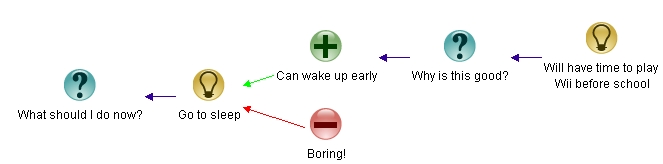
Figure 2
“What else can you do now?”
“I can talk to you,” said Rohan.
“And what are the plus points of that?” I asked.
“It is interesting to talk to you.” Ah, the boy has the makings of a diplomat…
“The minus points?”
“You are tired and crabby”
OK, may be he isn’t a diplomat…
The map at this point is shown in Figure 3.

Figure 3
“What else can you do,” I asked, as I cleaned up the map a bit.
“I could spend some time with Vikram.” (Vikram is Rohan’s 4 month old brother).
“What are the plus points of doing that?”
“He does funny things and he’s cute.”
“That’s two points, ” I said, adding them to the map. Then I asked, “What kinds of funny things?”
“He gurgles, smiles and blows spit bubbles.”
“Great,” I said, adding those points as elaborations of “does funny things”.
Rohan said, “I forgot. Vik is asleep so I can’t play with him.”
“OK, so that’s a minus point that rules out the choice,” I said, adding it as an argument against the idea. The map at this point is shown in Figure 4.

Figure 4
“Can you think of anything else you can do?” I asked.
He thought for a while and replied, “I could read.”
“OK,” I said. “What are the plus and minus points of that.”
“It’s interesting,” he said, and then in the same breath added, “but I have nothing to new to read.”
I put these points in as arguments for and against reading. The map at this point is shown in Figure 5.
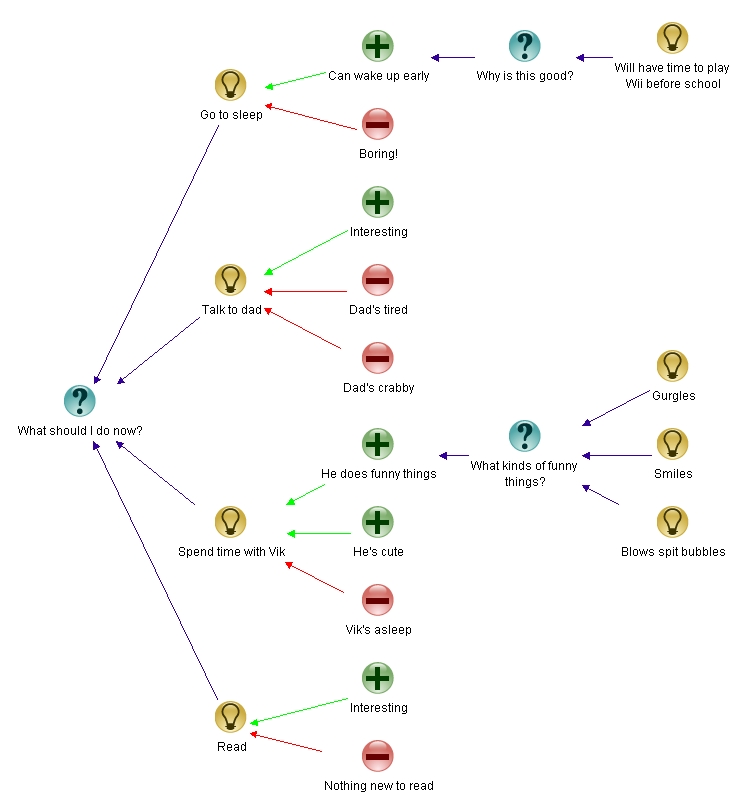
Figure 5
After finishing I asked, “Anything else you want to add.”
“I could just stay up and watch a movie,” he said.
I stopped myself from vetoing that outright. Instead, I put the point in and asked,” Why do you want to stay up and watch a movie?”
“It’s fun,” he said.
“May be so, but a movie would take too long and you have school tomorrow.”
“School’s boring.”
“I’ll note your point,” I said, “but I’m afraid I have to veto that option.”
“I was just trying it out, dad.”
“I know,” I said, as I updated the map (see Figure 6).

Figure 6
“Can you think of anything else you could do?”
“No.”
“OK, let’s look at where we are. Have a look at the map and tell me what you think.”
Rohan looked at the map for a bit and said, “It shows me all my choices and gives me reasons to choose or not to choose them.”
“Does that help you decide what you should do now?”
“Sort of,” he said, “I know I can’t spend time with Vik because he’s asleep. I can’t talk to you because you’re tired and might get crabby. I can’t stay up and watch a movie because you won’t let me.”
“So what can you do?”
“I can read or go to sleep”
“But you have nothing new to read.,” I pointed out.
“Yes, but I think I could find something that I would like to read again…Yes, I know what I will do – I’ll read for a while and then go to sleep.”
“Sounds like a good idea – that way you get to do two of the things on the list.” I said.
“This IBIS stuff is cool. I think I’ll talk about it at my news this Thursday. It is free choice.” (News is a 2-3 minute presentation that all kids in class get to do once a week. Most often the topic is assigned beforehand, but there’s one free-choice session per term where the kids can talk about anything they want to)
“Great idea,” I said, “I’ll help you make some notes and map images tomorrow. Now you’d really better go off to bed before your mum comes in and gets upset at us both.”
”Good night, dad”
“’night, Rohan”


 Eight to Late