Archive for the ‘General Management’ Category
Conditions over causes: towards an emergent approach to building high-performance teams
Introduction
Much of the work that goes on in organisations is done by groups of people who work together in order to achieve shared objectives. Given this, it is no surprise that researchers have expended a great deal of effort in building theories about how teams work. However, as Richard Hackman noted in this paper, more than 70 years of research (of ever-increasing sophistication) has not resulted in a true understanding of the factors that give rise to high-performing teams. The main reason for this failure is that:
“…groups are social systems. They redefine objective reality, they create new realities (both for their members and in their system contexts), and they evolve their own purposes and strategies for pursuing those purposes. Groups are not mere assemblies of multiple cause–effect relationships; instead, they exhibit emergent and dynamic properties that are not well captured by standard causal models.”
Hackman had a particular interest in leadership as a causal factor in team performance. One of the things he established is that leadership matters a whole lot less than is believed…or, more correctly, it matters for reasons that are not immediately obvious. As he noted:
“…60 per cent of the difference in how well a group eventually does is determined by the quality of the condition-setting pre-work the leader does. 30 per cent is determined by how the initial launch of the group goes. And only 10 per cent is determined by what the leader does after the group is already underway with its work. This view stands in stark contrast to popular images of group leadership—the conductor waving a baton throughout a musical performance or an athletic coach shouting instructions from the sidelines during a game.”
Although the numbers quoted above can be contested, the fact is that as far as team performance is concerned, conditions matter more than the quality of leadership. In this post, I draw on Hackman’s paper as well as my work (done in collaboration with Paul Culmsee) to argue that the real work of leaders is not to lead (in the conventional sense of the word) but to create the conditions in which teams can thrive.
The fundamental attribution error
Poor performance of teams is often attributed to a failure of leadership. A common example of this is when the coach of a sporting team is fired after a below par season. On the flip side, CxOs can earn big-buck dollar bonuses when their companies make or exceed their financial targets because they are seen as being directly responsible for the result.
Attributing the blame or credit for the failure or success of a team to a specific individual is called the leadership attribution error. Hackman suggested that this error is a manifestation of a human tendency to assign greater causal priority to factors that are more visible than those that are not: leaders tend to be in the limelight more than their teams and are therefore seen as being responsible for their teams’ successes and failures.
This leader-as-hero (or villain!) perspective has fueled major research efforts aimed at pinning down those elusive leadership skills and qualities that can magically transform teams into super-performing ensembles. This has been accompanied by a burgeoning industry of executive training programmes to impart these “scientifically proven” skills to masses of managers. These programmes, often clothed in the doublespeak of organisation culture, are but subtle methods of control that serve to establish directive approaches to leadership. Such methods rarely (if ever) result in high-performing organisations or teams.
An alternate approach to understanding team performance
The failure to find direct causal relationships between such factors and team performance led Hackman to propose a perspective that focuses on structural conditions instead. The basic idea in this alternate approach is to focus on the organisational and social conditions that enable the team to perform well.
This notion of conditions over causes is relevant in other related areas too. Here are a couple of examples:
- Innovation: Most attempts to foster innovation focus on exhorting people to be creative and/or instituting innovation training programmes (causal approach). Such approaches usually result in innovation of an incremental kind at best. Instead, establishing a low pressure environment that enables people to think for themselves and follow-up on their ideas without fear of failure generally meets with more success (structural approach).
- Collaboration: Organisations generally recognise the importance of collaboration. Yet, they attempt to foster in the worst possible way: via the establishment of cross-functional teams without clear mandates or goals and/or forced team-building exercises that have the opposite effect to the one intended (causal approach). The alternate approach is to simplify reporting lines, encourage open communication across departments and generally make it easy for people from different specialisations to work together in informal groups (structural approach). A particularly vexing intra-departmental separation that I have come across recently is the artificial division of responsibilities between information systems development and delivery. Such a separation results in reduced collaboration and increased finger pointing.
That said, let’s take a look at Hackman’s advice on how to create an environment conducive to teamwork. Hackman identified the following five conditions that tend to correlate well with improved team performance:
- The group must be a real team– i.e. it must have clear boundaries (clarity as to who is a member and who isn’t), interdependence (the performance of every individual in the team must in some way depend on others in the team) and stability (membership of the team should be stable over time).
- Compelling direction– the team must have a goal that is clear and worth pursuing. Moreover, and this is important, the team must be allowed to determine how the goal is to be achieved – the end should be prescribed, not the means.
- The structure must enable teamwork– The team should be structured in a way that allows members to work together. This consists of a couple of factors: 1) The team must be of the right size – as small and diverse as possible (large, homogenous teams are found to be ineffective), and 2) There must be clear norms of conduct. Note that Hackman lists these two as separate points in his paper.
- Supportive organizational context– the team must have the organisational resources that enable it to carry out its work. For example, access to the information needed for the team to carry out its work and access to technical and subject matter experts. In addition, there should be a transparent reward system that provides recognition for good work.
- Coaching– the team must have access to a mentor or coach who understands and has the confidence of the team. Apart from helping team members tide over difficult situations, a good coach should be able to help them navigate organizational politics and identify emerging threats and opportunities that may not be obvious to them.
To reiterate, these are structural rather than causal factors in that they do not enhance team performance directly. Instead, when present, they tend to encourage behaviours that enhance team performance and suppress those that don’t.
Another interesting point is that some of these factors are more important than others. For example, Ruth Wageman found that team design (the constitution and structure of the team) is about four times more important than coaching in affecting the team’s ability to manage itself and forty times as powerful in affecting team performance (see this paper for details). Although the numbers should not be taken at face value, Wageman’s claim reiterates the main theme of this article: that structural factors matter more than causal ones.
The notion of a holding environment
One of the things I noticed when I first read Hackman’s approach is that it has some similarities to the one that Paul and I advocated in our book, The Heretic’s Guide to Best Practices.
The Heretic’s Guide is largely about collaborative approaches to managing (as opposed to solving!) complex problems in organisations. Our claim is that the most intractable problems in organisations are consequences of social rather than technical issues. For example, the problem of determining the “right” strategy for an organisation cannot be settled on objective grounds because the individuals involved will have diverse opinions on what the organisation’s focus should be. The process of arriving at a consensual strategy is, therefore, more a matter of dealing with this diversity than reaching an objectively right outcome. In other words, it is largely about achieving a common view of what the strategy should be and then building a shared commitment to executing it.
The key point is that there is no set process for achieving a shared understanding of a problem. Rather, one needs to have the right environment (structure!) in which contentious issues can be discussed openly without fear. In our book we used the term holding environment to describe a safe space in which such open dialogue can take place.
The theory of communicative rationality formulated by the German philosopher, Juergen Habermas, outlines the norms that operate within a holding environment. It would be too long a detour to discuss Habermas’ work in any detail – see this paper or chapter 7 of our book to find out more. What is important to note is that an ideal holding environment has the following norms:
- Inclusion
- Autonomy
- Empathy
- Power neutrality
- Transparency
Problem is, some of these are easier to achieve than others. Inclusion, autonomy and power neutrality can be encouraged by putting in place appropriate organisational structures and rules. Empathy and transparency, however, are typically up to the individual. Nevertheless, conditions that enable the former will also encourage (though not guarantee) the latter.
In our book we discuss how such a holding environment can be approximated in multi-organisational settings such as large projects. It would take me too far afield to get into specifics of the approach here. The point I wish to make, however, is that the notion of a holding environment is in line with Hackman’s thoughts on the importance of environmental or structural factors.
In closing
Some will argue that this article merely sets up and tears down a straw man, and that modern managers are well aware of the pitfalls of a directive approach to leading teams. Granted, much has been written about the importance of setting the right conditions (such as autonomy)…and it is possible that many managers are aware of it too. The point I would make is that this awareness, if it exists at all, has not been translated into action often enough. As a result, the gap between the rhetoric and reality of leadership remains as wide as ever – managers talk the talk of leadership, but do not walk it.
Perhaps this is because many (most?) managers are reluctant let go the reins of control when they know they will be held responsible if things were to go belly-up. The few who manage to overcome their fears know that it requires the ability to trust others, as well as the courage and integrity to absorb the blame when things go wrong (as they inevitably will from time to time). These all too rare qualities are essential for the approach described here to truly take root and flourish. In conclusion, I think it is fair to say that the biggest challenges associated with building high-performance teams are ethical rather than technical ones.
Further Reading
Don’t miss Paul Culmsee’s entertaining and informative posts on the conditions over causes approach in enterprise IT and project management.
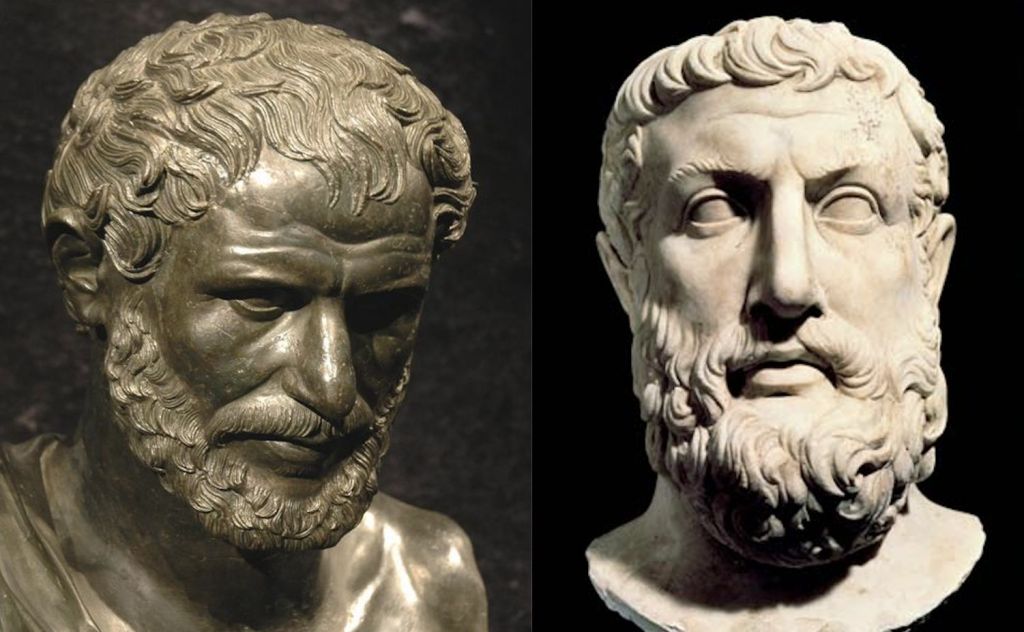
Heraclitus and Parmenides – a metalogue about organizational change
“Organizations are Heraclitian, but Parmenides is invariably in charge.” –Stafford Beer (paraphrased)
Heraclitus: Hello Parmenides, it’s been a while! What have you been up to since we last met?
Parmenides: Heraclitus, it is good to see you my old friend. You’re not going to believe it, but I’ve been doing some consulting work on managing change in organizations.
Heraclitus: [laughs] You’re right, that is beyond belief, particularly in view of your philosophical position on change. So, have you recanted? Have you now come around to the truth that everything changes and nothing stands still?
Parmenides: Ah, yes I am familiar with your views on change my friend, but I hate to disappoint you. My position remains the same as before: I still believe that the world is essentially unchanging. The key word here is “essentially” – by which I mean that the changes we see around us are superficial and that the essential properties of the world do not change. Indeed, as paradoxical as it may sound, understanding this unchanging essence enables us to manage superficial changes such as those that happen in organizations.
Heraclitus: I’m not sure I understand what you mean by unchanging essence and superficial change...
Parmenides: OK, let me try explaining this using an example. Let us consider the case of a physical law and a real world situation to which it applies. A concrete instance of this would be Newton’s Law of Gravitation and the motion of a spacecraft. The former represents the unchanging essence while the latter represents one of its manifestations. The point is this: the real world (as represented by a moving spacecraft) appears to be ever changing, but the underlying unity of the world (as represented by Newton’s law) does not change. If one understands the underlying unchanging laws then one has the power to predict or control the superficial changes.
Heraclitus: Hmm….I don’t see how it relates to organizations. Can you give me a more down to earth illustration from your work? For example: what is the “unchanging essence” in organizational change?
Parmenides: That’s easy: the unchanging essence is the concept of an organization and the principles by which they evolve. Consultants like me help organizations improve performance by influencing or adjusting certain aspects of their structure and interactions. However, the changes we facilitate do not affect the essence of the entities we work with. Organizations remain organizations, and they evolve according to universal laws despite the changes we wrought within them.
Heraclitus: Ah Parmenides, you are mistaken: concepts and principles evolve in time; they do not remain constant. Perhaps I can convince you of this by another means. Tell me, when you go into an organization to do your thing, how do you know what to change?
Parmenides: Well, we carry out a detailed study by talking to key stakeholders and then determine what needs to be done. There are a host of change models that have come out of painstaking research and practice. We use these to guide our actions.
Heraclitus: Are these models akin to the physical laws you mentioned earlier?
Parmenides: Yes, they are.
Heraclitus: But all such models are tentative; they are always being revised in the light of new knowledge. Theory building in organizational research (or any other area) is an ongoing process. Indeed, even physics, the most exact of sciences, has evolved dramatically over the last two millennia – consider how our conception of the solar system has changed from Ptolemy to Copernicus. For that matter, even our understanding of gravity is no longer the same as it was in Newton’s time. The “unchanging essence” – as you call it – is but a figment of your imagination.
Parmenides: I concede that our knowledge of the universe evolves over time. However, the principles that underlie its functioning don’t change. Indeed, the primary rationale behind all scientific inquiry is to find those eternal principles or truths.
Heraclitus: It is far from clear that the principles are unchanging, even in a so-called exact discipline like physics. For example, a recent proposal suggests that the laws of physics evolve in time. This seems even more likely for social systems: the theory and practice of management in the early twentieth century is very different from what it is now, and with good reason too – contemporary organizations are nothing like those of a century ago. In other words, the “laws” that were valid then (if one can call them that) are different from the ones in operation now.
Parmenides: You’re seduced by superficial change – you must look beneath surface appearances! As for the proposal that the laws of physics evolve in time, I must categorically state that it is a minority view that many physicists disagree with (Editor’s note: see this rebuttal for example)
Heraclitus: I take your point about the laws of physics…but I should mention that history is replete with “minority views” that were later proven to be right. However, I cannot agree with your argument about superficial change because it is beyond logic. You can always deem any change as being superficial, however deep it may be. So let me try to get my point across in yet another way. You had mentioned that you use management principles and models to guide your actions. Could you tell me a bit more about how this works in practice?
Parmenides: Sure, let me tell you about an engagement that we recently did for a large organization. The problem they came to us with was that their manufacturing department was simply not delivering what their customers expected. We did a series of interviews with senior and mid-level managers from the organisation as well as a wide spectrum of staff and customers and found that the problem was a systemic one – it had more to do with the lack of proper communication channels across the organisation rather than an issue with a specific department. Based on this we made some recommendations to restructure the organisation according to best practices drawn from organisational theory. We then helped them implement our recommendations.
Heraclitus: So you determined the change that needed to be made and then implemented the change over a period of time. Is that right?
Parmenides: Well, yes…
Heraclitus: And would I be right in assuming that the change took many months to implement?
Parmenides: Yes, about a year actually…but why does that matter?
Heraclitus: Bear with me for a minute. Were there any significant surprises along the way? There must have been things that happened that you did not anticipate.
Parmenides: Of course, that goes with the territory; one cannot foresee everything.
Heraclitus: Yet you persisted in implementing the changes you had originally envisioned them.
Parmenides: Naturally! We had determined what needed to be done, so we went ahead and did it. But what are you getting at?
Heraclitus: It’s quite simple really. The answer lies in a paradox formulated by your friend Zeno: you assumed that the organization remains static over the entire period over which you implemented your recommendations.
Parmenides: I did not say that!
Heraclitus: You did not say it, but you assumed it. Your recommendations for restructuring were based on information that was gathered at a particular point in time – a snapshot so to speak. Such an approach completely overlooks the fact that organisations are dynamic entities that change in unforeseen ways that models and theories cannot predict. Indeed, by your own admission, there were significant but unanticipated events and changes that occurred along the way. Now you might claim that those changes were superficial, but that won’t wash because you did not foresee those changes at the start and therefore could not have known whether they would be superficial or not.
Parmenides: Well, I’m not sure I agree with your logic my dear Heraclitus. And in any case, my approach has the advantage of being easy to understand. I don’t think decision-makers would trust a consultant who refuses to take action because every little detail about the future cannot be predicted.
Heraclitus: Admitting ignorance about the future is the first step towards doing something about it.
Parmenides: Yes, but you need to have a coherent plan, despite an uncertain future.
Heraclitus: True, but a coherent plan can be incremental…or better, emergent – where planned actions are adjusted in response to unexpected events that occur as one goes along. Such an approach is better than one based on a snapshot of an organisation at a particular point in time.
Parmenides: Try selling that approach to a CEO, my friend!
Heraclitus: I know, organizations are ever-changing, but those who run them are intent on maintaining a certain status quo. So they preach change, but do not change the one thing that needs changing the most – themselves.
Parmenides: [shakes his head] Ah, Heraclitus, I do not wish to convert you to my way of thinking, but I should mention that our differences are not of theoretical interest alone: they spell the difference between being a cashed-up consultant and a penurious philosopher.
Heraclitus: [laughs] At last we have something we can agree on.
Further reading:
Beer, Stafford (1997), “The culpabliss error: A calculus of ethics for a systemic world,” Systems Practice, Vol 10, No. 4. Pp. 365-380. Available online at: http://rd.springer.com/article/10.1007/BF02557886
Note: the quote at the start of this piece is a paraphrasing of the following line from the paper: “Society is Heraclitian; but Parmenides is in charge.”
Professionals or politicians? A client’s guide to management consultants
Introduction
The general image of management consultants in contemporary society is somewhat ambiguous. To take two rather extreme views: high achievers in universities may see management consulting as a challenging (and well paying!) profession that offers opportunities to make a positive difference to organisations, whereas those on the receiving end of a consultant-inspired restructure may see the profession as an embodiment of much that is wrong with the present-day corporate world.
The truth, as always, is not quite so black and white. In this post I explore this question by taking a look at the different types of consultants one may encounter in the wilds of the corporate jungle. My discussion is based on a typology of management consultants proposed by Mats Alvesson and Anders Johansson in a paper published in this book (see citation at the end of this post for the full reference).
Background
There is a considerable body of research on management consulting, most of which is tucked away in the pages of management journals and academic texts that are rarely read by professionals. It would take me too far afield to do even a cursory review of this literature so I’ll not go there, except to point out that much of the work can be classified as either strongly pro- or anti-consultant. This in itself is revealing: academics are just as divided in their opinions about consultants as professionals are. Indeed, to see just how strong the opinions are, here’s a small list of paper / book titles from the pro and anti-consultant camps
Pro
“Management Consulting as a Developer of SMEs”
“Process Consultation, Vol 1: Its Role in Organization Development”
Anti
“The Management Guru as an Organizational Witch Doctor”
“The Violent Rhetoric of Re-engineering: Management Consultancy on the Offensive”
These titles have been taken from the reference list in Alvesson and Johansson’s paper. A quick search on Amazon will reveal many more.
The pro camp depicts consultants as rational, selfless experts who solve complex problems for their clients, sometimes at considerable personal cost. The anti camp portrays them as politically-motivated, self-interested individuals whose main aim is to build relationships that ensure future work. The classification proposed by Alvesson and Johansson puts these extreme views in perspective.
A classification of management consultants
Alvesson and Johansson classify consultants into the following categories based on consultants’ claims to professionalism and their preferred approaches to dealing with political issues:
Esoteric experts
These consultants typically offer high expertise in some specialized area. Some examples of these include IT consultants specializing in complex products (such as ERP systems) and tax experts who have specialized knowledge typically not possessed by those who work within business organisations. As one might expect, esoteric experts have strong claims to professionalism.
One might think that such consultants have little need to play political games as their skill/knowledge does not threaten anyone within organizations. However, this is not always so because esoteric experts may portray themselves as being experts when they actually aren’t. In such cases they would have to use their social and political skills to cover up for their shortcomings. Perhaps more important, esoteric experts may also play politics to secure future gigs.
Typical clients of esoteric experts are purchasers of large IT systems, small organisations in occasional need of specialized skills (lawyers, accountants etc.) and so on.
Brokers of meaning
Brokers of meaning are sense makers: they help clients make sense of difficult or ambiguous situations. Typically brokers of meaning act as facilitators, teachers or idea-generators, who work together with clients to produce meaning. They often do not have deep technical knowledge like esoteric experts, but instead have a good understanding of human nature and the socio-political forces within organizations.
Brokers of meaning typically do not indulge in overt politics as the success of their engagements depends largely on their ability to gain the trust of a wide spectrum of stakeholders within the organization. That said, such consultants, once they have gained trust of a large number of people within an organization, are often able to influence key stakeholders in particular directions. Another way in which brokers of meaning influence decisions is through the skillful use of language – for example, depending on how one wants to portray it, an employee taking the initiative can be called gung-ho (negative) or proactive (positive).
Typical clients of brokers of meaning are managers who are faced with complex decisions.
Traders in trouble
The archetypal trader in trouble is the hatchet-man who is employed by a senior executive who wants to reduce costs. Since the work of these consultants typically involves a great deal of organizational suffering, they are careful to cast their aims in neutral or objective language. Indeed, much of the corporate doublespeak around layoffs (e.g. rightsizing) and cost reduction initiatives (e.g. productivity improvements) originated from traders in trouble. Typical outcomes of such consulting engagements involve massive restructuring on an organization-wide scale, often resulting in a lot of pain for minimal gain.
The work of such consultants is necessarily political – they must support senior management at all costs. Indeed this is another reason that they go to great lengths to portray their proposed solutions as being rational. On the other hand, their claim to professional knowledge is ambiguous as they often have to (knowingly) forgo actions that may be more logical and (more important!) ethical.
Alvesson and Johansson summarise this by quoting from Robert Jackall’s brilliant ethnographical study of managers, Moral Mazes:
The further the consultant moves away from strictly technical issues – that is from being an expert in the ideal sense, a virtuoso of some institutionalized and valued skill – the more anomalous his status becomes. He becomes an expert who trades in others’ troubles. In managerial hierarchies, of course, troubles, like everything else, are socially defined. Consultants have to depend on some authority ‘s definition of what is troublesome in an organization and, in most cases, have to work on the problem as defined. As it happens, it is extremely rare that an executive declares himself or his own circle to be the problem; rather, other groups in the corporation are targeted to be ‘worked on.
A terrific summary of the typical trader in trouble!
Clients of such consultants tend to be senior managers who have been tasked with increasing “efficiency” or “productivity.”
Agents of anxiety (suppliers of security)
The agent of anxiety is a messiah who sells a “best practice” solution to his clients’ problems. This type of consultant can therefore also be described as a supplier of security who assures his clients that their troubles will vanish if they just follow his prescribed process. Common examples of agents of anxiety are purveyors of project management methodologies and frameworks (such as PRINCE2 or IPMA) or process improvement techniques (such as Six Sigma).
Although such consultants may seem to have a high claim to professional expertise, they actually aren’t experts. A good number of them are blind followers of the methods they sell; rarely, if ever, do they develop a critical perspective on those practices. Also, agents of anxiety do not have to be overtly political: once they are hired by senior managers in an organization, employees have no choice but to follow the “best practice” techniques that are promoted.
Clients of such consultants tend to be senior managers in organisations that are having trouble with specific aspects of their work – projects, for example. What such managers do not realize is that they would be better served by creating and fostering the right work environment rather than attempting to impose silver bullet solutions sold by suppliers of security.
A comment
Now that we are done with the classification, I should mention that most of the consultants I have come across cannot be boxed into a single category. This is no surprise: consultants, like the rest of humanity, display behaviours that vary from situation to situation. Many consultants will display characteristics from all four categories within a single engagement or, at the very least, exhibit both professional and political behaviours. As Alvesson and Johansson state:
Management consultancy work probably typically means some blending of these four types. Sometimes one or two of the types dominates in the same assignment. But few management consultants presumably operate without appealing to the management fashions signalling the needs for consultancy services; few altogether avoid trouble-shooting tasks; few can solely rely on a technocratic approach, and few can simply work with cooperative meaning making processes. The complexity and diversity of consultancy assignments requires that the consultant move back and forth between a professional area and a non-professional area, i.e. areas viewed as coherent with claims of professionalism, recognizing the highly floating boundaries between these areas and the constructed character also of technical and professional work. Professional work is mingled with, but can’t be reduced to, political or symbolic work.
Finally, I should also add that consultants sometimes hide their real objectives because they are required to: their duplicity simply reflects the duplicity of those who hire them. Whether consultants should choose to do such work is another matter altogether. As I have argued elsewhere, the hardest questions we have to deal with in our professional lives are ethical ones.
Closing remarks
In this post I have described a typology of consultants. For sure, the four categories of consultants described are stereotypes. That said, although consultants may slip on different personas within a single engagement, most would fit into a single category based on the nature of their work and their overall approach. A knowledge of this classification is therefore helpful, not just for clients, but also for front-line employees who have to deal with consultants and those who hire them.
References
Alvesson, M. & Johansson, A.W. (2002). Professionalism and politics in management consultancy work. In R. Fincham & T. Clark (Eds), Critical consulting: New perspectives on the management advice industry. Oxford: Blackwell, pp. 228–246.


 Eight to Late