Archive for the ‘Issue Based Information System’ Category
What should I do now? A bedtime story about dialogue mapping
It was about half past eight in the evening a couple of weeks ago; I was sitting at my computer at home, writing up some notes for a blog post on issue mapping.
“What are you drawing?” asked my eight year old, Rohan. I hadn’t noticed him. He had snuck up behind me quietly, and was watching me draw an IBIS map. (Note: see my post entitled, the what and whence of issue-based information systems for a quick introduction to IBIS)
“Go to bed,” I said, still looking at the screen. It was past his bedtime.
“…but what are you drawing. What are those questions and arrows and stuff?”
A few minutes won’t hurt, I thought. I turned to him and explained the basics of the notation and how it worked.
“But what good is it,” he asked.
“Good question,” I said. “It has many uses, but one of the most important ones is that it can help people make good decisions.”
“Decisions about what?”
“Anything, I said, “for example: you may want to decide what you should do right now. Well, IBIS can help you make that decision.”
“How?”
“I’ll have to show you,” I said, “and I can’t because you have to go to bed now.” What a cop out, I thought to myself, as I said those words.
“Come on, dad – just a few minutes. I really want to know how it can help me make a decision about what I should do now.”
“You should go to bed.”
“How do I know that’s a good decision? Let’s see what IBIS says,” said the boy.
Brilliant! It was checkmate. I relented.
———
“OK, “ I said, opening a new map in Compendium and drawing a question node. “Every IBIS map begins with a question – we call it the root question. Our root question is: What should I do now?”
I typed in the root question and asked him: “So, tell me: what are the different things you could do now.”
He thought for a bit and said, “I could go to sleep but that’s boring.”
“Good. There are actually two things you’ve said there – an idea (go to sleep) and an argument against it (its boring). Let’s put that down in the map. In an IBIS map, an idea is shown as a light-bulb (as in a comic) and an argument against it by a minus sign.”
The map with the root question along with Rohan’s first response and argument is shown in Figure 1.

Figure 1
He looked at the map and said, “There’s another minus I can think of – it is hard to sleep so early.”
I put that point in and said, “I’m sure you could also think of some plus points for sleeping early.”
“Yes,” he said, “I can get up early and do stuff.”
“What stuff?”
“I can play Wii before I go to school.”
“OK let’s put all that into the map,” I said. “See, an argument supporting an idea is shown as a plus sign. Then, I asked you to explain a bit more about why getting up early is a good thing. Your answer goes into the map as another idea. Notice, also, that the map develops from right to left, starting from the root question.”
The map at this point of the discussion is shown in Figure 2.
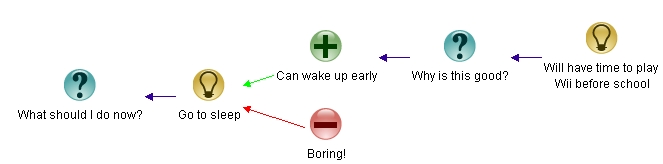
Figure 2
“What else can you do now?”
“I can talk to you,” said Rohan.
“And what are the plus points of that?” I asked.
“It is interesting to talk to you.” Ah, the boy has the makings of a diplomat…
“The minus points?”
“You are tired and crabby”
OK, may be he isn’t a diplomat…
The map at this point is shown in Figure 3.

Figure 3
“What else can you do,” I asked, as I cleaned up the map a bit.
“I could spend some time with Vikram.” (Vikram is Rohan’s 4 month old brother).
“What are the plus points of doing that?”
“He does funny things and he’s cute.”
“That’s two points, ” I said, adding them to the map. Then I asked, “What kinds of funny things?”
“He gurgles, smiles and blows spit bubbles.”
“Great,” I said, adding those points as elaborations of “does funny things”.
Rohan said, “I forgot. Vik is asleep so I can’t play with him.”
“OK, so that’s a minus point that rules out the choice,” I said, adding it as an argument against the idea. The map at this point is shown in Figure 4.

Figure 4
“Can you think of anything else you can do?” I asked.
He thought for a while and replied, “I could read.”
“OK,” I said. “What are the plus and minus points of that.”
“It’s interesting,” he said, and then in the same breath added, “but I have nothing to new to read.”
I put these points in as arguments for and against reading. The map at this point is shown in Figure 5.
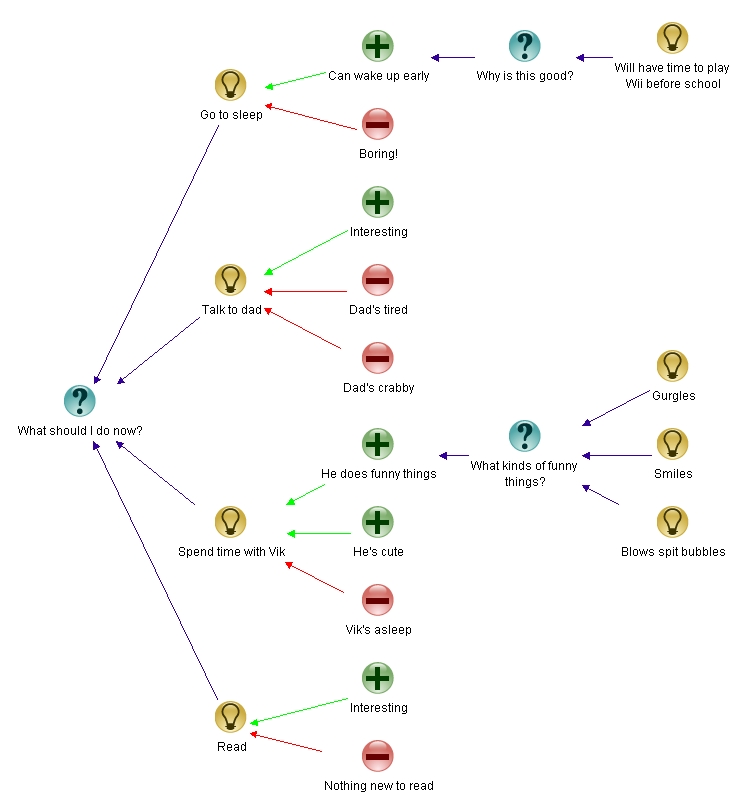
Figure 5
After finishing I asked, “Anything else you want to add.”
“I could just stay up and watch a movie,” he said.
I stopped myself from vetoing that outright. Instead, I put the point in and asked,” Why do you want to stay up and watch a movie?”
“It’s fun,” he said.
“May be so, but a movie would take too long and you have school tomorrow.”
“School’s boring.”
“I’ll note your point,” I said, “but I’m afraid I have to veto that option.”
“I was just trying it out, dad.”
“I know,” I said, as I updated the map (see Figure 6).

Figure 6
“Can you think of anything else you could do?”
“No.”
“OK, let’s look at where we are. Have a look at the map and tell me what you think.”
Rohan looked at the map for a bit and said, “It shows me all my choices and gives me reasons to choose or not to choose them.”
“Does that help you decide what you should do now?”
“Sort of,” he said, “I know I can’t spend time with Vik because he’s asleep. I can’t talk to you because you’re tired and might get crabby. I can’t stay up and watch a movie because you won’t let me.”
“So what can you do?”
“I can read or go to sleep”
“But you have nothing new to read.,” I pointed out.
“Yes, but I think I could find something that I would like to read again…Yes, I know what I will do – I’ll read for a while and then go to sleep.”
“Sounds like a good idea – that way you get to do two of the things on the list.” I said.
“This IBIS stuff is cool. I think I’ll talk about it at my news this Thursday. It is free choice.” (News is a 2-3 minute presentation that all kids in class get to do once a week. Most often the topic is assigned beforehand, but there’s one free-choice session per term where the kids can talk about anything they want to)
“Great idea,” I said, “I’ll help you make some notes and map images tomorrow. Now you’d really better go off to bed before your mum comes in and gets upset at us both.”
”Good night, dad”
“’night, Rohan”
Unforeseen consequences – an unexpected sequel to my previous post
Introduction – a dilemma resolved?
Last week I published a post about how a friend and I used the Issue-based Information System (IBIS) notation to map out a dilemma he was facing – whether to accept or decline a job offer. The final map of that discussion is reproduced in Figure 1 below.

Figure 1: Final map from previous post
The map illustrates how we analysed the pros and cons of the options before him.
As I’d mentioned in the post, a couple of days after we did the map, he called to tell me that he had accepted the offer. I was pleased that it had worked out for him and was pretty sure that the dilemma was essentially resolved: he’d accepted the job, so that was that.
..or so I thought.
An unforeseen consequence
Last Saturday I happened to meet him again. Naturally, I asked him how things were going – how his current employer had reacted to his resignation etc.
“You’re not going to believe this,” he said. “After he heard that I had resigned, the CEO (who is many levels above me in the org chart) asked to see me immediately.”
“Wow!” I couldn’t help interjecting.
“…Yeah. So, I met him and we had a chat. He told me that management had me marked for a role at a sister organization, at a much higher level than I am at now. So he asked me to hold off for a day or two, until I’d heard what was on offer. When I told him I’d signed the contract already, he said that I should hear what they had to say anyway.”
Wow, indeed – we couldn’t have anticipated this scenario… or could we?
An expert’s observations
In a comment on that post Tim van Gelder makes two important points:
- The options explored in the map (accept/decline) are in fact the same point – one is simply the negation of the other. So this should be represented as a single option (either accept or decline), with the pros arguing for the represented option and the cons arguing for the unrepresented one.
- Options other than the obvious one (accept or decline) should have been explored.
In my response I pointed out that although representing the two options as separate points causes redundancies, it can help participants “see” arguments that may not be obvious immediately. One is drawn to consider each of the actions separately because they are both represented as distinct options, each with their own consequences (I’ll say more about this later in this post). The downside, as Tim mentions, is more clutter and superfluity. This is not necessarily a problem for small maps but can be an issue in larger ones.
However, it is the second point that is more relevant here. In my response to Tim’s comment I stated:
For completeness we ought to have explored options other than the two (one?) that we did, and had we more time we may have done so. That said, my mate viewed this very much as an accept/decline dilemma (precluding other options) because he had only a day to make a decision.
Clearly, in view of what happened, my argument about not having enough time is a complete cop out: we should have made the time to explore the options because it is precisely what had come back to bite us.
Choice and consequence
In hindsight it’s all very well to say that we could have done this or should have done that. The question is: how could we have given ourselves the best possible chance to have foreseen the eventuality that occurred (and others ones that didn’t)?
One way to do this is to explore other ideas in response to the root question: what should I do? (see Figure1). However, it can be difficult for the person(s) facing the dilemma to come up with new ideas when one option looms so much larger than all others. It is the facilitator’s job to help the group come up with options when this happens, and I had clearly failed on this count.
Sure, it can be difficult to come up with options out of the blue – especially when one is not familiar with the context and background of the problem. This highlights the importance of getting a feel for things before the discussion starts. In this case, I should have probed my friends current work situation, how he was regarded at his workplace and his motivations for moving before starting with the map. However, even had I done so, it is moot whether we would have foreseen the particular consequence that occurred.
So, is there any way to get participants thinking about consequences of their choices? Remember, in IBIS one “evaluates” an idea in terms of its pros and cons. Such an analysis may not include consequences .
In my opinion, the best way to get folks thinking about consequences is to ask the question explicitly: “What are the consequences of this idea/option?”
Figure 2 illustrates how this might have worked in the case of my friend’s dilemma. Had we brainstormed the consequences of accepting, he may well have come up with the possibility that actually eventuated.
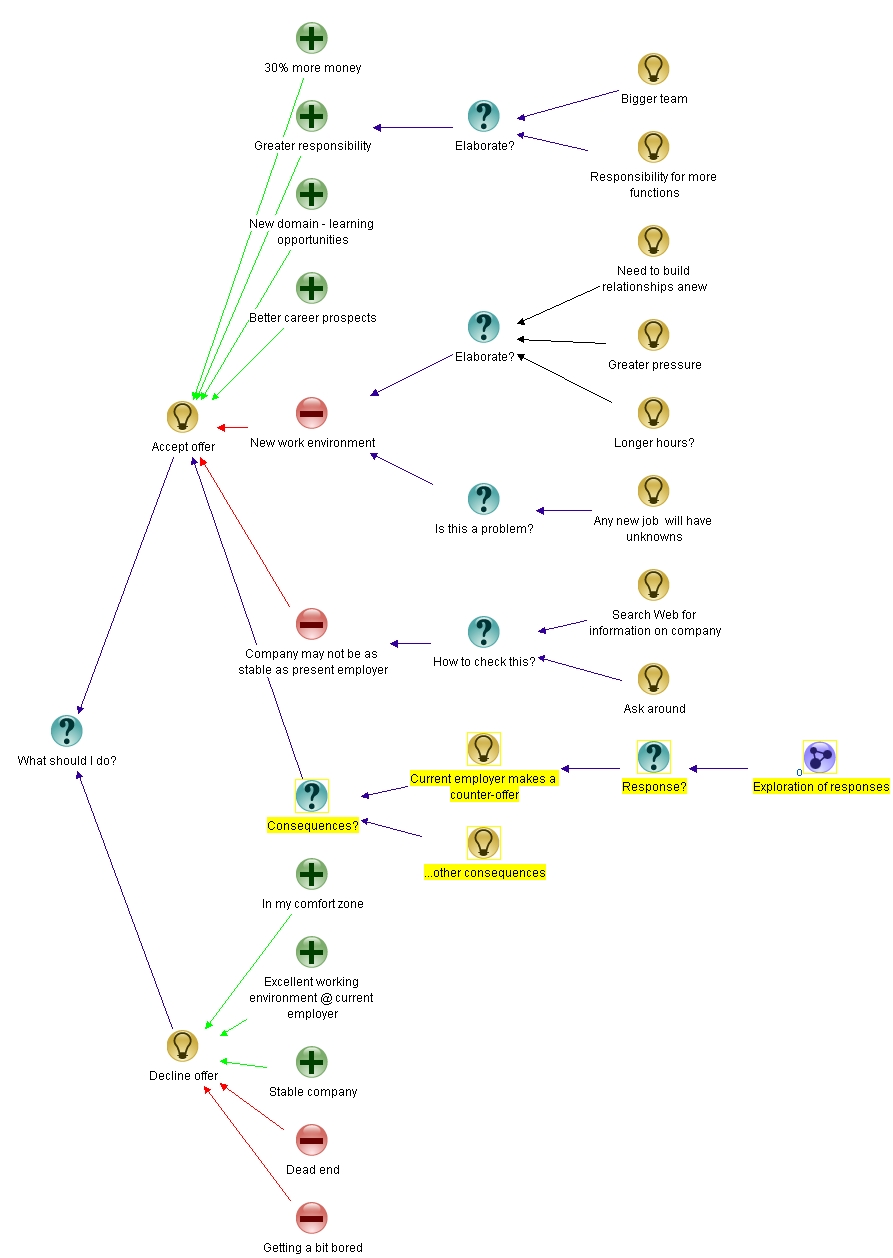
Figure 2: Exploring consequences (branch highlighted in yellow
The branch highlighted in yellow shows how we might have explored the consequences of accepting the job. For each consequence one could then consider how one might respond to it. The exploration of responses could be done on the same map or hived off into its own map as I’ve shown in the figure. Note that clicking on a map node in Compendium (the free software tool used to create IBIS maps) simply opens up a new map. Such sub-maps offer a convenient way to organise complex discussions into relatively self-contained subtopics.
I emphasise that the above is largely a reframing of pros and cons: all the listed consequences can be viewed as pros or cons (depending on whether the consequence is perceived as a negative or a positive one). However asking for consequences explicitly prompts participants to think in terms of what could happen, not just known pros and cons.
Of course, there is no guarantee that this process would have enabled us to foresee the situation that actually occurred. This deceptively simple dilemma is indeed wicked.
Epilogue
On Sunday I happened to re-read Rittel and Webber’s classic paper on wicked problems. In view of what had occurred, it isn’t surprising that the following lines in the paper had a particular resonance:
With wicked problems…. any solution, after being implemented, will generate waves of consequences over an extended–virtually an unbounded– period of time. Moreover, the next day’s consequences of the solution may yield utterly undesirable repercussions which outweigh the intended advantages or the advantages accomplished hitherto. In such cases, one would have been better off if the plan had never been carried out.
The full consequences cannot be appraised until the waves of repercussions have completely run out, and we have no way of tracing all the waves through all the affected lives ahead of time or within a limited time span.
I can’t hope to put it any better than that.
To accept or to decline: mapping life’s little dilemmas using IBIS
Introduction
Last weekend I met up with a friend I hadn’t seen for a while. He looked a bit preoccupied so I asked him what the matter was. It turned out he had been offered a job and was mulling over whether he should accept it or not. This dilemma is fairly representative of some of the tricky personal decisions that we are required to make at various junctures in our lives: there’s never enough information to be absolutely certain about the right course of action, and turning to others for advice isn’t particularly helpful because their priorities and motivations are likely differ from ours.
The question of whether or not to accept a job offer is a wicked problem because it has the following characteristics:
- It is a one-shot operation.
- It is unique.
- One is liable to face the consequences of whatever choice one makes (one has no right to be wrong)
- Since one can make only one choice, one has no opportunity to test the correctness of ones choice.
- The choice one makes (the solution) depends on which aspects of the two choices one focuses on (i.e. the solution depends on ones explanation of the issue).
Admittedly, there are some characteristics of wickedness that the job dilemma does not satisfy. For example, the problem has a definitive formulation (specified by the choices) and there are an enumerable number of choices (accept or decline). Nevertheless, since it satisfies five criteria, one can deem the problem as being wicked. No doubt, those who have grappled with this question in real life will probably agree.
Horst Rittel, the man who coined the term wicked problem also invented the Issue-based Information System (IBIS) notation to document and manage such problems (note that I don’t use the word “solve” because such problems can’t be solved in the conventional sense). The notation is very easy to learn because it has just three elements and a simple grammar – see this post for a quick introduction. Having used IBIS to resolve work related issues before (see this post, for example), I thought it might help my friend if we could used it to visualize his problem and options. So, as we discussed the problem, I did a pencil and paper IBIS map of the issue (I didn’t have my computer handy at the time). In the remainder of this post, I reconstruct the map based on my recollection of the conversation.
Developing the map
All IBIS maps begin with a root question that summarises the issue to be resolved. The dilemma faced by my friend can be summarized by the question:
What should I do (regarding the job offer)?
Questions are represented by blue-green question marks in IBIS (see Figure 1).
There are two possible responses to the question– accept or decline. Responses are referred to as ideas in IBIS, and are denoted by yellow lightbulbs. The root question and the two ideas responding to it are shown in Figure 1.

Figure 1
An IBIS map starts with the root questions and develops towards the right as the discussion progresses.
The next step is to formulate arguments for and against each idea. These are referred to as pros and cons in IBIS, and are denoted by a green + and red – sign respectively (See Figures 2 and 3 for examples of these).
We focused on the “accept” option first. The pros were quite easy to see as the offer was generous and the new role a step up from where he was now. I asked him to describe list all the pros he could think of. He mentioned the following:
- Better pay (30% more than current)
- Greater responsibility compared to current job.
- Good learning opportunity (new domain)
- Better career prospects
These points have been depicted in Figure 2.
I felt the second point needed clarification, so I asked him to elaborate on what he meant by “Greater responsibility.” Now, any node in IBIS can be elaborated by asking appropriate questions and responding to them. He mentioned that he would be managing a bigger team which was responsible for a wider range of functions. I broke these up into two points elaborating on the “greater responsibility” point. The elaborations are on the extreme right in Figure 2.

Figure 2
“Do you see any downside to taking the job?” I asked.
“A big one,” he said, “there are all the unknowns that go with a new working environment: the need to build relationships from scratch, greater pressure and possibly longer working hours until I establish my credibility.”
I mapped these points with “New working environment” as the main point and the others as elaborations of it.
I then asked him if there were any other cons he could think of.
“Just one,” he said, “From what I hear, the company may not be as stable as my current employer.”
I added this in and asked him to check if the map was an accurate representation of what he meant. “Yes,” he said, “that’s a good summary of my concerns.”
The map at this stage is shown in Figure 3.

Figure 3
He seemed to be done with the “accept” option, so I suggested moving on to outlining arguments for and against staying with his present employer.
Tellingly, he outlined the pros first:
- He was in his comfort zone – he knew what was expected of him and was able to deliver it with ease.
- The working environment in his company was excellent.
- The company was doing very well and the outlook for the foreseeable future was good.
I mapped these as he spoke. After he was done, I asked him to outline the cons of staying. Almost right away he mentioned the following:
- No prospects for career advancement; the job was a dead end.
- After five odd years, he was getting a bit bored.
The map at this stage is shown in Figure 4.

Figure 4
Through the conversation, he was watching me sketch out the map on paper, but he hadn’t been looking too closely (perhaps because my handwriting is pure chicken scrawl). Nevertheless, at this point he turned the paper around to have a closer look, and said, “Hey, this isn’t bad – my options and reasons for and against them in one glance.”
I asked him if the analysis thus far suggested a choice.
“No,” he said shaking his head.
To make progress, I suggested looking at the cons for both options, to see if these could be mitigated in some way.
We looked at the “stay with the current employer option” – there was really nothing that could be done about the issue of career stagnation or the fact that the work was routine. The company couldn’t create a new position just for him, and the work was all routine because he had done it for so long.
Finally, we turned our attention to the cons of the “move to the new employer” option.
After a while, he said “The uncertainty regarding a new work environment isn’t specific to this employer. It applies to any job – including the ones I may consider in future.”
“That’s an excellent point,” I said, “So we should disregard it, right?”
“Yes. So we’re left with only the stability issue.”
“Perhaps you can search the Web for some information on the company and may be even ask around.”
“I think things are a lot clearer now,” he said as I added the points we’d just discussed to the map.

Figure 5
Figure 5 shows the final result of our deliberations.
Afterword
A few days later he called to tell me that he had accepted the job, but only after satisfying himself that the company was sound. He had to rely on information that he found on the web because no one in his network of accquaintances knew anything about the company. But that’s OK, he said – absolute certainty is impossible when dealing with life’s little dilemmas.


 Eight to Late