Archive for the ‘Management’ Category
Pathways to folly: a brief foray into non-knowledge
One of the assumptions of managerial practice is that organisational knowledge is based on valid data. Of course, knowledge is more than just data. The steps from data to knowledge and beyond are described in the much used (and misused) data-information-knowledge-wisdom (DIKW) hierarchy. The model organises the aforementioned elements in a “knowledge pyramid” as shown in Figure 1. The basic idea is that data, when organised in a way that makes contextual sense, equates to information which, when understood and assimilated, leads to knowledge which then, finally, after much cogitation and reflection, may lead to wisdom.
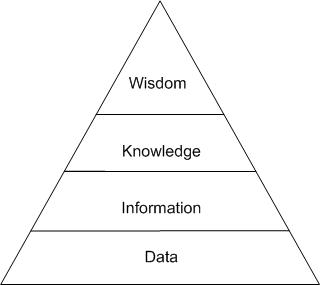
Figure 1: Data-Information-Knowledge-Wisdom (DIKW) Pyramid
In this post, I explore “evil twins” of the DIKW framework: hierarchical models of non-knowledge. My discussion is based on a paper by Jay Bernstein, with some extrapolations of my own. My aim is to illustrate (in a not-so-serious way) that there are many more managerial pathways to ignorance and folly than there are to knowledge and wisdom.
I’ll start with a quote from the paper. Bernstein states that:
Looking at the way DIKW decomposes a sequence of levels surrounding knowledge invites us to wonder if an analogous sequence of stages surrounds ignorance, and where associated phenomena like credulity and misinformation fit.
Accordingly he starts his argument by noting opposites for each term in the DIKW hierarchy. These are listed in the table below:
| DIKW term | Opposite |
| Data | Incorrect data, Falsehood, Missing data, |
| Information | Misinformation, Disinformation, Guesswork, |
| Knowledge | Delusion, Unawareness, Ignorance |
| Wisdom | Folly |
This is not an exhaustive list of antonyms – only a few terms that make sense in the context of an “evil twin” of DIKW are listed. It should also be noted that I have added some antonyms that Bernstein does not mention. In the remainder of this post, I will focus on discussing the possible relationships between these terms that are opposites of those that appear in the DIKW model.
The first thing to note is that there is generally more than one antonym for each element of the DIKW hierarchy. Further, every antonym has a different meaning from others. For example – the absence of data is different from incorrect data which in turn is different from a deliberate falsehood. This is no surprise – it is simply a manifestation of the principle that there are many more ways to get things wrong than there are to get them right.
An implication of the above is that there can be more than one road to folly depending on how one gets things wrong. Before we discuss these, it is best to nail down the meanings of some of the words listed above (in the sense in which they are used in this article):
Misinformation – information that is incorrect or inaccurate
Disinformation – information that is deliberately manipulated to mislead.
Delusion – false belief.
Unawareness – the state of not being fully cognisant of the facts.
Ignorance – a lack of knowledge.
Folly – foolishness, lack of understanding or sense.
The meanings of the other words in the table are clear enough and need no elaboration.
Meanings clarified, we can now look at the some of the “pyramids of folly” that can be constructed from the opposites listed in the table.
Let’s start with incorrect data. Data that is incorrect will mislead, hence resulting in misinformation. Misinformed people end up with false beliefs – i.e. they are deluded. These beliefs can cause them to make foolish decisions that betray a lack of understanding or sense. This gives us the pyramid of delusion shown in Figure 2.

Figure 2: A pyramid of delusion
Similarly, Figure 3 shows a pyramid of unawareness that arises from falsehoods and Figure 4, a pyramid of ignorance that results from missing data.

Figure 3: A pyramid of unawareness
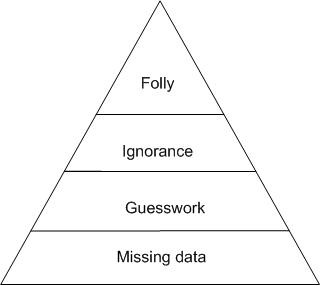
Figure 4: A pyramid of ignorance
Figures 2 through 4 are distinct pathways to folly. I reckon many of my readers would have seen examples of these in real life situations. (Tragically, many managers who traverse these pathways are unaware that they are doing so. This may be a manifestation of the Dunning-Kruger effect.)
There’s more though – one can get things wrong at higher level independent of whether or not the lower levels are done right. For example, one can draw the wrong conclusions from (correct) data. This would result in the pyramid shown in Figure 5.

Figure 5: Yet another pyramid of delusion
Finally, I should mention that it’s even worse: since we are talking about non-knowledge, anything goes. Folly needs no effort whatsoever, it can be achieved without any data, information or knowledge (or their opposites). Indeed, one can play endlessly with antonyms and near-antonyms of the DIKW terms (including those not listed here) and come up with a plethora of pyramids, each denoting a possible pathway to folly.
To freeze or to flee: a water dragon’s perspective on managing change
Over the last few weeks, it has been raining quite a bit in Sydney. Last weekend I took advantage of a break in the rain and went bushwalking in the Lane Cove National Park with a friend. The park lies along the Lane Cove River – a picturesque little waterway that runs through suburban Sydney. The track we walked along was a bit slippery from the rain of the previous weeks but was drying out nicely in the morning sun.
One of the consequences of sunny weather after a long spell of rain is that reptiles tend to seek open spaces to soak in some sun. With dense vegetation on either side, the open, rocky areas on the track were inviting spots for reptiles looking to sunbathe. I thought we might see snake or two but we didn’t. Instead we walked into a number of Eastern Water Dragons, semi-aquatic lizards that are common in eastern Australia (see Figure 1). Incidentally, fully-grown water dragons are a pretty impressive sight, growing up to a metre in length. They are also quite well camouflaged, black stripes over a grey-brown coat that merges nicely with the rock-and-mud colours of the track.

Figure 1 - Eastern water dragon
When a water dragon sunbathes, it stays still, rock-like, for long periods of time. This makes sense from a safety perspective: motion might attract the attention of predators (mainly omnivorous native birds such as Currawongs and Kookaburras). So the reptile remains statue-like, perfectly camouflaged by colours that merge with the ground it lies on…until a blundering bushwalker disturbs its repose, like we did many times (to many lizards) last weekend. At that point the creature has two options: to freeze (maintain the status quo) or to flee (turn tail and scuttle off).
The water dragon senses approaching bushwalkers by the disturbance caused by their footfalls along the trail, further amplified by the crackling of leaves and brush that come underfoot. To the water dragon, the approaching footfalls signify an unknown: it could be benign but could also be a predator on the prowl. It is safest to assume the latter because if the lizard chooses the former wrongly it could end up dead. However, even if it is a predator, it is quite possible that the lizards’s superb camouflage will do its job and render it unnoticeable. (Besides, it is comfortable out there in the sun, so there’s an understandable reluctance to move.) Consequently, the first reaction of the lizard is to continue its statue-like stance, but remain alert to the danger. As the footsteps get closer it reassesses the situation continually, deciding whether to run for it or stay put. At some point, a threshold is reached and the lizard dashes off into the undergrowth (or a stream, if there’s one handy – water dragons are good swimmers).
Now, if there were no blundering bushwalker, the dragon would presumably continue basking in the sun undisturbed. The bushwalker changes the lizard’s environment and the lizard reacts to this change in one of the two ways it knows – it stays put (does nothing) or runs (takes evasive action). Both actions are aimed at self-preservation – we can take it as given that the lizard does not want to be a lizard-eater’s lunch! The first action has the benefit of not expending energy unnecessarily, but could lead to an unpleasant end. The second is a better guarantor of safety but involves some effort. There is a tradeoff: not becoming lunch involves understanding that there is no such thing as a free lunch.
The interesting thing is that the threshold seems to vary from dragon to dragon. When I used the phrase “walking into” earlier in this piece, I meant it quite literally: many times we didn’t notice a recumbent reptile until we were almost upon it. At other times, though, a startled slinker would speed off when we were several metres away. It seems some water dragons scare easily while others don’t. In either case, the lizard makes an assessment of the situation based on the information gleaned through its senses and then decides on a course of action.
These musings got me thinking about workplace change and our reactions to it. Although such changes are rarely life threatening, they can be unsettling. I thought it interesting that the most typical reactions to workplace change are much like those of a water dragon to approaching footsteps. Many (most?) people is to attempt to maintain the status quo and failing that, they quit for (supposedly) greener pastures. This is a perfectly normal reaction considering our evolutionary heritage – most creatures (be they water dragons or humans) prefer the familiar and will do what they can to avoid change. It is no surprise, then, that our first reactions to changes forced upon us is to:
- Pretend they haven’t occurred or
- Run away from them.
The implications for management are the following: since the above is pretty much a guaranteed first reaction from those affected, change management initiatives need to address it upfront. This isn’t the same as the “what’s in it for me” (or WIIFM) factor – it is more basic than that – it is the loss of the familiar world. What is needed is reassurance that the changes are benign – or even better, beneficial – to those affected. On the other hand, if there are going to be negative consequences, then it is best to state – early in the process – that people’s work conditions (or employment) are under threat. In this case folks know exactly what’s coming and can make their own plans to deal with it. Unfortunately, this kind of honesty is rare – organisations seem to prefer to keep their employees stumbling around in a fog of uncertainty.
The implication for employees is much more straightforward. There is a key difference between humans and water dragons: we can think before we act, water dragons can’t. Consequently, we have a third option available to us, one that involves neither freezing nor fleeing – it is to face up to changes and adapt to them.
The Abilene paradox in front-end decision-making on projects
The Abilene paradox refers to a situation in which a group of people make a collective decision that is counter to the preferences or interests of everyone in the group. The paradox was first described by Jerry Harvey, via a story that is summarised nicely in the Wikipedia article on the topic. I reproduce the story verbatim below:
On a hot afternoon in Coleman, Texas, the family is comfortably playing dominoes on a porch, until the father-in-law suggests that they take a trip to Abilene [53 miles north] for dinner. The wife says, “Sounds like a great idea.” The husband, despite having reservations because the drive is long and hot, thinks that his preferences must be out-of-step with the group and says, “Sounds good to me. I just hope your mother wants to go.” The mother-in-law then says, “Of course I want to go. I haven’t been to Abilene in a long time.”
The drive is hot, dusty, and long. When they arrive at the cafeteria, the food is as bad as the drive. They arrive back home four hours later, exhausted.
One of them dishonestly says, “It was a great trip, wasn’t it?” The mother-in-law says that, actually, she would rather have stayed home, but went along since the other three were so enthusiastic. The husband says, “I wasn’t delighted to be doing what we were doing. I only went to satisfy the rest of you.” The wife says, “I just went along to keep you happy. I would have had to be crazy to want to go out in the heat like that.” The father-in-law then says that he only suggested it because he thought the others might be bored.
The group sits back, perplexed that they together decided to take a trip which none of them wanted. They each would have preferred to sit comfortably, but did not admit to it when they still had time to enjoy the afternoon.
Harvey contends that variants of this story play out over and over again in corporate environments. As he states in this paper, organizations frequently take actions in contradiction to what they really want to do and therefore defeat the very purposes they are trying to achieve.
—
The Abilene paradox is essentially a consequence of the failure to achieve a shared understanding of a problem before deciding on a solution. A case in point is Nokia’s ill-judged restructuring circa 2003, initiated in response to the rapidly changing mobile phone market.
Prior to the restructure, Nokia was a product-oriented company that focused on developing one or two new phone models per year. Then, as quoted by an employee in an article published in Helsingin Sanomat (A Finnish daily), Nokia management deemed that: “Two new models a year was no longer enough, but there was a perceived need to bring out as many as 40 or 50 models a year… An utterly terrifying number.” Company management knew that it would be impossible to churn out so many models under the old, product-focused structure. So they decided to reorganise the company into different divisions comprising of teams dedicated to creating standard components (such as cameras), the idea being that standard components could be mixed-and-matched into several “new” phone models every year .
The restructuring and its consequences are described in this article as follows:
[The] re-organisation split Nokia’s all-conquering mobile phones division into three units. The architect was Jorma Ollila, Nokia’s most successful ever CEO, and a popular figure – who steered the company from crisis in 1992 to market leadership in mobile phones – and who as chairman oversaw the ousting of Olli-Pekka Kallasvuo this year [i.e 2010].
In Ollila’s reshuffle, Nokia made a transition from an agile, highly reactive product-focused company to one that managed a matrix, or portfolio. The phone division was split into three: Multimedia, Enterprise and Phones, and the divisions were encouraged to compete for staff and resources. The first Nokia made very few products to a very high standard. But after the reshuffle, which took effect on 1 January 2004, the in-fighting became entrenched, and the company being increasingly bureaucratic. The results were pure Dilbert material.
That the Nokia restructure was possibly a “trip to Abilene” is suggested by the following excerpt from an interview with a long-time Nokia employee (see part IV of the Helsingin Salomat article):
…Even CEO Jorma Ollila was less than enthusiastic about the heavy organisational structure, and recognised perfectly well that it was making Nokia stiff and sluggish in its movements. In their time, Ollila’s views made it all the way down to the factory floor.
But was it not Jorma Ollila himself who created the organisation he led?
“Yes”, replies the woman.Ollila’s unwavering line was to allow his subordinates freedom, to trust them without tight controls. In this way the then leaders of the business units like Mobile Phones and Multimedia could recruit whom they wanted. And in so doing the number of managers at all levels mushroomed to enormous proportions and the product development channels became clogged…
Management actions aimed at shoring up and boosting Nokia’s market share ended up achieving just the opposite, and the irony is that the restructure did not even have the whole-hearted support of management.
—
Like the Nokia restructuring effort, most projects are initiated in response to a perceived problem. Often times, those responsible for giving the project the go-ahead do not have an adequate appreciation of the problem or the proposed solution. As I have stated in an earlier post:
Many high profile projects fail because they succeed. This paradoxical statement is true because many projects are ill-conceived efforts directed at achieving goals that have little value or relevance to their host organisations. Project management focuses on ensuring that the project goals are achieved in an efficient manner. The goals themselves are often “handed down from above”, so the relevance or appropriateness of these is “out of scope” for the discipline of project management. Yet, the prevalence of projects of dubious value suggests that more attention needs to be paid to “front-end” decision making in projects – that is, decision making in the early stages, in which the initiative is just an idea.
Front-end decisions are difficult because they have to be made on the basis of ambiguous or incomplete information. This makes it all the more important that such decisions incorporate the honest views and opinions of all stakeholders in the organisation (or their nominated representatives). The first step in such a process is to ensure that all stakeholders have a common understanding of the goals of the project – i.e. what needs to be done. The next is to reach a shared understanding of how those goals will be achieved. Such stakeholder alignment can be facilitated through communication-centric, collaborative techniques such as dialogue mapping. Genuine dialogue is the only way to prevent pointless peregrinations to places that an organisation can ill-afford to go to.


 Eight to Late