Archive for the ‘Organizational Paradoxes’ Category
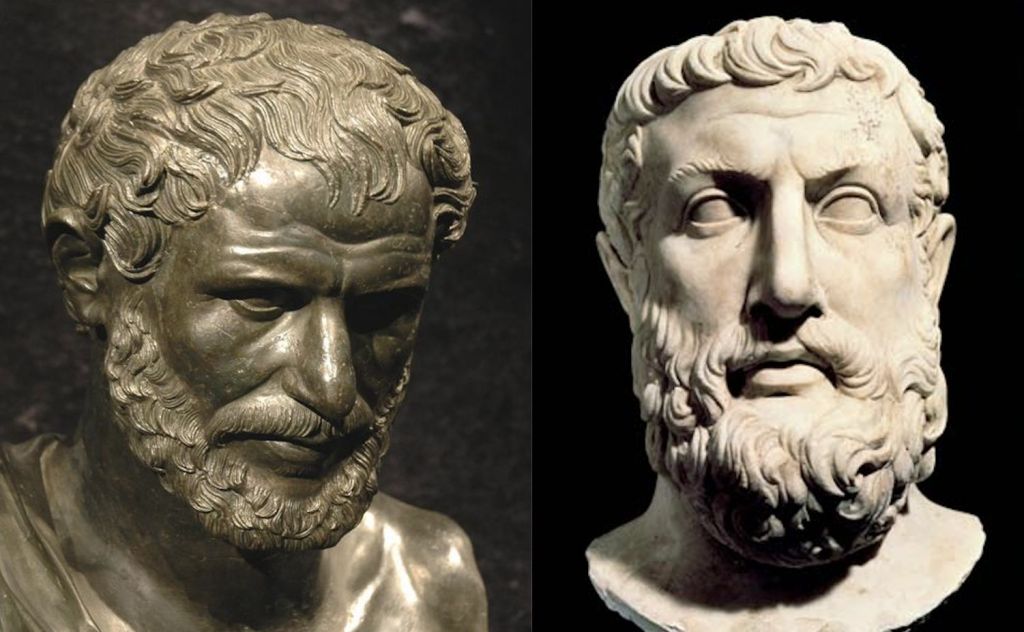
Heraclitus and Parmenides – a metalogue about organizational change
“Organizations are Heraclitian, but Parmenides is invariably in charge.” –Stafford Beer (paraphrased)
Heraclitus: Hello Parmenides, it’s been a while! What have you been up to since we last met?
Parmenides: Heraclitus, it is good to see you my old friend. You’re not going to believe it, but I’ve been doing some consulting work on managing change in organizations.
Heraclitus: [laughs] You’re right, that is beyond belief, particularly in view of your philosophical position on change. So, have you recanted? Have you now come around to the truth that everything changes and nothing stands still?
Parmenides: Ah, yes I am familiar with your views on change my friend, but I hate to disappoint you. My position remains the same as before: I still believe that the world is essentially unchanging. The key word here is “essentially” – by which I mean that the changes we see around us are superficial and that the essential properties of the world do not change. Indeed, as paradoxical as it may sound, understanding this unchanging essence enables us to manage superficial changes such as those that happen in organizations.
Heraclitus: I’m not sure I understand what you mean by unchanging essence and superficial change...
Parmenides: OK, let me try explaining this using an example. Let us consider the case of a physical law and a real world situation to which it applies. A concrete instance of this would be Newton’s Law of Gravitation and the motion of a spacecraft. The former represents the unchanging essence while the latter represents one of its manifestations. The point is this: the real world (as represented by a moving spacecraft) appears to be ever changing, but the underlying unity of the world (as represented by Newton’s law) does not change. If one understands the underlying unchanging laws then one has the power to predict or control the superficial changes.
Heraclitus: Hmm….I don’t see how it relates to organizations. Can you give me a more down to earth illustration from your work? For example: what is the “unchanging essence” in organizational change?
Parmenides: That’s easy: the unchanging essence is the concept of an organization and the principles by which they evolve. Consultants like me help organizations improve performance by influencing or adjusting certain aspects of their structure and interactions. However, the changes we facilitate do not affect the essence of the entities we work with. Organizations remain organizations, and they evolve according to universal laws despite the changes we wrought within them.
Heraclitus: Ah Parmenides, you are mistaken: concepts and principles evolve in time; they do not remain constant. Perhaps I can convince you of this by another means. Tell me, when you go into an organization to do your thing, how do you know what to change?
Parmenides: Well, we carry out a detailed study by talking to key stakeholders and then determine what needs to be done. There are a host of change models that have come out of painstaking research and practice. We use these to guide our actions.
Heraclitus: Are these models akin to the physical laws you mentioned earlier?
Parmenides: Yes, they are.
Heraclitus: But all such models are tentative; they are always being revised in the light of new knowledge. Theory building in organizational research (or any other area) is an ongoing process. Indeed, even physics, the most exact of sciences, has evolved dramatically over the last two millennia – consider how our conception of the solar system has changed from Ptolemy to Copernicus. For that matter, even our understanding of gravity is no longer the same as it was in Newton’s time. The “unchanging essence” – as you call it – is but a figment of your imagination.
Parmenides: I concede that our knowledge of the universe evolves over time. However, the principles that underlie its functioning don’t change. Indeed, the primary rationale behind all scientific inquiry is to find those eternal principles or truths.
Heraclitus: It is far from clear that the principles are unchanging, even in a so-called exact discipline like physics. For example, a recent proposal suggests that the laws of physics evolve in time. This seems even more likely for social systems: the theory and practice of management in the early twentieth century is very different from what it is now, and with good reason too – contemporary organizations are nothing like those of a century ago. In other words, the “laws” that were valid then (if one can call them that) are different from the ones in operation now.
Parmenides: You’re seduced by superficial change – you must look beneath surface appearances! As for the proposal that the laws of physics evolve in time, I must categorically state that it is a minority view that many physicists disagree with (Editor’s note: see this rebuttal for example)
Heraclitus: I take your point about the laws of physics…but I should mention that history is replete with “minority views” that were later proven to be right. However, I cannot agree with your argument about superficial change because it is beyond logic. You can always deem any change as being superficial, however deep it may be. So let me try to get my point across in yet another way. You had mentioned that you use management principles and models to guide your actions. Could you tell me a bit more about how this works in practice?
Parmenides: Sure, let me tell you about an engagement that we recently did for a large organization. The problem they came to us with was that their manufacturing department was simply not delivering what their customers expected. We did a series of interviews with senior and mid-level managers from the organisation as well as a wide spectrum of staff and customers and found that the problem was a systemic one – it had more to do with the lack of proper communication channels across the organisation rather than an issue with a specific department. Based on this we made some recommendations to restructure the organisation according to best practices drawn from organisational theory. We then helped them implement our recommendations.
Heraclitus: So you determined the change that needed to be made and then implemented the change over a period of time. Is that right?
Parmenides: Well, yes…
Heraclitus: And would I be right in assuming that the change took many months to implement?
Parmenides: Yes, about a year actually…but why does that matter?
Heraclitus: Bear with me for a minute. Were there any significant surprises along the way? There must have been things that happened that you did not anticipate.
Parmenides: Of course, that goes with the territory; one cannot foresee everything.
Heraclitus: Yet you persisted in implementing the changes you had originally envisioned them.
Parmenides: Naturally! We had determined what needed to be done, so we went ahead and did it. But what are you getting at?
Heraclitus: It’s quite simple really. The answer lies in a paradox formulated by your friend Zeno: you assumed that the organization remains static over the entire period over which you implemented your recommendations.
Parmenides: I did not say that!
Heraclitus: You did not say it, but you assumed it. Your recommendations for restructuring were based on information that was gathered at a particular point in time – a snapshot so to speak. Such an approach completely overlooks the fact that organisations are dynamic entities that change in unforeseen ways that models and theories cannot predict. Indeed, by your own admission, there were significant but unanticipated events and changes that occurred along the way. Now you might claim that those changes were superficial, but that won’t wash because you did not foresee those changes at the start and therefore could not have known whether they would be superficial or not.
Parmenides: Well, I’m not sure I agree with your logic my dear Heraclitus. And in any case, my approach has the advantage of being easy to understand. I don’t think decision-makers would trust a consultant who refuses to take action because every little detail about the future cannot be predicted.
Heraclitus: Admitting ignorance about the future is the first step towards doing something about it.
Parmenides: Yes, but you need to have a coherent plan, despite an uncertain future.
Heraclitus: True, but a coherent plan can be incremental…or better, emergent – where planned actions are adjusted in response to unexpected events that occur as one goes along. Such an approach is better than one based on a snapshot of an organisation at a particular point in time.
Parmenides: Try selling that approach to a CEO, my friend!
Heraclitus: I know, organizations are ever-changing, but those who run them are intent on maintaining a certain status quo. So they preach change, but do not change the one thing that needs changing the most – themselves.
Parmenides: [shakes his head] Ah, Heraclitus, I do not wish to convert you to my way of thinking, but I should mention that our differences are not of theoretical interest alone: they spell the difference between being a cashed-up consultant and a penurious philosopher.
Heraclitus: [laughs] At last we have something we can agree on.
Further reading:
Beer, Stafford (1997), “The culpabliss error: A calculus of ethics for a systemic world,” Systems Practice, Vol 10, No. 4. Pp. 365-380. Available online at: http://rd.springer.com/article/10.1007/BF02557886
Note: the quote at the start of this piece is a paraphrasing of the following line from the paper: “Society is Heraclitian; but Parmenides is in charge.”
The dilemmas of enterprise IT
Information technology (IT) is an integral part of any modern day business. Indeed, as Bill Gates once put it, “Information technology and business are becoming inextricably interwoven. I don’t think anybody can talk meaningfully about one without the talking about the other.” Although this is true, decision makers often display ambivalent, even contradictory attitudes towards enterprise IT. For example, depending on the context, an executive might view IT as a cost of doing business or as a strategic advantage: the former view is common when budgets are being drawn up whereas the latter may come to the fore when a bold new e-marketing initiative is being discussed.
In this post I discuss some of these dilemmas of IT and show how the opposing viewpoints embodied in them need to be managed rather than resolved. I illustrate my point by describing one way in which this can be done.
The dilemmas in brief
Many of the dilemmas of IT are consequences of conflicting views of what IT is and/or how it should be managed. I’ll describe some of these in brief below, leaving a discussion of their implications to the next section:
- IT as a cost of doing business versus IT as strategic asset: This distinction highlights the ambivalent attitudes that senior executives have towards IT. On the one hand, IT is seen as offering strategic advantages to the organization (for example a custom built application for customer segmentation). On the other, it is seen as an operational necessity (for example, core banking systems in the financial industry).
- Centralised IT versus Autonomous IT: This refers to the debate about whether an organisation’s IT environment should be tightly controlled from head office or whether subsidiaries should be given a degree of autonomy. This is essentially a debate between top-down versus bottom-up approaches to IT planning.
- Planning versus Improvisation: This refers to the tension between the structure offered by a plan and process-driven approach to IT and the necessity to step outside of plans and processes in order to come up with improvised solutions suited to the situation at hand. I have written about this paradox in a post on planning and improvisation.
There are other dilemmas – for example, technology driven IT versus business driven IT. However, for the purpose of this discussion the three listed above will suffice.
The poles of a dilemma
In his book entitled Polarity Management, Barry Johnson described how complex organizational issues can often be analysed in terms of their mutually contradictory facets. He termed these facets poles or polarities. In this and the next section, I elaborate on Johnson’s notion of polarity and show how it offers a means to understand and manage the dilemmas of enterprise IT.
The key features of poles are as follows:
Each pole has associated positives and negatives. For example, the up side of viewing IT as a cost is that the organisation focuses on IT efficiency and value for money; the downside is that exploration and experimentation that is necessary for IT innovation would likely be seen as risky. On the other hand, the positive side of IT as a strategic asset is that it is seen as a means to enable an organisation’s growth and development; the negative is that it can encourage unproven technologies (since new technologies are more likely to offer competitive advantages) and uncontrolled experimentation along with their attendant costs.
Most organisations oscillate between poles. At any given time the organisation will be “living” in one pole. In such situations, some stakeholders will perceive the negatives of that pole strongly and will thus see the other pole as being more desirable (the “grass is greener on the other” side syndrome). Johnson labels such stakeholders crusaders” – those who want to rush off into the new world. On the other hand, there are tradition bearers, those who want to stay put. When an organisation has spent a fair bit of time in one pole, the influence of crusaders tends wax while that of the tradition bearers weakens because the negatives become apparent to more and more people.
A concrete example may help clarify this point:
Consider a situation where all subsidiaries of a multinational have autonomous IT units (and have had these for a while). The main benefits of such a model are responsiveness and relevance: local IT units will able to respond quickly to local needs and will also be able to deliver solutions that are tailored to the specific needs of the local business. However, this model has many negative aspects: for example, high costs, duplication of effort, massive software portfolio and attendant costs, high cost of interfacing between subsidiaries etc.
When the model has been in operation for a while, it is quite likely that IT decision makers will perceive the negatives of this pole more clearly than they see the positives. They will then initiate a reform to centralize IT because they perceive the positives of that pole –i.e. low costs, centralization of services etc. – as being worth striving for. However, when the new world is in place and has been operating for a while, the organisation will begin to see its downside: bureaucracy, lack of flexibility, applications that don’t meet specific local business needs etc. They will then start to delegate responsibility back to the subsidiaries…and thus goes the polarity merry-go-round.
Managing enterprise IT dilemmas
As discussed above, any option will have its supporters and detractors. For example, finance folks may see IT as a cost of doing business whereas those in IT will consider it to be a strategic asset. What’s important, however, is that most organisations “resolve” such contradictions by taking sides. That is, one side “wins” and their point of view gets implemented as a “solution.” The concerns of the “losing” side are overlooked entirely.
Although such a “solution” appears to solve the problem, it does not take long for the negative aspects of the other pole to manifest itself; the rumbles of discontent from those whose concerns have been ignored grow louder with time. In this sense, issues that can be defined in terms of polarities are wicked problems – they are perceived in different ways by different stakeholders and so are difficult to define, let alone solve.
As we have seen above, however, the poles of a dilemma are but different facets of a single reality. Hence, the first step towards managing a dilemma lies in realizing that it cannot be resolved definitively; regardless of the path chosen, there will always be a group whose concerns remain unaddressed. The best one can do is to be aware of the positives and negatives of each pole and ensure that the entire spectrum of stakeholders is aware of these. A shared awareness can help the group in figuring out ways to mitigate the worst effects of the negatives.
One which this can be done is via a facilitated session, involving people who represent the two sides of the issue. To begin with, the facilitator helps the group identify the poles. She then helps the group create a polarity map which shows the contradictory aspects of the issue along with their positives and negatives. A rudimentary polarity map for the autonomous/centralized IT dilemma is shown in Figure 1 below.

Figure 1: Polarity map for centralised / autonomous IT dilemma
To ensure completeness of the map, the group must include stakeholders who represent both sides of the dilemma (and also those who hold views that lie between).
As mentioned in the previous section, organisations are not static, they oscillate between poles. Moreover, Johnson claimed that they follow a specific path in the map. Quoting from the book I wrote with Paul Culmsee:
According to Johnson, organisations tended to oscillate between poles. If you accept the notion of a wicked problem as a polarity, the overall pattern traced as one moves between these poles resembles an infinity symbol. The typical path is L- to R+, to R-, across to L+ and Johnson argued that the trajectory could not be avoided. All we can do is focus on minimizing our time spent in the lower quadrants.
Again, it is worth emphasizing that the conflict between the two groups of stakeholders cannot be resolved definitively. The best one can do is to get the two sides to understand each other’s’ point of view and hence attempt to minimize the downsides of each option.
Finally, polarity management is but one way to manage the dilemmas associate with enterprise IT or any other organizational decision. There are many others – and I highly recommend my book if you’re interested in finding out more about these . In the end, though, the point I wished to make in this post is less about any particular technique and more about the need to air and acknowledge differing perspectives on issues pertaining to enterprise IT or any other decision with organization-wide implications.
Wrapping up
The dilemmas of enterprise IT are essentially consequences of mutually contradictory, yet equally valid perspectives. Is IT a cost of doing business or is it a strategic asset? The answer depends on the perspective one takes…and there is no objectively right or wrong answer. Given this, it is important to be aware of both the up and down side of each perspective (or pole) before one makes a decision. Unfortunately, most often decisions are made on the basis of the up side of one option and the down side of the other. As should be evident now, a decision that is based on such a selective consideration of viewpoints invariably invites conflict and leads to undesirable outcomes.
On the contradictions of consulting (and management) rhetoric
Introduction
Successful management consultants are often seen as experts and trendsetters in the business world. The best among them are able to construct convincing narratives about their expertise and experience, thereby gaining the trust of senior managers in large organisations.
Have you ever wondered how they manage to pull this off?
In a paper entitled, The Invincible Character of Management Consulting Rhetoric: How One Blends Incommensurates While Keeping Them Apart, Jonas Berglund and Andreas Werr discuss how consultants, unbeknownst to their clients, often draw from two mutually contradictory forms of rhetoric to construct their arguments: rational (scientific or fact-based) and practical (action-based). This renders them immune to potential challenges from skeptics. This post, which is based on the work of Berglund and Werr, is an elaboration of this claim.
Background and case study
Typically management consultants are hired to help organisations formulate and implement strategic initiatives aimed at improving organisational performance. On the ground, such initiatives usually result in large-scale change initiatives such as organisation-wide restructuring or the implementation of enterprise systems. Whatever the specific situation, however, consultants are generally brought in because clients perceive them as being experts who have the necessary knowledge and practical experience to plan and execute such transformations.
A typical consulting engagement consists of many interactions between consultants and diverse client-side stakeholders. Berglund and Werr begin their paper with a description of an example of such an interaction drawn from their fieldwork in a large organisation. In brief: the example describes a workshop that was aimed at redesigning business processes in an organisation. The two-day event was facilitated by the consultants and involved many stakeholders from the business. I reproduce their description of the event below so that you can read it in its original form:
The event begins with a plenary session. The 25 participants—a selection of key persons on different levels in the organization—sit around a u-shaped table in a large room. Three consultants sit at one end of the table. One (a bit older than the others) is Ben, the project manager.
At 9 am sharp he rises and enters the stage. A nervousness is reflected in his somewhat impatient movements and way of talking. This is an important presentation. It is the first time since the ‘kick off’ of the project, that it is being delivered to a larger audience. Ben welcomes the participants and briefly introduces himself: ‘I am a consultant at Consulting Ltd. My specialty is BPR [Business Process Reengineering]. I have worked extensively with this method in the telecom industry.’ He also briefly introduces the two colleagues sitting at the end of the table. But the consulting team is not complete: ‘We are waiting for Alan, a portal figure and innovator concerning BPR.’
Ben suggests beginning the seminar with a brief introduction of the participants. After this has been completed, he remarks: ‘we clearly have a massive competence here today’. Thereafter, he leaves the floor to Ken, the CEO of the company, who says the following:
‘There are many reasons why we are sitting here today. The triggering factor has been the rapid growth rate of the market. But why should we start working with BPR? I have worked a lot with process improvement, and I have failed many times, but then I heard a presentation by Alan and everything fell in place. I saw the mistakes we had made—we focused on the current situation instead of being creative.’ Following this introduction, the importance of the project is further stressed. ‘The high growth rate of the market demands a new way of working . . . The competitive situation for the company is getting harder; the years when the customers just came to us are over. Now we have to start working for our money . . . The reason for this project is that we want to become the best from our owners’, customers’ and employees’ perspective.’
After this presentation, Ben takes over the floor again: ‘I have something to tell you. I want to report what we have done in the project so far . . . We have worked in four steps, which is a quite typical approach in reengineering’, he says, showing a slide headed ‘Method for Implementation’, which depicts four project phases arranged in the form of steps from the lower left to the upper right. The more detailed exploration of these phases, and the related activities occupy the group for some minutes.
Thereafter, a sequence of transparencies is shown. They describe the overall situation of the company using well-known business concepts. The titles of the slides read ‘Strategic Positioning’ (the model presented under this title has strong similarities with the BCG [Boston Consulting Group] matrix), ‘SWOT Analysis’, ‘Core Competencies’, and ‘Critical Success Factors’.
I expect many readers who work in organisational settings will be able to relate elements from the above extract to their own experiences with management consultants.
Although the case-study is dated, the rhetoric used by the consultant is timeless. Indeed, in such plenary sessions, the main aim of consultants (and client-side senior management) is to justify the proposed changes and convince client-side staff to get involved in implementing them. This is as true now as it was a decade ago, the rhetoric used has hardly changed at all. What’s more interesting, though, is that their arguments taken as a whole are often inconsistent. To see why, let’s take a closer look at two kinds of rhetoric employed by consultants.
The rhetoric of reason
Consultants often legitimize their proposed actions by claiming to use “established” or “proven” methods. At the time of the case study (remember this was in the 90s), BPR was all the rage and, as a consequence, there were a number of contemporary books and articles (both in research and trade journals) that consultants could draw upon to legitimize their claims. Indeed, many of the articles about BPR from that era delved into things such as critical success factors and core competencies – the very terms used by Ben, the consultant in the case study. By doing so, Ben emphasised that BPR was a logically justifiable undertaking for the client organisation.
However, that’s not all: by referring to a stepwise “method for implementation,” Ben makes the process seem like a rational one with an “if we do X then Y will follow” logic. Of course, real life is never that simple, as evidenced by the statistics on failed BPR projects. Consultants often confuse their clients by presenting the map which is the idealised process as being equivalent to the territory that is organisational reality.
The rhetoric of action
To be sure, those who run organisations care more about results than models or methodologies. As a result, consultants have to portray themselves as being practical rather than theoretical. This is where the rhetoric of action comes in.
Ben’s reference to his “extensive experience in the telecom industry” and his invocation of “Alan, the portal figure and innovator” are clearly intended to emphasise the consulting organisation’s experience and “innovative approaches” to implementing BPR initiatives. Notice there are no references to reason here; there is only the implicit, “trust me, I’ve done this before”, and (if not that, then), “trust Alan, the portal figure and innovator.”
Ben’s spiel is backed up by the CEO; consider the CEO’s line, ” …I have worked a lot with process improvement, and I have failed many times, but then I heard a presentation by Alan and everything fell in place. I saw the mistakes we had made…”
The boss heard the BPR Gospel According To Alan and had an epiphany; everything just “fell in place.”
Discussion
The short case study illustrates how consultants shift back and forth between two essentially incompatible modes of rhetoric when speaking to clients: a rational one which assumes the existence of objective management models and a normative one which appeals to human behaviours and emotions. This enables them to construct narratives that, on the surface, seem plausible and convincing, and more important, are hard to refute.
Although the rhetoric of reason refers to an idealised world of management models, its power and appeal cannot be overstated. As the authors state:
The belief in experts and their techniques is firmly anchored in the modern belief in rationality. In our culture ‘the notions of ‘‘science’’, ‘‘rationality’’, ‘‘objectivity’’, and ‘‘truth’’ are bound up with one another’. Knowledge is power, and formalized knowledge is praised as the only legitimate form of knowledge, offering hard and objective truth in correspondence to reality.
Indeed, consultants play a huge role in the diffusion of new knowledge and models in the wider business world, thus perpetuating the myth that management models work.
On the other hand, consultants must show results. They have to portray themselves action-oriented and hence Ben’s attempt to establish his (and his organisation’s) credibility via credentials. This mode of rhetoric downplays scientific-rational thinking and highlights wisdom gained by experience instead. As the authors state:
The chain of argument usually goes like this: merit always prevails over privilege; management knowledge is often contrasted with scientific, theoretically informed knowledge, which is regarded with suspicion by managers; and a persons’ track record and ‘hands-on’ experience is regarded as more important than expertise in general management skills acquired through extensive education.
Another facet of the rhetoric of action is that it emphasises the uniqueness of each situation. This is based on the idea that things in organisations are subject to continual change and that the lack of a stable configuration and environment makes it impossible to employ management models. The implication being that the only way to deal with the mess is to create a sense of collectivism – a “we’re in this together” attitude. The concept of organisational culture plays on this by portraying an organisation as this unique, wonderful place in which everyone shares the same values and deep sense of meaning. As the authors state:
The management literature discussing corporate culture is filled with religious and magical metaphors of the leader stressing the less rational sides of the organization, emphasizing the role of ceremonies, rituals, sagas, and legends (to mention only a few), in creating a system of shared values in the organization.
Seen in this light, the CEO’s references to Alan’s epiphany-inducing presentation, the “competitive situation,” and the need to “start working for our money” are attempts to generate this sense of collectivism.
The foregoing discussion highlights how consultants and their allies draw upon incompatible modes of rhetoric to justify their plans and actions. This essentially makes it difficult to refute their claims: if one tries to pin them down on logical grounds, they can argue based on their track record and deep experience; if one questions their experience, they can point to the logic of their models and processes.
…but we are all guilty
Finally, I should emphasise that management consultants are not the only ones guilty of using both forms of rhetoric, we all are: the business cases we write, the presentations we deliver, the justifications we give our bosses and staff are all rife with examples of this. Out of curiosity, I re-read a business case I wrote recently and was amused to find a couple of contradictions of the kind discussed in this post.
Conclusion
In this post I have discussed how consulting rhetoric frequently draws upon two incompatible kinds of arguments –rational/fact-based and practical/action-based. This enables consultants to present arguments that are hard to refute on logical grounds. However, it isn’t fair to single out consultants: most people who work in organisation-land are just as guilty of mixing incompatible rhetorics when attempting to convince others of the rightness of their views.


 Eight to Late