Archive for the ‘Organizations’ Category
Scapegoats and systems: contrasting approaches to managing human error in organisations
Much can be learnt about an organization by observing what management does when things go wrong. One reaction is to hunt for a scapegoat, someone who can be held responsible for the mess. The other is to take a systemic view that focuses on finding the root cause of the issue and figuring out what can be done in order to prevent it from recurring. In a highly cited paper published in 2000, James Reason compared and contrasted the two approaches to error management in organisations. This post is an extensive summary of the paper.
The author gets to the point in the very first paragraph:
The human error problem can be viewed in two ways: the person approach and the system approach. Each has its model of error causation and each model gives rise to quite different philosophies of error management. Understanding these differences has important practical implications for coping with the ever present risk of mishaps in clinical practice.
Reason’s paper was published in the British Medical Journal and hence his focus on the practice of medicine. His arguments and conclusions, however, have a much wider relevance as evidenced by the diverse areas in which his paper has been cited.
The person approach – which, I think is more accurately called the scapegoat approach – is based on the belief that any errors can and should be traced back to an individual or a group, and that the party responsible should then be held to account for the error. This is the approach taken in organisations that are colloquially referred to as having a “blame culture.”
To an extent, looking around for a scapegoat is a natural emotional reaction to an error. The oft unstated reason behind scapegoating, however, is to avoid management responsibility. As the author tells us:
People are viewed as free agents capable of choosing between safe and unsafe modes of behaviour. If something goes wrong, it seems obvious that an individual (or group of individuals) must have been responsible. Seeking as far as possible to uncouple a person’s unsafe acts from any institutional responsibility is clearly in the interests of managers. It is also legally more convenient…
However, the scapegoat approach has a couple of serious problems that hinder effective risk management.
Firstly, an organization depends on its frontline staff to report any problems or lapses. Clearly, staff will do so only if they feel that it is safe to do so – something that is simply not possible in an organization that takes scapegoat approach. The author suggests that the Chernobyl disaster can be attributed to the lack of a “reporting culture” within the erstwhile Soviet Union.
Secondly, and perhaps more important, is that the focus on a scapegoat leaves the underlying cause of the error unaddressed. As the author puts it, “by focusing on the individual origins of error it [the scapegoat approach] isolates unsafe acts from their system context.” As a consequence, the scapegoat approach overlooks systemic features of errors – for example, the empirical fact that the same kinds of errors tend to recur within a given system.
The system approach accepts that human errors will happen. However, in contrast to the scapegoat approach, it views these errors as being triggered by factors that are built into the system. So, when something goes wrong, the system approach focuses on the procedures that were used rather than the people who were executing them. This difference from the scapegoat approach makes a world of difference.
The system approach looks for generic reasons why errors or accidents occur. Organisations usually have a series of measures in place to prevent errors – e.g. alarms, procedures, checklists, trained staff etc. Each of these measures can be looked upon as a “defensive layer” against error. However, as the author notes, each defensive layer has holes which can let errors “pass through” (more on how the holes arise a bit later). A good way to visualize this is as a series of slices of Swiss Cheese (see Figure 1).
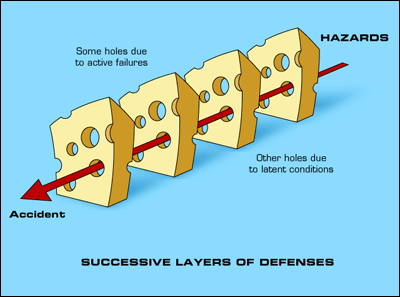
Figure 1: The Swiss cheese model (from: http://patientsafetyed.duhs.duke.edu/module_e/swiss_cheese.html)
The important point is that the holes on a given slice are not at a fixed position; they keep opening, closing and even shifting around, depending on the state of the organization. An error occurs when the ephemeral holes on different layers temporarily line up to “let an error through”.
There are two reasons why holes arise in defensive layers:
- Active errors: These are unsafe acts committed by individuals. Active errors could be violations of set procedures or momentary lapses. The scapegoat approach focuses on identifying the active error and the person responsible for it. However, as the author points out, active errors are almost always caused by conditions built into the system, which brings us to…
- Latent conditions: These are flaws that are built into the system. The author uses the term resident pathogens to describe these – a nice metaphor that I have explored in a paper review I wrote some years ago. These “pathogens” are usually baked into the system by poor design decisions and flawed procedures on the one hand, and ill-thought-out management decisions on the other. Manifestations of the former include faulty alarms, unrealistic or inconsistent procedures or poorly designed equipment; manifestations of the latter include things such as unrealistic targets, overworked staff and the lack of funding for appropriate equipment.
The important thing to note is that latent conditions can lie dormant for a long period before they are noticed. Typically a latent condition comes to light only when an error caused by it occurs…and only if the organization does a root cause analysis of the error – something that is simply not done in an organization takes a scapegoat approach.
The author draws a nice analogy that clarifies the link between active errors and latent conditions:
…active failures are like mosquitoes. They can be swatted one by one, but they still keep coming. The best remedies are to create more effective defences and to drain the swamps in which they breed. The swamps, in this case, are the ever present latent conditions.
“Draining the swamp” is not a simple task. The author draws upon studies of high performance organisations (combat units, nuclear power plants and air traffic control centres) to understand how they minimised active errors by reducing system flaws. He notes that these organisations:
- Accept that errors will occur despite standardised procedures, and train their staff to deal with and learn from them.
- Practice responses to known error scenarios and try to imagine new ones on a regular basis.
- Delegate responsibility and authority, especially in crisis situations.
- Do a root cause analysis of any error that occurs and address the underlying problem by changing the system if needed.
In contrast, an organisation that takes a scapegoat approach assumes that standardisation will eliminate errors, ignores the possibility of novel errors occurring, centralises control and, above all, focuses on finding scapegoats instead of fixing the system.
Acknowledgement:
Figure 1 was taken from the Patient Safety Education website of Duke University Hospital.
Further reading:
The Swiss Cheese model was first proposed in 1991. It has since been applied in many areas. Here are a couple of recent applications and extensions of the model to project management:
- Stephen Duffield and Jon Whitty use the Swiss Cheese model as a basis for their model of Systemic Lessons Learned and Knowledge Captured (SLLKC model) in projects.
- In this post, Paul Culmsee extends the SLLKC model to incorporate aspects relating to teams and collaboration.
Towards an antifragile IT strategy
Introduction
In his thought-provoking book on antifragility, Nassim Taleb makes the point that the opposite of fragility is not robustness or resilience, rather it is the ability to thrive on or benefit from uncertainty. There is no word in the English language to describe such behavior, and that is what led him to coin the term antifragile.
Nature is an excellent example of an antifragile system: whenever subjected to a cataclysmic event (like this one that occurred ~66 million years ago), nature manages not only to recover, but does so in novel and arguably better ways. Unlike nature, however, most human-made systems tend to be fragile. An example that Taleb highlights is the global financial system , not just prior to the 2008 financial crisis but even now.
The broader lesson to be learnt from the financial crisis is that it is impossible to predict the future in any detail. Systems should therefore be designed to cope with (if not take advantage of) the irreducible uncertainty associated with this lack of predictability. Human-made systems that overlook this inescapable fact tend to be brittle by design.
The above is true not only of systems, but also of future-directed activities such as strategic planning. Overlooking the role of irreducible uncertainty in planning invariably locks an organization into an inflexible course of action. Unfortunately, this is not always appreciated by those who run organisations. As Taleb puts it:
Corporations are in love with the idea of the strategic plan. They need to pay to figure out where they are going. Yet there is no evidence that strategic planning works —we even seem to have evidence against it. A management scholar, William Starbuck, has published a few papers debunking the effectiveness of planning [see this paper, for example]—it makes the corporation option-blind, as it gets locked into a non-opportunistic course of action.
The trick, as Taleb hints in the above passage (and elaborates on in his book), is to plan in such a way as to take advantage of options that we are unaware of now, but might emerge in the future.
That, of course, is easier said than done.
In this post, I draw on Taleb’s book and my own experiences to discuss how one can formulate an IT strategy that thrives on uncertainty. Although my focus is primarily on IT, the points discussed have a wider applicability to strategic planning in general.
Towards an antifragile IT strategy
Before we get into antifragility, it is useful to take a brief look at how IT strategy is usually formulated.
Although some IT leaders will contest this point, a good majority of organisations tend to view IT as a cost rather than a strategic focus area. As a consequence, the objectives of an IT strategy are generally geared towards cost reduction and increased efficiency. The obvious ways in which to do this are through strict governance, standardization and/or outsourcing. Unfortunately, these actions tend to make organisations less flexible and hence more susceptible to uncertainty…and thus more fragile.
So, the key to an antifragile strategy is flexibility…but what exactly is flexibility?
The best definition of flexibility I have come across is the one proposed by Gregory Bateson who defined it as uncommitted potential for change (see this post for more on Bateson’s definition of flexibility). Only if one is flexible in this sense can one take advantage of unexpected events when they occur. The problem of formulating an antifragile IT (or any other!) strategy thus boils down to finding ways in which one can increase one’s flexibility. With that in mind, here are some suggestions.
Decentralisation
This one is going to raise some eyebrows because the general trend in the world of corporate IT is to move in exactly the opposite direction – i.e. towards greater centralisation. The drive to centralisation manifests itself in many different ways: from top-down decision-making to the deployment of standardized processes and pan-organisational “enterprise” applications (single instance ERP systems being an extreme example).
The justification offered by advocates of centralisation is that it increases efficiency and reduces cost by using a one-size-fits-all approach. In reality, however, such an approach almost always has undesirable features. For example:
- It overlooks the unique features of different structural units of the organization (subsidiaries in different countries, for example). Indeed, this is precisely at platform standardization fail – see my post entitled, The ERP paradox for more on this point.
- It increases coupling between different structural units. Since systems and processes have a global reach, an unexpected glitch in any of these will affect all structural units within the organization.
Decentralisation basically amounts to giving structural units the autonomy they need in order to make decisions and choices that affect them. To be sure, this must be balanced with some oversight and direction from a central authority, but the overall aim should be a federal structure rather than a centralized one. A few examples of things that can be controlled centrally include network infrastructure, security…and possibly even things such as preferred vendors, especially from the perspective of getting volume discounts on pricing. There is no black and white here: choices need to be made judiciously and revisited if they don’t work.
Agility
I use the term agile here in the sense of adaptability rather than as a reference to the slew of methodologies that go under the banner of Agile. Indeed, agility in the sense I use it here is more about a mindset than a methodology: if you are adapting to a shifting environment by changing your approach and priorities appropriately, then you are being agile in the sense of adaptability.
So, what does agility entail? Here are some things I see as being important:
- Responding to changes within and outside the organization…but only after determining that they need to be responded to. The qualifier is important: one must be able to distinguish between changes that merit a response and those that don’t. Moreover, any change should be instituted in a gradual or incremental fashion so that one can adjust one’s approach and take corrective actions if needed. Agility does not imply rapid, large-scale change.
- Sensing (or even creating!) new opportunities and taking advantage of them. The term intrapreneurial is often used to describe such a mindset. Many IT leaders are aware of the need to do this, but don’t always know how. In my experience, instituting a dedicated innovation group isn’t the best way to go about it. Instead, it may be better to focus on creating an environment in which people feel inspired to try new things. One of the ways to do this is to actively encourage staff to learn by experimenting on company time – say, one Friday afternoon per month – with no expectation of useful outcomes.
- Building flexibility into your external contracts so that you can respond to changes that weren’t foreseen when the contract was drawn up. Essentially this amounts to building a trust-based relationship with your vendors (see the last point in the present post for more on this) and factoring in transaction costs in your outsourcing deals.
An agile mindset is unlikely to thrive in an IT department that is bogged down by overly onerous rules and procedures. To be sure, rules and processes are necessary, but not at the expense of flexibility.
Diversification
One of the keys to being antifragile in financial investing is to spread one’s investments over a range of different products. In analogy, one of the best ways towards developing an antifragile IT strategy is to diversify elements of your IT environment, especially those things that are likely to be negatively affected by uncertainty.
Here are some examples:
- For coverage in times of trouble, ensure that your team consists of people with overlapping sets of skills. This should be reinforced by periodic cross-training of staff in all key technologies that are used within your organisation.
- Hire people with different thinking styles. Your teams should contain a mix of people with analytic and synthetic approaches to problem solving. Most uncertain situations require both types of approaches.
- Diversify your vendor base. Among other things this means do not…and I repeat, do not…tie yourself to a single vendor by signing a multi-year, multi-million dollar contract!
- Set up small, low-cost skunkworks projects to explore technologies and ideas that have the potential to provide your business an edge.
- Seek to understand diverse viewpoints. Any important decision should be made only after soliciting and understanding viewpoints that are different from yours. Such an understanding will lead to better decisions than those made by relying on gut instinct or advice from a single source.
…and I’m sure there are many other possibilities.
Creating an environment of trust
I kept this for the last because it is possibly the hardest to put into practice. An antifragile IT strategy will only work if there is a mutual trust between all parties involved in a business relationship – be they managers and employees or IT folks and the businesses they serve. Although much has been written and spoken about trust, the fact is that it is conspicuous by its absence in the present day corporate world. Indeed, use of the word in corporate circles tends to evoke cynical reactions from the rank and file; it is seen as platitude rather than a word of significance.
Why is trust important?
Elinor Ostrom’s prize winning work established that trust is one of the core relationships that promote cooperation (see this post for more on this point). In situations of uncertainty, those who work in a high-trust environment would generally be willing to step outside their regular roles and work with others to fix the problem. In contrast those in a low-trust environment are likely to switch off or worse, start apportioning blame. On another note, people are more likely to share their ideas in a high-trust environment rather than in one that is riven by mistrust and unhealthy competition. I’m pretty sure that most readers would have experience of low-trust environments and would know from experience that such work environments are fragile in that they simply fall apart under stress.
It should be noted that that trust is also important in external relationships, such as those with vendors. Although purchasing and legal departments are quick to advise us about the importance of rock-solid contracts, in my experience it is far better to rely on trust. Indeed, it has been suggested that contracts can destroy trust!
Finally, just in case it is not clear: the onus for creating an environment of trust lies with management rather than the rank and file.
Summing up
I offer the above as some suggestions aimed at making your IT environment less susceptible, even responsive, to unexpected external or internal events. Indeed, I believe that in times of uncertainty, they are likely to work much better than some of the well-worn but discredited command and control approaches that are inexplicably popular.
To sum up: IT strategies are invariably focused on improving efficiency and reducing cost. Typical measures to achieve this tend to reduce flexibility (tighter governance and outsourcing, for example). As a result most IT strategies are unable to deal with, let alone benefit from uncertainty. In this post I have outlined key elements of an antifragile IT strategy that can correct this oversight.
When I reviewed this piece just prior to posting it, I was struck by the fact that the points I have mentioned have more to do with social or ethical matters than technology. This reminded me of Heinz von Foerster’s ethical imperative:
“Act always so as to increase the number of choices.”
And that, quite possibly, is the perfect one-line summary of an antifragile strategy.
Making sense of project management – a conversation with Jon Whitty
I’ve long been thinking about initiating an ongoing series of conversations with sensemakers – a term I define, very broadly, as people who help us make sense of the things we do at work. So I’m absolutely delighted to kick-off the series with Dr. Jon Whitty, who teaches project management at the University of Southern Queensland.
In an hour-long conversation, Jon shared his unique perspective on project management, seasoning his insights with anecdotes ranging from the Simpsons to medieval rituals and fairs.
Intrigued? Then read on…
—
KA: Good morning, Jon! It’s great to have you as the first guest on my sensemakers series. To get things going, please tell us a bit about yourself.
JW: Thanks for that – I’m always glad to be a guinea pig [laughs]
Actually, I see myself as being a little selfish because much of what I do is about explaining stuff to myself. Then I realise that if I write it down, other people might find it useful too. But largely it’s about me trying to solve problems and explain stuff to myself.
Specifically, one of the things I find myself doing is looking at topics like project or program management using an evolutionary approach, which is a Darwinian framework in which one looks at things through the lens of competition, adaptation and selection, and see how they play out in the real world.
KA: Your paper on the memetic paradigm of project management exemplifies this approach. Incidentally, that was the first work of yours that I read and it completely blew me away. Among other things, one of the things that struck me when I read it is that a project should be treated as a system – you can’t treat parts of it in isolation. (Editor’s note: see this article for a summary of Jon’s paper)
JW: Yeah, that’s very much in my way of thinking. One of the things about taking an evolutionary view is that you can’t “half swallow the pill” – you’ve got to swallow the whole thing. And when you look at the whole thing, what strikes you is that it is actually rather meaningless; meaning is something we impose on it.
This might sound somewhat radical so let me elaborate by drawing on the great philosopher Homer…I mean Homer Simpson, of course…
I think it’s in the episode in which he donates blood for Mr. Burns. Towards the end of the show Mr. Burns gives him a gift, and it’s this big carved stone head (something like an Easter Island statue). So you have this head is sitting in the Simpsons’ lounge, and they’re all trying to make sense out of it. Marge goes through all the possible morals that one can get out of the episode – may be it is this and may be it’s that and so on. So, there is much debate but no consensus. Finally, Homer interrupts and says, “Marge, there is no purpose to any of this…it’s just a bunch of stuff that happened.”
(Editor’s note: The Simpson episode is The Blood Feud)
That really goes to the heart of the evolutionary framework – which is, to see things as they actually happen, without any presumption of purpose. As soon as you start putting purpose in there, you start clouding your perception of what is going on. What you have to look at instead is the notion of selection. Some people criticize the evolutionary framework because they see it as randomness. Although there is an element of randomness to it, it is selection that is the key.
So you have this system, as you put it, and there are all these people caught up in it – project managers, teams, sponsors etc. –interacting with each other and also with various artefacts (Gantt charts, status reports, plans etc.). The point is, stakeholders and artefacts all have different purposes: artefacts aren’t there because they work, and neither are people there because they are committed to the objective. Purposes and meanings differ. The utility of the evolutionary framework is that it exposes the system for what it really is, without being clouded by the meanings that are imposed upon projects by standards and frameworks.
(Editor’s note: for example, a project manager may craft a status report in such a way as to reassure a sponsor (actual purpose) rather than reveal the real status of a project (espoused purpose). As another, a team member may be in a project because she wants to improve her skills (actual purpose), not because she’s interested in the objective of the project (espoused purpose)).
As another example, take the iron triangle – you know, the time, cost, quality triple constraint. It’s been around for a long time, so people say, “if it didn’t work, it wouldn’t still be around, would it?”
The answer to that is, “That depends on what you mean by, ‘it works’!”
In reality, the triple constraint is a good answer to a very specific question, which is: “what are the major variables or drivers of a project?” As an answer, you can even draw a really simple diagram to explain what it’s about. It survives because of its simplicity, rather than its correctness or utility.
KA: This challenges basic, taken-for-granted concepts in project management, and I think it is why your work resonates with practitioners. However, I’m curious about the kind of reaction you get from standards bodies and institutions when you talk about things such as these.
JW: Hate mail…no, not that [laughs]. Look, they have trouble inviting me to events. I’m not on their list of mainstream invitees. However, I still manage to get invited to PMI-run conferences because people I know often coordinate these events and invite me to them.
Going back to what you said– that some of what I said resonates with practitioners. I think it resonates because some people find it hard to figure out how something that they are reading in a textbook or learning in the classroom can be relevant in real projects.
KA: That’s true…it’s the issue of the practical utility of concepts. For example, what use is the iron triangle, apart from being a pat answer to a question? Many of the things found in texts are formulaic concepts that are trotted out in class or in training courses, but are not so useful in the day-to-day running of projects.
In my experience, the day-to-day work of a project manager is largely about reacting to stuff that happens on the ground. It’s about improvisation rather than planning. I see it all the time in real-life projects – all this stuff you do at the start, scoping planning etc. is useful, but when you are thrust into the nitty-gritty of a project, you have to make decisions on the fly, react to things that you hadn’t anticipated and so on. To me, that’s an equally real, and perhaps more fascinating part of project management…but nobody ever talks about it. No textbook does at any rate. Philosophers do delve into this kind of stuff, but definitely not project management academics or professionals!
JW: Well, this is where books like yours, The Heretic’s Guide to Best Practices, help. They help people look behind the façade – the false shells of ideas about things. You know, people really beat themselves up about this kind of stuff.
One of the things I do is I run postgrad workshops where I bring in high flier PMs from industry – the kind of people who build big hospitals, infrastructure etc. Many of them are from the construction industry, but not all. So these people come in and tell us their war stories, and often I notice that they say things like, “We got a quality control system in place” or “We have a change management system in place” and so on. Then they add, almost apologetically, “It’s not like it is in the books, but we are trying…” And I’m always thinking to myself, “Why do they feel like they have to apologize for that?”
What they do not understand is that the things described in the PMBOK and other guides are “stick man-like” idealisations. Someone probably looked at 20 different ways to do something, found a common theme and then made up a model. The problem is that the model is just a high-level abstraction; you won’t actually find it anywhere because it doesn’t exist. So all these poor guys are working towards something that doesn’t exist and probably doesn’t work!
KA: Yes, that is definitely the case. I like to use the map versus territory metaphor when talking about this with practicing PMs. Textbook knowledge of PM is a bit like the knowledge that a map conveys. When you’re working on a project, however, you’re actually in the territory. When I explain it to people in this way, they often go, “Yeah, that makes sense: so the PMBOK is actually a map.” Then I warn them, “It is, but beware for it may not be as accurate as you think, so you’ve got to be careful”
JW: Yeah, that’s the point: you’re helping people I suppose. Most project managers simply do not have the time to think about these kinds of things. What they end up doing instead, is joining some kind of PM institution – the APM or PMI or whatever. They then keep getting this information that is pushed out to them through these bodies, and the hidden theme running through all of it is that they (the PMs) somehow aren’t “doing it right.”
I wrote a paper on this a while ago, talking about the almost Puritan influence that these institutions have on their members. There is this Jeremiad type story telling that goes on in professional PM circles. The message is: you shouldn’t do this and you shouldn’t do that; and if you strive, one day you may be as good as us. This sort of talk doesn’t make people feel good about themselves at all.
I see this in another context, when people talk to me as an academic, they sometimes feel like they have to apologize for not doing things “by the book.” As if I’ve got this Golden Book that has all the “right answers”…
KA: I’d like to change tack here a bit, if I may. Over the last few years, PMI and other standards bodies have sort of embraced Agile methodologies and have attempted to bring them into their fold. What are your thoughts on this?
JW: Well, I like to think of it as domestication – they’ve domesticated Agile. Indeed, the PMI and other bodies have no choice; they have to embrace Agile. The Agile community is big and is more cooperative and will continue to adapt and change with the times. They frankly couldn’t care less about the PMI and what it thinks. The standards bodies can’t just stand by and do nothing, they have to grab on to this movement somehow, and that’s what they’ve done. And I say, watch out; as the Agile folks move up the PMI hierarchy, there could be further disruptions on the way.
KA: So, the institutes have to adapt too, in order to survive…
JW: Indeed, and they do it in many ways. Let me tell you about something else that is going on: the lead project management body in UK, the APM, is trying to get chartered status. If that happens, it would mean that a PM could work towards a Chartered Project Manager qualification. In my opinion that would be a dangerous development because it would, in effect, force people to go for the APM qualification. Any freedom for a practitioner to get any other certification would be lost.
KA: That’s true, but someone might counter that by saying, “We have Chartered Engineers and Chartered Accountants, so why not Chartered Project Managers?” I think I know the answer to that, but I’d like to hear your view on it [laughs]
JW: [laughs]…and I think my answer would be the same as yours. The engineering and accountancy “body of knowledge,” if one can call it that, is evidence-based. The same is true of medicine. In comparison, project management (and management in general) is stuck in the medieval era.
For instance, I could claim that a success factor for a project is this bag of lavender – you know, you sort twirl it around three times, lay it on the floor and jump over it. It’s almost at the level that people were at when they cooked up rituals to stave off the Black Death. If the project succeeds, I attribute success to the bag of lavender ritual, if it fails, well… I can always attribute the failure to something else.
KA: [laughs] I’ve got to use that bag of lavender for my next kickoff meeting…
JW: Seriously, this is where we are…all those things that are in various bodies of knowledge are like that. One person actually said to me, “Ah well, wait a minute Jon, the APM’s body of knowledge isn’t a body of knowledge at all – it is a glossary of terms.”
So I said, “Why on earth didn’t you call it that!”
Well, I suppose they couldn’t because you can’t well ask people to get a certification on a glossary of terms now, can you? For crying out loud, this is ridiculous isn’t it?? I guess my point is that these are all good reasons why the profession shouldn’t be chartered.
What we really need to do is start looking at how projects are managed across different domains instead of looking for a lowest common denominator. This is far more than research based on a survey of a small bunch of people, written up for publication in an academic journal.
Most academic articles are written in impenetrable academic language for a small bunch of people to read. And to be honest, most people don’t even read them. In most cases, if you read them carefully and take them apart, however, you realize that they are based on not very much at all.
KA: Yes, I’ve noticed…
JW: …and you know, it is actually worse than that. I started teaching a good number of years ago, and I started out as an electronics instructor. It’s a very practical domain where physics and maths come together in a physical device.
One of the things I used to teach was TV repair – in the days when you could actually repair TVs yourself. The thing about TV repair is that you can’t sit around and discuss whether a TV’s been repaired, it isn’t a matter of opinion; you simply switch it on and see if it works. You can see where I’m going with this…
You were talking about how the map’s an abstraction of the territory. The dangerous thing is that one can get caught up in abstractions that never make contact with reality. This happens in maths quite a bit: mathematicians invent new concepts – multidimensional spaces etc. – and spend their entire working lives in these abstractions. That may be OK for maths, but it’s not OK for management.
The problem is, many management academics are actually specialists in abstractions. Moreover, this is what they teach in their courses because it is all they know. So now you have all these senior managers who’ve been through an MBA; they have a wealth of abstract knowledge, but they can’t actually do anything. They have no practical skills at all. This is why there is a gap between strategy development and strategy implementation.
KA: Yeah, I’ve read some interesting work by William Starbuck on the gap between strategy formulation and implementation (Editor’s note: see this paper for example). So I think this issue is recognized in academia. The problem is that strategy is usually in terms of causal models: if we do this, then that will happen. The real world is complicated and isn’t straightforward to figure out what causes what. Instead, managers need to develop certain sensibilities – like being attuned to what’s actually happening in their organisations. To use a term I’ve used before, it is about developing a systemic view. But how do you teach that?
JW: I could actually think of some practical ways in which one could teach that. Every university ought to have a couple of corner shops or even blacksmithing shops, say. Students should be asked to run these. If you reckon you can run a multi-million dollar business then surely you can run a corner shop, right? We don’t do that because it costs and it’s difficult to do. But more important, you can’t sell an MBA based on corner shops, although I think students would learn a lot more from it.
As a result people walk out with MBAs they can’t use. And academia becomes more and more detached. We’ve made a commodity out of education, particularly in management because we can get away with it. You can’t get away with this kind of thing in engineering schools.
KA: I think you’re absolutely right. There’s this big con trick pulled by business schools over the last so many years about selling model-based learning.
I think a lot of influential management academics have lamented this over the last decade or so – Warren Bennis, for example – but nothing seems to have changed.
JW: Changing this would destroy the business model of all these schools, so nobody’s going to volunteer to be the first to do this. They’d be wiped out.
Let me give you an example. The PMI accredits universities. Effectively, this amounts to you paying them to advertise your courses in their literature. They’re not really accrediting you; all they check is whether you’re using their name and materials in your courses. Once they are satisfied that you are doing that, you pay the fee and you are accredited. Schools have to go along because if they don’t, their competitors will, and they’ll get all the students.
So we all end up playing this ridiculous education “arms” race. You can’t opt out even if you want to.
KA: Yes, you can’t opt out. However, the one thing I’ve realized is that the best way to challenge the system is from within…and you certainly do that through your writing.
JW: Yeah, and I’m sure you must’ve got some feedback on your work as well. I think your book would have resonated well with practitioners because it speaks to the kinds of things that people actually do. There is a sort of “self-help” aspect to it.
KA: It’s interesting you put it that way, because that’s exactly what a few people have said to me after reading it…although I should add that I don’t particularly like the term “self- help” [laughs]
Seriously, though, the feedback has been the most gratifying part of the whole thing. We really had no idea what kind of reception we’d get so it’s been absolutely fantastic to hear from some folks that the book has made a difference to the way they look at things.
JW: I don’t know if there’s anything more in the pipeline, but I would suggest that a continuation in that sort of light would be useful. That is what I mean by self-help – in that it is helpful. Even if it is not helpful in actual practice, it might be helpful in the way they think and feel about their practice.
KA: Yes, well it’s been a couple of years now. Over the last year or so Paul and I have been talking and thinking about what comes next. The ideas and material are there, and there’s at least a couple of directions in which we can take them. Paul has developed a bunch of practical techniques through his consultancy work, and I’ve gained some insights through experience and my somewhat random reading on topics from management to philosophy. It’s really a question of finding the time to put it all together in a book that people will find interesting and useful.
JW: That reminds me of what you said before: that many of these things aren’t dealt with in management texts, but philosophers do have something useful to say about them. That is why I spend some of my time looking back to those works, because they are incredibly insightful about human practice. I also get some of my postgrads to read these works, so as to challenge the way they look at things.
There’s a book chapter I wrote entitled, “Thinking in slow motion about project management.” It deals with thinking about thinking about project management. That is, to question the way we actually think about the discipline. It is about questioning the the [tacit] assumptions we make when we think about projects.
Here’s an example: one of my students wrote to me the other day saying that he’d sketched out a couple of papers on thinking critically (see note below) about project management – the kind of work done by Damian Hodgson and others. One of the major themes underlying critical work in project management is project failure – you know, why projects fail etc. If one “thinks about this thinking” one realizes that there is a tacit assumption here that failure is a bad thing. However, from an evolutionary point of view, failure occurs more often than success does!
(Editor’s note: Jon uses the word critical in a technical sense here. As per my understanding, critical studies are aimed at critiquing a practice (project management, in this case) with the aim of changing it in such a way that it benefits the largest number of people possible. See this paper review for an example of a critical study in project management.)
KA: Yes, that’s true. However, one can also see the rationale for focusing on failure. There is an economic driver here; one can’t go to a project sponsor and say, “this project failed because of evolution.” I can’t see that going down too well [laughs]
JW: True, but then again it’s about selecting the stories we tell. When you look at the personal development literature, it’s not put together to describe success stories, but to describe strategies that people have used to overcome failure. So, if we were to try and put together a set of stories about how failures or potential failures were overcome by evidence based means – that is, not by using rituals such as bags of lavender [laughs] – then people would be more comfortable about talking about failure.
Indeed, if you look at the great stories of management, they are all about how adversity was overcome or how innovations arose from failures. People say, “Yes we failed, but we learnt something from it. We now know how to do it better.” And that’s a lesson that won’t be forgotten.
KA: That’s absolutely right, and it brings to mind a related point. The fortunate thing for those who work in information technology is that it is relatively easy to fail quickly and learn something from it. Indeed that’s what Agile is largely about – flushing out the difficulties early in the game. And even if one does not use the full machinery of an Agile methodology, it is easy enough to work in an incremental way: you know, do a quick prototype and run it past the business to flush out hidden requirements.
JW: Yes, but it’s not just in IT; one can do it in customer service or even construction – things like role-playing, building a façade, these kinds of things are in fact agile approaches relevant to those domains. One doesn’t have to wait for feedback from real customers or commission an architect to do these kinds of things. So the idea of mistaking-making and overcoming mistakes is actually a process of building new knowledge about how things work in that domain. These are the sorts of stories we should be sharing more and telling more.
KA: Yes, you’re right…and one could even get people to think about what could go wrong by asking questions like, “what could come back to bite us if we did this?” The advantage is that this can be done by simply thinking through scenarios with a group of people, prior to problems actually occurring.
JW: Yes, but the trouble is that it is difficult capture any intellectual property around this kind of thinking. If you want to build a critical mass around these sorts of ideas, you have to be able write them down and market them. The problem is, they change from domain to domain and they are difficult to write down into something like a BOK. The PMI, on the other hand, have a well-defined product which they can build branding around. . They have the stories to tell as to why you should become a member- all the great benefits you would enjoy and so forth.
It’s a bit like the atheists versus the church: one side has the full machinery of religion the other has nothing. You know, I’m an atheist, but I could go into Notre Dame cathedral on a late afternoon when the sun is shining through that massive window, and lighting up all those dust particles in that spectacular way, with the guy playing the organ the background. I take all that in and think to myself, “You know, there might be something in this.”
KA: [laughs] Yes, that’s an excellent point.
JW: Yeah, the whole structure around you can make you feel as though, “Hey, I can for a moment entertain the thought of being a part of this.” Now, when you’re at a PMI meeting, with all those people in suits and ties and those badges with their names and titles on, you could well think that there is something in it. But when I’m in a supermarket, pushing a trolley around, I simply can’t entertain such a thought.
KA: You know, I think it is more of a security blanket than anything else. One thinks that by joining a professional organization and getting a certification, one somehow becomes more professional. There is this myth (or idea) floating around that certifications are good because employers like them. I don’t know how true that is, I haven’t really tested that; but right now, in this tight job market, people will do whatever they think will give them an edge.
JW: Yes, and the evolutionary framework would see this as a device to get selected – to keep your job (or get a new one)…and also to feel good about yourself.
There is this wonderful medieval fete that takes place in Queensland every year. It’s an event that takes place in this huge field. People come from all over; they descend for a week and set up this medieval camp. It’s like a scene out of a Harry Potter film or a camp in King Alfred’s time – and with all those tents, smoky ambience from fires, people walking around in armour and costumes etc, one can really get immersed in the scene and feel that one is actually there.
Now, just towards the end of the camp there’s a set of stalls – trading stalls – there’s the blacksmith, for example and others. Then there is a stall that sells replica medieval weapons and costumes. When I was there, I was thinking to myself that if I were really in a medieval setting, I would actually have to buy a weapon to protect myself. And then I realized that this is precisely what the exhibition hall in the PMI Global Congress is like, right?
KA: [laughs]
JW: Seriously, that’s exactly what is going on. On the one side you have people selling certifications, university degrees or books like “55 Ways to get Certified in 35 Seconds”, and on the other you have practitioners who feel they must choose a certification, university or a book. All the vendors and universities claim that their “weapons” are better than the other ones on the market.
However, these vendors will never show you how to actually use their “weapons.” If they were to show you how to use them, you’d probably find out that they don’t work… and that won’t do at all, would it? Nevertheless, you are made to feel that you must have these “weapons” because you know you will be up against others who have them.
KA: [laughs] That’s brilliant!
JW: When I go to these chapter and branch meetings, I’m always amazed at how oblivious some project managers are about what’s going on here (and I don’t mean this in an unkind way at all). They see themselves as active participants in this group that they have joined, whereas really what they are is simply a market for the standards and the institutions. They are somebody to sell to.
KA: Yes, they’re somebody to sell to, and somebody to propagate the message.
JW: You know what I would really like to do? Well, one of the ways of undermining what the standards bodies are doing is through humour. One way to do this is through cartooning scenarios that highlight some of the ludicrous things that happen in the project management workplace. Dilbert is an excellent example. I’d really like to explore this way of getting people to look at project management through an evolutionary lens because I think it would be much more effective and useful than writing for an academic audience.
KA: Yes, a “Dilbert for PM.” I like that!
JW: I think this would help engage project managers. Actually, in some ways it is a bit like what you’re doing with your blog.
KA: Yes, but humour and satire are so much better; there’s no better way to undermine over-seriousness and pompousness.
JW: Yeah, there’s a long history to that kind of stuff – Voltaire for instance. But you’ve written a bit along those lines, haven’t you?
KA: Yes, I’ve written a few satirical pieces (Editor’s note: see this piece, for example). Unfortunately, that kind of writing doesn’t come naturally to me. It is a surprise even for me when I come up with something like that.
JW: One of the things I’m going to try and do is to push this “bag of lavender” metaphor further; I haven’t exercised it fully as yet. I think I’ll do a short blog post on it soon. (Editor’s note: This conversation was recorded a few days before Jon published his brilliant post on medieval management balms. Don’t miss it!)
KA: Ah, that idea’s got great potential. I look forward to reading it, Jon.
Well, I think I’d better let you go back to your work now…we’ve been talking for over an hour. Thanks so much Jon, it’s been wonderful talking to you.
JW: It was good, and I hope there’s something useful in there.
KA: There’s plenty, all I have to do now is transcribe it! I look forward to chatting with you again sometime in the near future. Thanks again.
JW: No worries; always good to chat.


 Eight to Late