Archive for the ‘Organizations’ Category
The system and the lifeworld: a note on the gap between work and life
Introduction
Regardless of how much we enjoy our work, there is a distinct disconnect between our professional and personal/social lives. A major reason for this gap is the (perceived) degree of control we have over what we do in the two spheres: in the former, we generally do as we are required to, even if we don’t agree with it; in the latter we (generally) follow our own interests and wishes.
In this post I explore the gap between the two worlds using the ideas of the social theorist and philosopher Juergen Habermas. My discussion draws upon a couple of sources: a short and very readable book by James Finlayson entitled, Habermas: A Very Short Introduction and a considerably heavier (but very enlightening) text by Mats Alvesson and Hugh Willmott entitled, Making Sense of Management: A Critical Introduction.
Communicative and strategic action
Juergen Habermas is best known for his theory of communicative rationality, wherein he argues that rationality (or reason) is tied to social interactions and dialogue. In other words, the exercise of reason ought to occur through open debate that is free from the constraints of power and politics. For a more detailed discussion of communicative rationality in an organisational setting, see my post entitled, More than just talk: rational dialogue in project environments or Chapter 7 of the book I wrote with Paul Culmsee.
Habermas terms collective actions that arise as a consequence of such dialogue communicative action. These are cooperative actions based on a shared understanding of the particular issue under consideration. The point Habermas makes is that many (most?) of the collective actions that we undertake in our work lives are not communicative because they are aimed at achieving a particular outcome regardless of whether or not there is any shared understanding about the objective or the means by which it should be achieved. Habermas terms such actions strategic.
To sum up: actions that are carried out in the professional sphere are invariably strategic, whereas those that are performed in the social/personal sphere can be communicative.
The system and the lifeworld
As mentioned in the first line of this post, our day-to-day lives are played out in two distinct spheres: the social arena which comprises our interactions with family and society at large, and the professional and administrative sphere in which we work and/or interact with institutional authority. Habermas refers to the former as the lifeworld and the latter as the system.
The lifeworld is the everyday world that we share with others. This includes all aspects of life barring organised or institution-driven ones. For example, it includes family life, culture and informal social interactions. In short: it is the sphere within which we lead much of our social and personal life. The lifeworld is based on a tacit fund of shared meanings and understandings that enable us to perform actions that we know others will comprehend. Thus day-to-day actions that we perform in the lifeworld are generally communicative in nature.
In contrast, the system refers to common patterns of strategic action that serve the interests of institutions and organisations. System actions are essentially driven by money and power. To put it somewhat crudely, the system uses money and power to manipulate individuals to achieve its own (i.e. the system’s) aims. These generally do not coincide with aims of individuals. The term instrumental action is used to describe actions via which individuals are manipulated in this way. Clearly, such actions are related to strategic actions, since they are aimed at achieving specific ends, regardless of whether or not there is a common understanding underlying the objectives.
The relationship between the system and the lifeworld
Historically, the system arose from prevailing social conditions of the late 19th and early 20th centuries. The system is therefore embedded in the lifeworld. This wouldn’t be a problem if it weren’t for the fact that the system grows at the expense of the lifeworld , or in Habermas’ words, colonises the lifeworld. The verb evokes images that are quite appropriate: at a personal level, many people struggle to find that mythical balance between their work and personal/social lives, and in most cases it is a losing struggle because the former intrudes upon, invades and eventually takes over the latter.
This has little to do with personal choice. Although there are those who would say that we are free to opt out of the rat race, the truth is that most of us aren’t. To understand how things come to be this way, one has to recognise the role that power and money play in the colonisation process. These foster a self-interested “rational” attitude towards value which makes people amenable to being manipulated. Those who hold power and purse-strings can thus exert undue influence on the decisions of stakeholders while bypassing consensus-oriented communication (or rational dialogue) that is characteristic of the lifeworld. The lifeworld is thus devalued and becomes less and less important in the daily lives of people.
The colonisation of the lifeworld results in several dysfunctions that are all too evident in modern-day professional life. At the workplace this can manifest itself through a general sense of alienation from organisation, and a lack of shared meaning of its purpose and goals.
Critics of the Habermasian view sometimes argue that the modern day organisation is more enlightened – for example, HR departments are now aware of the need to foster an appropriate culture that focuses on employee inclusiveness, empowerment and similar feel-good themes. However, as Wilmott and Alvesson warn in their book, the concept of organisational culture is but an insidious means of control that aims at getting employees to think in ways that the organisation would like them to (also see this paper by Wilmott – if only for its truly memorable title…)
The problem with management practice
Notwithstanding the fact that there are islands of enlightened management, it would not be a stretch to say that many managerial strategies and actions serve to perpetuate, even grow the system at the expense of the lifeworld. As Alvesson and Willmott state in their book:
Within the rationality of the system individuals are treated as numbers or categories (e.g. grades of employees determined by qualifications, or types of clients determined by market segments), and more generally as objects whose value lies in reproducing the system….
However, the instrumental logic of the system – i.e. the logic which “justifies” the manipulation of individuals – is ultimately self-defeating. As Alvesson and Willmott note:
The devaluation of lifeworld properties is perverse because the instrumental rationality of the system depends on the communicative rationality of the lifeworld, even though it appears to function independently of lifeworld understandings and competences. At the very least, the system depends upon human beings who are capable of communicating effectively and who are not manipulated and demoralized to the point of being incapable of cooperation and productivity.
The central problem of present day management practice is that this issue remains largely unaddressed.
A way forward?
To be fair, it is impossible to achieve open dialogue in the sense of Habermas at the level of, say, an organisation. Nevertheless, as Paul and I discuss in our book, it is eminently possible to approximate it in smaller settings over short time periods. In case you don’t have a copy of our book at hand, see our paper entitled, Towards a holding environment: building shared understanding and commitment on projects, for a detailed case study illustrating this point.
Before going any further, I should state clearly that the approach we propose is but one of many. One does not have to use any particular technique or approach, all one needs is the possibility of engaging in genuine dialogue with those who have a stake in the issue under consideration. This needs an environment that is (relatively) free from power, politics and other constraints that come in the way of open, honest discussion. Although it is impossible to create such an environment at an organisational level, it is quite possible to approximate it at on a smaller scale – say, for example, in a one-on-one interaction or even a workgroup discussion.
Interactions that occur in such a holding environment are a step forward from present day practice because they acknowledge the existence of the lifeworld, something that has long been denied by mainstream management.
Summing up
In their book, Alvesson and Wilmott use the metaphor of organisations as structures of communicative interactions. In our paper and book, we invoke an alternate metaphor coined by Terry Winograd and Fernando Flores: organisations as networks of commitments. Genuine commitments are possible only when people’s concerns and aspirations are heard, acknowledged and acted upon. And this is possible only via communicative or open dialogue.
In closing, I reiterate my main point: although it is impossible to create an environment that encourages genuine dialogue at the level of an entire organisation, it is certainly possible approximate it on a smaller scale. The importance of this cannot be overstated, for although one cannot change the system overnight one can bring it closer to the lifeworld, one interaction at a time.
Pseudo-communication in organisations
Introduction
Much of what is termed communication in organisations is but a one-way, non-interactive process of information transfer. It doesn’t seem right to call this communication, and other terms such as propaganda carry too much baggage. In view of this, I’ve been searching for an appropriate term for some time. Now – after reading a paper by Terence Moran entitled Propaganda as Pseudocommunication – I think I have found one.
Moran’s paper discusses how propaganda, particularly in the social and political sphere, is packaged and sold as genuine communication even though it isn’t – and hence the term pseudo-communication. In this post,I draw on the paper to show how one can distinguish between communication and pseudo-communication in organisational life.
Background
Moran’s paper was written in 1978, against a backdrop of political scandal and so, quite naturally, many of the instances of pseudo-communication he discusses are drawn from the politics of the time. For example, he writes:
As Watergate should have taught us, the determined and deliberate mass deceptions that are promulgated via the mass media by powerful political figures cannot be detected, much less combated easily.
Such propaganda is not the preserve of politicians alone, though. The wonderful world of advertising illustrates how pseudo-communication works in insidious ways that are not immediately apparent. For example, many car or liquor advertisements attempt to associate the advertised brand with sophistication and style, suggesting that somehow those who consume the product will be transformed into sophisticates.
As Moran states:
It was reported in the Wall Street Journal of August 14, 1978 that the the Federal Trade Commission finally has realized that advertisements carry messages via symbol systems other than language. The problem is in deciding how to recognise, analyse and legislate against deceptive messages…
Indeed! And I would add that the problem has only become worse in the 30 odd years since Mr. Moran wrote those words.
More relevant to those of us who work in organisation-land, however, is the fact that sophisticated pseudo-communication has wormed its way into the corporate world, a prime example being mission/vision statements that seem to be de rigueur for corporations. Such pseudo-communications are rife with platitudes, a point that Paul Culmsee and I explore at length in Chapter 1 of our book.
Due to the increasing sophistication of pseudo-communication it can sometimes be hard to distinguish it from the genuine stuff. Moran offers some tips that can help us do this.
Distinguishing between communication and pseudo-communication
Moran describes several characteristics of pseudo-communication vis-à-vis its authentic cousin. I describe some of these below with particular reference to pseudo-communication in organisations.
1. Control and interpretation
In organisational pseudo-communication the receiver is not free to interpret the message as per his or her own understanding. Instead, the sender determines the meaning of the message and receivers are expected to “interpret” the message as the sender requires them to. An excellent example of this are corporate mission/vision statements – employees are required to understand these as per the officially endorsed interpretation.
Summarising: in communication control is shared between the sender and receiver whereas in pseudo-communication, control rests solely with the sender.
2. Stated and actual purpose
To put it quite bluntly, the aim of most employee-directed corporate pseudo communication is to get employees to behave in ways that the organisation would like them to. Thus, although pseudo-communiques may use words like autonomy and empowerment they are directed towards achieving organisational objectives, not those of employees.
Summarising: in communication the stated and actual goals are the same whereas in pseudo-communication they are different. Specifically, in pseudo-communication actual purposes are hidden and are often contradictory to the stated ones.
3. Thinking and analysis
Following from the above it seems pretty clear that the success of organisational pseudo-communication hinges on employees not analysing messages in an individualistic or critical way. If they did, they would see it for them for the propaganda that they actually are. In fact, it isn’t a stretch to say that most organisational pseudo-communication is generally are aimed at encouraging groupthink at the level of the entire organisation.
A corollary of this is that in communication it is assumed that the receiver will act on the message in ways that he or she deems appropriate whereas in pseudo-communication the receiver is encouraged to act in “organisationally acceptable” ways.
Summarising: in communication it is expected that receivers will analyse the message individually in a critical way so as to reach their own conclusions. In pseudo-communication however, receivers are expected to think about the message in a standard, politically acceptable way.
4. Rational vs. emotional appeal
Since pseudo-communication works best by dulling the critical faculties of recipients, it seems clear that it should aim evoke a emotional response rather than a rational (or carefully considered) one. Genuine communication, on the other hand, makes clear the relationship between elements of the message and supporting evidence so that receivers can evaluate it for themselves and reach their own conclusions.
Summarising: communication makes an appeal to the receivers’ critical/rational side whereas pseudo-communication aims to make an emotional connection with receivers.
5. Means and ends
In organisational pseudo-communication such as mission/vision statements and the strategies that arise from it, the ends are seen as justifying the means. The means are generally assumed to be value-free in that it is OK to do whatever it takes to achieve organisational goals, regardless of the ethical or moral implications. In contrast, in (genuine) communication, means and ends are intimately entwined and are open to evaluation on rational and moral/ethical bases.
Summarising: in pseudo-communication, the ends are seen as justiying the means whereas in communication they are not.
6. World view
In organisational pseudo-communication the the organisation’s world is seen as being inherently simple, so much so that it can be captured using catchy slogans such as “Delivering value” or “Connecting people” or whatever. Communication, on the other hand, acknowledges the existence of intractable problems and alternate worldviews and thus viewing the world as being inherently complex. As Moran puts it, “the pseudo-communicator is always endeavouring to have us accept a simplified view of life.” Most corporate mission and vision statements will attest to the truth of this.
Summarising: pseudo communication over-simplifies or ignore difficult or inconvenient issues whereas communication acknowledges them.
Conclusion
Although Moran wrote his paper over 30 years ago, his message is now more relevant and urgent than ever. Not only is pseudo-communication prevalent in politics and advertising, it has also permeated organisations and even our social relationships. In view of this, it is ever more important that we are able to distinguish pseudo-communication from the genuine stuff. Incidentally, I highly recommend that reading the original paper -it is very readable and even laugh-out-loud funny in parts.
Finally, to indulge in some speculation: I wonder why pseudo-communication is so effective in the organisational world when even a cursory analysis exposes its manipulative nature. I think an answer lies in the fact that modern organisations use powerful, non-obtrusive techniques such as organisational culture initiatives to convince their people of the inherent worth of the organisation and their roles in it. Once this is done, it makes employees less critical and hence more receptive to pseudo-communication. Anyway, that is fodder for another post. For now, I leave you to ponder the points made above and perhaps use them in analysing (pseudo)communication in your own organisation.
On the velocity of organisational change
Introduction
Management consultants and gurus emphasise the need for organisations to adapt to an ever-changing environment. Although this advice is generally sound, change initiatives continue to falter, stumble and even fail outright. There are many reasons for this. One is that the unintended consequences of change may overshadow its anticipated benefits, a point that gurus/consultants are careful to hide when selling their trademarked change formulas. Another is that a proposed change may be ill-conceived (though it must be admitted that this often becomes clear only after a change has been implemented). That said, many changes initiatives that are well thought through still end up failing. In this post I discuss one of the main reasons why this happens and what one can do to address it.
Change velocity
Let’s begin with a two dimensional grid as in Figure 1, with time on the horizontal axis and the state of the organisation along vertical axis (before going any further I should also mention that this model is grossly simplified – among other things it assumes that the state of the organisation can be defined by a single variable). We can represent the current state of a hypothetical organisation by the point marked as the “Initial state” in Figure 1.
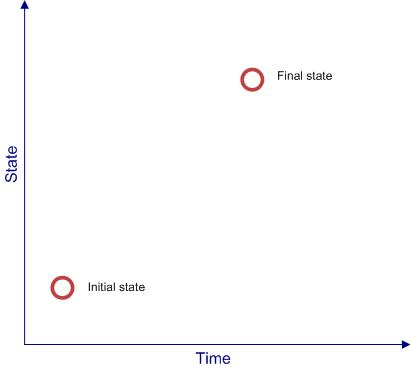
Figure 1: Initial and final states of change.
Now imagine that the powers that be have decided that the organisation needs to change. Further, let’s imagine (…and this is hard) that they have good advisors who know what the organisation should look like after the change. This tells us the position of the final state along the vertical axis.
To plot the final state of the organisation on our grid we also need to fix its position along the horizontal (time) dimension- that is, we need to know by when the change will be implemented. The powers that be are so delighted by the consultants’ advice that they want the changes to be rolled out asap (sound familiar?). Plucking a deadline out of thin air, they decree it must be done by within a certain fixed (short!) period of time.
The end state of the organisation is thus represented by the point marked as the final state in Figure 1.
Let’s now consider some of the paths that by which the organisation can get from initial to the final state. Figure 2 shows some possible change paths – a concave curve (top), a straight line (middle) and a convex curve (bottom).
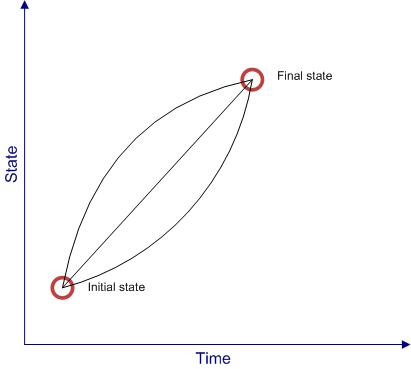
Figure 2: Three change paths
Insofar as this discussion is concerned, the important difference between these three curves is that each them describes a different “rate of change of change.” This is a rather clumsy and confusing term because the word change is used in two different senses. To simplify matters and avoid confusion, I will henceforth refer to it as the velocity of organisational change or simply, the velocity of change. The important point to note is that the velocity of change at any point along a change path is given by the steepness of the curve at that point.
Now for the paths shown in Figure 2:
- The concave path describes a situation in which the velocity of change is greatest at the start and then decreases as time goes on (i.e. the path is steepest at the start and then flattens out)
- The straight line path describes a situation in which the velocity of change is constant (i.e. the steepness is constant)
- The convex path describes a situation in which the velocity of change is smallest at the start and then increases with time. (i.e. the path starts out flat and then becomes steeper as the end state is approached)
To keep things simple I’ll assume that the change in our fictitious organisation happens at a constant velocity – i.e it can be described by the straight line. This is an oversimplification, of course, but not one that materially affects the conclusion.
What is clear is that by mandating the end date, the powers be have committed the organisation to a particular velocity of change. The key question is whether the required velocity is achievable and, more important, sustainable over the entire period in which the change is to be implemented.
An achievable and sustainable change velocity
Figuring out an achievable and sustainable velocity of change is no easy matter. It requires a deep understanding of how the organisation works at a detailed level. This knowledge is held by key people who work at the coalface of the organisation, and it is only by identifying and talking to them that management can get a good understanding of how long their proposed changes may take to implement and thus the actual path (i.e. curve) from the initial to the final state. Problem is, this is rarely done.
The foregoing discussion suggests a rather obvious way to address the issue –reduce the velocity of change or, to put it in simple terms, slow the pace of change. There are two benefits that come from doing this:
- First, the obvious one – a slower pace means that it is less likely that people will be overwhelmed by the work involved in making the change happen.
- The organisation can make changes incrementally, observe its effects and decide on next steps based on actual observations rather than wishful thinking.
- The organisation has enough time to absorb and digest the changes before the next instalment comes through. Implementing changes too fast will only result in organisational indigestion.
Problem is, the only way to do this is to allow a longer time for the change to be implemented (see Figure 3). The longer the time allotted, the lower the velocity of change (or steepness) and the more likely it is that the velocity will be achievable and sustainable.

Figure 3: Increasing allotted time reduces change velocity
Of course, there is nothing radical or new about this, It is intuitively obvious that the more time one allows for a change to be implemented, the more likely it is to be successful. Proponents of iterative and incremental change have been saying this for years – Barbara Czarniawska’s wonderful book, A Theory of Organizing, for example.
Summarising
Many well-intentioned organisational change initiatives fail because they are implemented in too short a time. When changes are implemented are too fast, there is no time to reflect on what’s happening and/or fix problems. The way to avoid this is clear: slow down. As in a real journey, this will give you time to appreciate the scenery and, more important, you’ll be better placed to deal with unforeseen events and hazards.


 Eight to Late