Archive for the ‘Organizations’ Category
A thin veneer of process
Some time back I published a post arguing that much of the knowledge relating to organizational practices is tacit – i.e. it is impossible to capture in writing or speech. Consequently, best practices and standards that purportedly codify “best of breed” organizational practices are necessarily incomplete: they do not (and cannot) detail how a practice should be internalised and implemented in specific situations.
For a best practice to be successful, it has to be understood and moulded in a way that makes sense in the working culture and environment of the implementing organisation. One might refer to this process as “adaptation” or “customization”, but it is much more than minor tweaking of a standard process or practice. Tacit knowledge relates to the process of learning, or getting to know. This necessarily differs from individual to individual, and can’t be picked up by reading best practice manuals. Building tacit knowledge takes time and, therefore, so does the establishment of new organizational processes. Consequently, there is a lot of individual on-the-job learning and tinkering before a newly instituted procedure becomes an organizational practice.
This highlights a gap between how practices are implemented and how they actually work. All too often, an organisation will institute a project to implement a best practice – say a quality management methodology – and declare success as soon as the project is completed. Such a declaration is premature because the new practice is yet to take root in the organisation. This common approach to best practice implementation does not allow enough time for the learning and dialogue that is so necessary for the establishment of an organizational practice. The practice remains “a thin veneer of process” that peels off all too easily.
Yet, despite the fact that it does not work, the project-oriented approach remains popular. Why is this so? I believe this happens because decision-makers view the implementation of best practices as a purely technical problem – practices are seen as procedures that can be grafted upon the organization without due regard to culture or context and environment or ethics. When culture, context and people are considered as incidental, practices are reduced to their mechanical (or bureaucratic) elements – those that can be captured in documents, workflow diagrams and forms. These elements are tangible so implementers can point to these as “proof” that the processes have been implemented.
Hence the manager who says: “We have rolled out our new project management system and all users have undergone training. The implementation of the new methodology has been completed. ”
Sorry, but it has just begun. Success – if it comes at all – will take a lot more time and effort.
So how should best practice implementations be approached?
It should be clear that a successful implementation cannot come from a cookbook approach that follows textbook or consultant “recipes.” Rather, it involves the following:
- Extensive adaptation of techniques to suit the context and environment of the organisation.
- Involvement of the people who will work with and be affected the processes. This often goes under the banner of “buy-in”, but it is more than that: these people must have a say in what adaptations are made and how they are made. But even before they do that, they must be allowed to play with the process – to tinker – so that they can improve their understanding of its intent and working.
- An understanding that the process is not cast in stone – that it must be modified as employees gain insights into how the process can be improved.
All these elements tie into the idea that practices and procedures involve tacit knowledge that sits in people’s heads. The visible, or explicit, aspects – which are often mistaken for the practice – are but a thin veneer of process.
So, in conclusion, the technical implementation of a best practice is only the beginning – it is the start of the real work of internalizing the practice through learning required to sustain and support it.
What is the make of that car? A tale about tacit knowledge
My son’s fascination with cars started early: the first word he uttered wasn’t “Mama” or “Dada”, it was “Brrrm.”
His interest grew with him; one of the first games we played together as a family was “What’s the make of that car?” – where his mum or I would challenge him to identify the make of a car that had just overtaken us when we were out driving. The first few times we’d have to tell him what a particular car was (he couldn’t read yet), but soon enough he had a pretty good database in his little head. Exchanges like the following became pretty common:
“So what’s that one Rohan?”
“Mitsubishi Magna, Dad”
“Are you sure?”
“Yes, it is Mitsubishi,” he’d assert, affronted that I would dare question his ability to identify cars.
He was sometimes wrong about the model (and his mum would order me not to make an issue of it). More often than not, though, he’d be right. Neither his mum nor I are car enthusiasts, so we just assumed he figured it out from the logo and / or the letters inscribing the make on the boot.
Then one day we asked him to identify a car that was much too far away for him to be able to see letters or logos. Needless to say, he got it right…
Astounded, I asked, “Did you see the logo when the car passed us?”
“No Dad”
“How did you know then?”
“From the shapes, of course?” As though it were the most obvious thing in the world.
“What shapes?” I was truly flummoxed.
“All cars have different shaped lights and bumpers and stuff.” To his credit, he refrained from saying, didn’t you know that.
“Ah, I see…”
But I didn’t really. Somehow Rohan had intuitively figured out that specific makes and models have unique tail-light, boot and bumper designs. He understood, or knew, car makes and models in a completely different way than we did – his knowledge of cars was qualitatively different from ours.
(I should make it clear that he picked up this particular skill because he enjoys learning about cars; he is, therefore, intrinsically motivated to learn about them. In most other areas his abilities are pretty much in line with kids his age)
—
Of course, the cognoscenti are well aware that cars can be identified by their appearance. I wasn’t, and neither was my dear wife. Those who know cars can identify the make (and even the model) from a mere glance. Moreover, they can’t tell you exactly how they know, they just know – and more often than not they’re right.
This incident came back to me recently, as I was reading Michael Polanyi’s book, The Tacit Dimension, wherein he explains his concept of tacit knowledge (which differs considerably from what it has come to mean in mainstream knowledge management). The basic idea is that we know more than we can tell; that a significant part of our knowledge cannot be conveyed to others via speech or writing. At times we may catch a glimpse of it when the right questions are asked in the right context, but this almost always happens by accident rather than plan. We have to live with the fact that it is impossible for me to understand something you know in the same way that you do. You could explain it to me, I could even practice it under your guidance, but my understanding of it will never be the same as yours.
My point is this: we do not and cannot fully comprehend how others understand and know things, except through fortuitous occurrences. If this is true for a relatively simple matter like car makes and models, what implications does it have for more complex issues that organisations deal with everyday? For example: can we really understand a best practice in the way that folks in the originating organisation do? More generally, are our present methods of capturing and sharing insights (aka Knowledge Management) effective?
Pathways to folly: a brief foray into non-knowledge
One of the assumptions of managerial practice is that organisational knowledge is based on valid data. Of course, knowledge is more than just data. The steps from data to knowledge and beyond are described in the much used (and misused) data-information-knowledge-wisdom (DIKW) hierarchy. The model organises the aforementioned elements in a “knowledge pyramid” as shown in Figure 1. The basic idea is that data, when organised in a way that makes contextual sense, equates to information which, when understood and assimilated, leads to knowledge which then, finally, after much cogitation and reflection, may lead to wisdom.
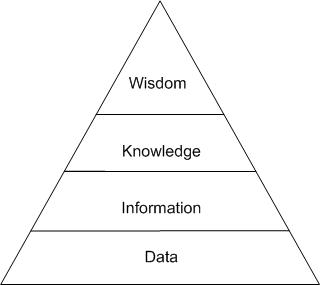
Figure 1: Data-Information-Knowledge-Wisdom (DIKW) Pyramid
In this post, I explore “evil twins” of the DIKW framework: hierarchical models of non-knowledge. My discussion is based on a paper by Jay Bernstein, with some extrapolations of my own. My aim is to illustrate (in a not-so-serious way) that there are many more managerial pathways to ignorance and folly than there are to knowledge and wisdom.
I’ll start with a quote from the paper. Bernstein states that:
Looking at the way DIKW decomposes a sequence of levels surrounding knowledge invites us to wonder if an analogous sequence of stages surrounds ignorance, and where associated phenomena like credulity and misinformation fit.
Accordingly he starts his argument by noting opposites for each term in the DIKW hierarchy. These are listed in the table below:
| DIKW term | Opposite |
| Data | Incorrect data, Falsehood, Missing data, |
| Information | Misinformation, Disinformation, Guesswork, |
| Knowledge | Delusion, Unawareness, Ignorance |
| Wisdom | Folly |
This is not an exhaustive list of antonyms – only a few terms that make sense in the context of an “evil twin” of DIKW are listed. It should also be noted that I have added some antonyms that Bernstein does not mention. In the remainder of this post, I will focus on discussing the possible relationships between these terms that are opposites of those that appear in the DIKW model.
The first thing to note is that there is generally more than one antonym for each element of the DIKW hierarchy. Further, every antonym has a different meaning from others. For example – the absence of data is different from incorrect data which in turn is different from a deliberate falsehood. This is no surprise – it is simply a manifestation of the principle that there are many more ways to get things wrong than there are to get them right.
An implication of the above is that there can be more than one road to folly depending on how one gets things wrong. Before we discuss these, it is best to nail down the meanings of some of the words listed above (in the sense in which they are used in this article):
Misinformation – information that is incorrect or inaccurate
Disinformation – information that is deliberately manipulated to mislead.
Delusion – false belief.
Unawareness – the state of not being fully cognisant of the facts.
Ignorance – a lack of knowledge.
Folly – foolishness, lack of understanding or sense.
The meanings of the other words in the table are clear enough and need no elaboration.
Meanings clarified, we can now look at the some of the “pyramids of folly” that can be constructed from the opposites listed in the table.
Let’s start with incorrect data. Data that is incorrect will mislead, hence resulting in misinformation. Misinformed people end up with false beliefs – i.e. they are deluded. These beliefs can cause them to make foolish decisions that betray a lack of understanding or sense. This gives us the pyramid of delusion shown in Figure 2.

Figure 2: A pyramid of delusion
Similarly, Figure 3 shows a pyramid of unawareness that arises from falsehoods and Figure 4, a pyramid of ignorance that results from missing data.

Figure 3: A pyramid of unawareness
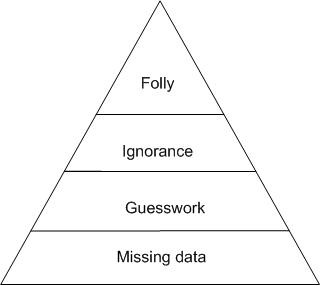
Figure 4: A pyramid of ignorance
Figures 2 through 4 are distinct pathways to folly. I reckon many of my readers would have seen examples of these in real life situations. (Tragically, many managers who traverse these pathways are unaware that they are doing so. This may be a manifestation of the Dunning-Kruger effect.)
There’s more though – one can get things wrong at higher level independent of whether or not the lower levels are done right. For example, one can draw the wrong conclusions from (correct) data. This would result in the pyramid shown in Figure 5.

Figure 5: Yet another pyramid of delusion
Finally, I should mention that it’s even worse: since we are talking about non-knowledge, anything goes. Folly needs no effort whatsoever, it can be achieved without any data, information or knowledge (or their opposites). Indeed, one can play endlessly with antonyms and near-antonyms of the DIKW terms (including those not listed here) and come up with a plethora of pyramids, each denoting a possible pathway to folly.


 Eight to Late