Archive for the ‘Organizations’ Category
Uncertainty, ambiguity and the art of decision making
A common myth about decision making in organisations is that it is, by and large, a rational process. The term rational refers to decision-making methods that are based on the following broad steps:
- Identify available options.
- Develop criteria for rating options.
- Rate options according to criteria developed.
- Select the top-ranked option.
Although this appears to be a logical way to proceed it is often difficult to put into practice, primarily because of uncertainty about matters relating to the decision.
Uncertainty can manifest itself in a variety of ways: one could be uncertain about facts, the available options, decision criteria or even one’s own preferences for options.
In this post, I discuss the role of uncertainty in decision making and, more importantly, how one can make well-informed decisions in such situations.
A bit about uncertainty
It is ironic that the term uncertainty is itself vague when used in the context of decision making. There are at least five distinct senses in which it is used:
- Uncertainty about decision options.
- Uncertainty about one’s preferences for options.
- Uncertainty about what criteria are relevant to evaluating the options.
- Uncertainty about what data is needed (data relevance).
- Uncertainty about the data itself (data accuracy).
Each of these is qualitatively different: uncertainty about data accuracy (item 5 above) is very different from uncertainty regarding decision options (item 1). The former can potentially be dealt with using statistics whereas the latter entails learning more about the decision problem and its context, ideally from different perspectives. Put another way, the item 5 is essentially a technical matter whereas item 1 is a deeper issue that may have social, political and – as we shall see – even behavioural dimensions. It is therefore reasonable to expect that the two situations call for vastly different approaches.
Quantifiable uncertainty
A common problem in project management is the estimation of task durations. In this case, what’s requested is a “best guess” time (in hours or days) it will take to complete a task. Many project schedules represent task durations by point estimates, i.e. by single numbers. The Gantt Chart shown in Figure 1 is a common example. In it, each task duration is represented by its expected duration. This is misleading because the single number conveys a sense of certainty that is unwarranted. It is far more accurate, not to mention safer, to quote a range of possible durations.

Figure 1: Gantt Chart (courtesy Wikimedia)
In general, quantifiable uncertainties, such as those conveyed in estimates, should always be quoted as ranges – something along the following lines: task A may take anywhere between 2 and 8 days, with a most likely completion time of 4 days (Figure 2).

Figure 2: Task completion likelihood (3 point estimates)
In this example, aside from stating that the task will finish sometime between 2 and 4 days, the estimator implicitly asserts that the likelihood of finishing before 2 days or after 8 days is zero. Moreover, she also implies that some completion times are more likely than others. Although it may be difficult to quantify the likelihood exactly, one can begin by making simple (linear!) approximations as shown in Figure 3.
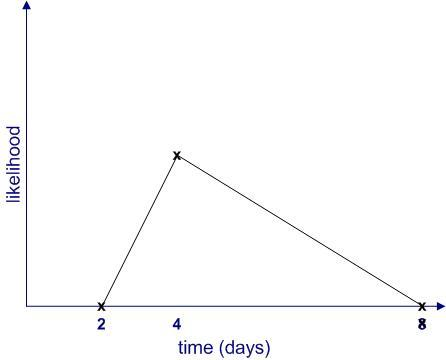
Figure 3: Simple probability distribution based on the estimates in Fig 2
The key takeaway from the above is that quantifiable uncertainties are shapes rather than single numbers. See this post and this one for details for how far this kind of reasoning can take you. That said, one should always be aware of the assumptions underlying the approximations. Failure to do so can be hazardous to the credibility of estimators!
Although I haven’t explicitly said so, estimation as described above has a subjective element. Among other things, the quality of an estimate depends on the judgement and experience of the estimator. As such, it is prone to being affected by errors of judgement and cognitive biases. However, provided one keeps those caveats in mind, the probability-based approach described above is suited to situations in which uncertainties are quantifiable, at least in principle. That said, let’s move on to more complex situations in which uncertainties defy quantification.
Introducing ambiguity
The economist Frank Knight was possibly the first person to draw the distinction between quantifiable and unquantifiable uncertainties. To make things really confusing, he called the former risk and the latter uncertainty. In his doctoral thesis, published in 1921, wrote:
…it will appear that a measurable uncertainty, or “risk” proper, as we shall call the term, is so far different from an unmeasurable one that it is not in effect an uncertainty at all. We shall accordingly restrict the term “uncertainty” to cases of the non-quantitative type (p.20)
Terminology has moved on since Knight’s time, the term uncertainty means lots of different things, depending on context. In this piece, we’ll use the term uncertainty to refer to quantifiable uncertainty (as in the task estimate of the previous section) and use ambiguity to refer to non–quantifiable uncertainty. In essence, then, we’ll use the term uncertainty for situations where we know what we’re measuring (i.e. the facts) but are uncertain about its numerical or categorical values whereas we’ll use the word ambiguity to refer to situations in which we are uncertain about what the facts are or which facts are relevant.
As a test of understanding, you may want to classify each of the five points made in the second section of this post as either uncertain or ambiguous (Answers below)
Answer: 1 through 4 are ambiguous and 5 is uncertain.
How ambiguity manifests itself in decision problems
The distinction between uncertainty and ambiguity points to a problem with quantitative decision-making techniques such as cost-benefit analysis, multicriteria decision making methods or analytic hierarchy process. All these methods assume that decision makers are aware of all the available options, their preferences for them, the relevant evaluation criteria and the data needed. This is almost never the case for consequential decisions. To see why, let’s take a closer look at the different ways in which ambiguity can play out in the rational decision making process mentioned at the start of this article.
- The first step in the process is to identify available options. In the real world, however, options often cannot be enumerated or articulated fully. Furthermore, as options are articulated and explored, new options and sub-options tend to emerge. This is particularly true if the options depend on how future events unfold.
- The second step is to develop criteria for rating options. As anyone who has been involved in deciding on a contentious issue will confirm, it is extremely difficult to agree on a set of decision criteria for issues that affect different stakeholders in different ways. Building a new road might improve commute times for one set of stakeholders but result in increased traffic in a residential area for others. The two criteria will be seen very differently by the two groups. In this case, it is very difficult for the two groups to agree on the relative importance of the criteria or even their legitimacy. Indeed, what constitutes a legitimate criterion is a matter of opinion.
- The third step is to rate options. The problem here is that real-world options often cannot be quantified or rated in a meaningful way. Many of life’s dilemmas fall into this category. For example, a decision to accept or decline a job offer is rarely made on the basis of material gain alone. Moreover, even where ratings are possible, they can be highly subjective. For example, when considering a job offer, one candidate may give more importance to financial matters whereas another might consider lifestyle-related matters (flexi-hours, commuting distance etc.) to be paramount. Another complication here is that there may not be enough information to settle the matter conclusively. As an example, investment decisions are often made on the basis of quantitative information that is based on questionable assumptions.
A key consequence of the above is that such ambiguous decision problems are socially complex – i.e. different stakeholders could have wildly different perspectives on the problem itself. One could say the ambiguity experienced by an individual is compounded by the group.
Before going on I should point out that acute versions of such ambiguous decision problems go by many different names in the management literature. For example:
- Horst Rittel called them wicked problems..
- Russell Ackoff referred to them as messes.
- Herbert Simon labelled them non-programmable problems.
All these terms are more or less synonymous: the root cause of the difficulty in every case is ambiguity (or unquantifiable uncertainty), which prevents a clear formulation of the problem.
Social complexity is hard enough to tackle as it is, but there’s another issue that makes things even harder: ambiguity invariably triggers negative emotions such as fear and anxiety in individuals who make up the group. Studies in neuroscience have shown that in contrast to uncertainty, which evokes logical responses in people, ambiguity tends to stir up negative emotions while simultaneously suppressing the ability to think logically. One can see this playing out in a group that is debating a contentious decision: stakeholders tend to get worked up over issues that touch on their values and identities, and this seems to limit their ability to look at the situation objectively.
Tackling ambiguity
Summarising the discussion thus far: rational decision making approaches are based on the assumption that stakeholders have a shared understanding of the decision problem as well as the facts and assumptions around it. These conditions are clearly violated in the case of ambiguous decision problems. Therefore, when confronted with a decision problem that has even a hint of ambiguity, the first order of the day is to help the group reach a shared understanding of the problem. This is essentially an exercise in sensemaking, the art of collaborative problem formulation. However, this is far from straightforward because ambiguity tends to evoke negative emotions and attendant defensive behaviours.
The upshot of all this is that any approach to tackle ambiguity must begin by taking the concerns of individual stakeholders seriously. Unless this is done, it will be impossible for the group to coalesce around a consensus decision. Indeed, ambiguity-laden decisions in organisations invariably fail when they overlook concerns of specific stakeholder groups. The high failure rate of organisational change initiatives (60-70% according to this Deloitte report) is largely attributable to this point
There are a number of techniques that one can use to gather and synthesise diverse stakeholder viewpoints and thus reach a shared understanding of a complex or ambiguous problem. These techniques are often referred to as problem structuring methods (PSMs). I won’t go into these in detail here; for an example check out Paul Culmsee’s articles on dialogue mapping and Barry Johnson’s introduction to polarity management. There are many more techniques in the PSM stable. All of them are intended to help a group reconcile different viewpoints and thus reach a common basis from which one can proceed to the next step (i.e., make a decision on what should be done). In other words, these techniques help reduce ambiguity.
But there’s more to it than a bunch of techniques. The main challenge is to create a holding environment that enables such techniques to work. I am sure readers have been involved in a meeting or situation where the outcome seems predetermined by management or has been undermined by self- interest. When stakeholders sense this, no amount of problem structuring is going to help. In such situations one needs to first create the conditions for open dialogue to occur. This is precisely what a holding environment provides.
Creating such a holding environment is difficult in today’s corporate world, but not impossible. Note that this is not an idealist’s call for an organisational utopia. Rather, it involves the application of a practical set of tools that address the diverse, emotion-laden reactions that people often have when confronted with ambiguity. It would take me too far afield to discuss PSMs and holding environments any further here. To find out more, check out my papers on holding environments and dialogue mapping in enterprise IT projects, and (for a lot more) the Heretic’s Guides that I co-wrote with Paul Culmsee.
The point is simply this: in an ambiguous situation, a good decision – whatever it might be – is most likely to be reached by a consultative process that synthesises diverse viewpoints rather than by an individual or a clique. However, genuine participation (the hallmark of a holding environment) in such a process will occur only after participants’ fears have been addressed.
Wrapping up
Standard approaches to decision making exhort managers and executives to begin with facts, and if none are available, to gather them diligently prior to making a decision. However, most real-life decisions are fraught with uncertainty so it may be best to begin with what one doesn’t know, and figure out how to make the possible decision under those “constraints of ignorance.” In this post I’ve attempted to outline what such an approach would entail. The key point is to figure out the kind uncertainty one is dealing with and choosing an approach that works for it. I’d argue that most decision making debacles stem from a failure to appreciate this point.
Of course, there’s a lot more to this approach than I can cover in the span of a post, but that’s a story for another time.
Note: This post is written as an introduction to the Data and Decision Making subject that is part of the core curriculum of the Master of Data Science and Innovation program at UTS. I’m co-teaching the subject in Autumn 2018 with Rory Angus and Alex Scriven.
The law of requisite variety and its implications for enterprise IT
Introduction
There are two facets to the operation of IT systems and processes in organisations: governance, the standards and regulations associated with a system or process; and execution, which relates to steering the actual work of the system or process in specific situations.
An example might help clarify the difference:
The purpose of project management is to keep projects on track. There are two aspects to this: one pertaining to the project management office (PMO) which is responsible for standards and regulations associated with managing projects in general, and the other relating to the day-to-day work of steering a particular project. The two sometimes work at cross-purposes. For example, successful project managers know that much of their work is about navigate their projects through the potentially treacherous terrain of their organisations, an activity that sometimes necessitates working around, or even breaking, rules set by the PMO.
Governance and steering share a common etymological root: the word kybernetes, which means steersman in Greek. It also happens to be the root word of Cybernetics which is the science of regulation or control. In this post, I apply a key principle of cybernetics to a couple of areas of enterprise IT.
Cybernetic systems
An oft quoted example of a cybernetic system is a thermostat, a device that regulates temperature based on inputs from the environment. Most cybernetic systems are way more complicated than a thermostat. Indeed, some argue that the Earth is a huge cybernetic system. A smaller scale example is a system consisting of a car + driver wherein a driver responds to changes in the environment thereby controlling the motion of the car.
Cybernetic systems vary widely not just in size, but also in complexity. A thermostat is concerned only the ambient temperature whereas the driver in a car has to worry about a lot more (e.g. the weather, traffic, the condition of the road, kids squabbling in the back-seat etc.). In general, the more complex the system and its processes, the larger the number of variables that are associated with it. Put another way, complex systems must be able to deal with a greater variety of disturbances than simple systems.
The law of requisite variety
It turns out there is a fundamental principle – the law of requisite variety– that governs the capacity of a system to respond to changes in its environment. The law is a quantitative statement about the different types of responses that a system needs to have in order to deal with the range of disturbances it might experience.
According to this paper, the law of requisite variety asserts that:
The larger the variety of actions available to a control system, the larger the variety of perturbations it is able to compensate.
Mathematically:
V(E) > V(D) – V(R) – K
Where V represents variety, E represents the essential variable(s) to be controlled, D represents the disturbance, R the regulation and K the passive capacity of the system to absorb shocks. The terms are explained in brief below:
V(E) represents the set of desired outcomes for the controlled environmental variable: desired temperature range in the case of the thermostat, successful outcomes (i.e. projects delivered on time and within budget) in the case of a project management office.
V(D) represents the variety of disturbances the system can be subjected to (the ways in which the temperature can change, the external and internal forces on a project)
V(R) represents the various ways in which a disturbance can be regulated (the regulator in a thermostat, the project tracking and corrective mechanisms prescribed by the PMO)
K represents the buffering capacity of the system – i.e. stored capacity to deal with unexpected disturbances.
I won’t say any more about the law of requisite variety as it would take me to far afield; the interested and technically minded reader is referred to the link above or this paper for more.
Implications for enterprise IT
In plain English, the law of requisite variety states that only “variety can absorb variety.” As stated by Anthony Hodgson in an essay in this book, the law of requisite variety:
…leads to the somewhat counterintuitive observation that the regulator must have a sufficiently large variety of actions in order to ensure a sufficiently small variety of outcomes in the essential variables E. This principle has important implications for practical situations: since the variety of perturbations a system can potentially be confronted with is unlimited, we should always try maximize its internal variety (or diversity), so as to be optimally prepared for any foreseeable or unforeseeable contingency.
This is entirely consistent with our intuitive expectation that the best way to deal with the unexpected is to have a range of tools and approaches at ones disposal.
In the remainder of this piece, I’ll focus on the implications of the law for an issue that is high on the list of many corporate IT departments: the standardization of IT systems and/or processes.
The main rationale behind standardizing an IT process is to handle all possible demands (or use cases) via a small number of predefined responses. When put this way, the connection to the law of requisite variety is clear: a request made upon a function such as a service desk or project management office (PMO) is a disturbance and the way they regulate or respond to it determines the outcome.
Requisite variety and the service desk
A service desk is a good example of a system that can be standardized. Although users may initially complain about having to log a ticket instead of calling Nathan directly, in time they get used to it, and may even start to see the benefits…particularly when Nathan goes on vacation.
The law of requisite variety tells us successful standardization requires that all possible demands made on the system be known and regulated by the V(R) term in the equation above. In case of a service desk this is dealt with by a hierarchy of support levels. 1st level support deals with routine calls (incidents and service requests in ITIL terminology) such as system access and simple troubleshooting. Calls that cannot be handled by this tier are escalated to the 2nd and 3rd levels as needed. The assumption here is that, between them, the three support tiers should be able to handle majority of calls.
Slack (the K term) relates to unexploited capacity. Although needed in order to deal with unexpected surges in demand, slack is expensive to carry when one doesn’t need it. Given this, it makes sense to incorporate such scenarios into the repertoire of the standard system responses (i.e the V(R) term) whenever possible. One way to do this is to anticipate surges in demand and hire temporary staff to handle them. Another way is to deal with infrequent scenarios outside the system- i.e. deem them out of scope for the service desk.
Service desk standardization is thus relatively straightforward to achieve provided:
- The kinds of calls that come in are largely predictable.
- The work can be routinized.
- All non-routine work – such as an application enhancement request or a demand for a new system- is dealt with outside the system via (say) a change management process.
All this will be quite unsurprising and obvious to folks working in corporate IT. Now let’s see what happens when we apply the law to a more complex system.
Requisite variety and the PMO
Many corporate IT leaders see the establishment of a PMO as a way to control costs and increase efficiency of project planning and execution. PMOs attempt to do this by putting in place governance mechanisms. The underlying cause-effect assumption is that if appropriate rules and regulations are put in place, project execution will necessarily improve. Although this sounds reasonable, it often does not work in practice: according to this article, a significant fraction of PMOs fail to deliver on the promise of improved project performance. Consider the following points quoted directly from the article:
- “50% of project management offices close within 3 years (Association for Project Mgmt)”
- “Since 2008, the correlated PMO implementation failure rate is over 50% (Gartner Project Manager 2014)”
- “Only a third of all projects were successfully completed on time and on budget over the past year (Standish Group’s CHAOS report)”
- “68% of stakeholders perceive their PMOs to be bureaucratic (2013 Gartner PPM Summit)”
- “Only 40% of projects met schedule, budget and quality goals (IBM Change Management Survey of 1500 execs)”
The article goes on to point out that the main reason for the statistics above is that there is a gap between what a PMO does and what the business expects it to do. For example, according to the Gartner review quoted in the article over 60% of the stakeholders surveyed believe their PMOs are overly bureaucratic. I can’t vouch for the veracity of the numbers here as I cannot find the original paper. Nevertheless, anecdotal evidence (via various articles and informal conversations) suggests that a significant number of PMOs fail.
There is a curious contradiction between the case of the service desk and that of the PMO. In the former, process and methodology seem to work whereas in the latter they don’t.
Why?
The answer, as you might suspect, has to do with variety. Projects and service requests are very different beasts. Among other things, they differ in:
- Duration: A project typically goes over many months whereas a service request has a lifetime of days,
- Technical complexity: A project involves many (initially ill-defined) technical tasks that have to be coordinated and whose outputs have to be integrated. A service request typically consists one (or a small number) of well-defined tasks.
- Social complexity: A project involves many stakeholder groups, with diverse interests and opinions. A service request typically involves considerably fewer stakeholders, with limited conflicts of opinions/interests.
It is not hard to see that these differences increase variety in projects compared to service requests. The reason that standardization (usually) works for service desks but (often) fails for PMOs is that the PMOs are subjected a greater variety of disturbances than service desks.
The key point is that the increased variety in the case of the PMO precludes standardisation. As the law of requisite variety tells us, there are two ways to deal with variety: regulate it or adapt to it. Most PMOs take the regulation route, leading to over-regulation and outcomes that are less than satisfactory. This is exactly what is reflected in the complaint about PMOs being overly bureaucratic. The solution simple and obvious solution is for PMOs to be more flexible– specifically, they must be able to adapt to the ever changing demands made upon them by their organisations’ projects. In terms of the law of requisite variety, PMOs need to have the capacity to change the system response, V(R), on the fly. In practice this means recognising the uniqueness of requests by avoiding reflex, cookie cutter responses that characterise bureaucratic PMOs.
Wrapping up
The law of requisite variety is a general principle that applies to any regulated system. In this post I applied the law to two areas of enterprise IT – service management and project governance – and discussed why standardization works well for the former but less satisfactorily for the latter. Indeed, in view of the considerable differences in the duration and complexity of service requests and projects, it is unreasonable to expect that standardization will work well for both. The key takeaway from this piece is therefore a simple one: those who design IT functions should pay attention to the variety that the functions will have to cope with, and bear in mind that standardization works well only if variety is known and limited.
The Heretic’s Guide to Management – understanding ambiguity in the corporate world
I am delighted to announce that my new business book, The Heretic’s Guide to Management: The Art of Harnessing Ambiguity, is now available in e-book and print formats. The book, co-written with Paul Culmsee, is a loose sequel to our previous tome, The Heretics Guide to Best Practices.
Many reviewers liked the writing style of our first book, which combined rigour with humour. This book continues in the same vein, so if you enjoyed the first one we hope you might like this one too. The new book is half the size of the first one and I considerably less idealistic too. In terms of subject matter, I could say “Ambiguity, Teddy Bears and Fetishes” and leave it at that…but that might leave you thinking that it’s not the kind of book you would want anyone to see on your desk!
Rest assured, The Heretic’s Guide to Management is not a corporate version of Fifty Shades of Grey. Instead, it aims to delve into the complex but fascinating ways in which ambiguity affects human behaviour. More importantly, it discusses how ambiguity can be harnessed in ways that achieve positive outcomes. Most management techniques (ranging from strategic planning to operational budgeting) attempt to reduce ambiguity and thereby provide clarity. It is a profound irony of modern corporate life that they often end up doing the opposite: increasing ambiguity rather than reducing it.
On the surface, it is easy enough to understand why: organizations are complex entities so it is unreasonable to expect management models, such as those that fit neatly into a 2*2 matrix or a predetermined checklist, to work in the real world. In fact, expecting them to work as advertised is like colouring a paint-by-numbers Mona Lisa, expecting to recreate Da Vinci’s masterpiece. Ambiguity therefore invariably remains untamed, and reality reimposes itself no matter how alluring the model is.
It turns out that most of us have a deep aversion to situations that involve even a hint of ambiguity. Recent research in neuroscience has revealed the reason for this: ambiguity is processed in the parts of the brain which regulate our emotional responses. As a result, many people associate it with feelings of anxiety. When kids feel anxious, they turn to transitional objects such as teddy bears or security blankets. These objects provide them with a sense of stability when situations or events seem overwhelming. In this book, we show that as grown-ups we don’t stop using teddy bears – it is just that the teddies we use take a different, more corporate, form. Drawing on research, we discuss how management models, fads and frameworks are actually akin to teddy bears. They provide the same sense of comfort and certainty to corporate managers and minions as real teddies do to distressed kids.

A Plain Teddy
Most children usually outgrow their need for teddies as they mature and learn to cope with their childhood fears. However, if development is disrupted or arrested in some way, the transitional object can become a fetish – an object that is held on to with a pathological intensity, simply for the comfort that it offers in the face of ambiguity. The corporate reliance on simplistic solutions for the complex challenges faced is akin to little Johnny believing that everything will be OK provided he clings on to Teddy.
When this happens, the trick is finding ways to help Johnny overcome his fear of ambiguity.
Ambiguity is a primal force that drives much of our behaviour. It is typically viewed negatively, something to be avoided or to be controlled.

A Sith Teddy
The truth, however, is that ambiguity is a force that can be used in positive ways too. The Force that gave the Dark Side their power in the Star Wars movies was harnessed by the Jedi in positive ways.

A Jedi Teddy
Our book shows you how ambiguity, so common in the corporate world, can be harnessed to achieve the results you want.
The e-book is available via popular online outlets. Here are links to some:
For those who prefer paperbacks, the print version is available here.
Thanks for your support 🙂


 Eight to Late