Archive for the ‘Paper Review’ Category
The user who wasn’t there: on the role of the imagined user in design discourse
Introduction
Users should be the centre of focus on projects as they are the ultimate beneficiaries (or sufferers) of the end-product. Given this, there should be frequent dialogue between the designers/creators of a product and those who will use it. Most project managers would accept the foregoing as an uncontroversial, even obvious, statement of the way things should be done. However, there is a potentially a gap between this and reality. In a fascinating case-study-based paper entitled, The imagined user in projects: Articulating competing discourses of space and knowledge work, Chris Ivory and Neil Alderman look at how, in project work, knowledge about users is often constructed without direct user input – i.e. is inferred, or even attributed without justification. This post is an annotated summary of their paper.
The paper is based on a case-study of a project that was aimed at redesigning office space for employees in a higher education environment. The contentious choice here – as one might imagine – is the one between an open-plan and cellular (individual office-based) design. In the paper Ivory and Alderman discuss how the notion of the imagined user is used (by designers, or even by management) to justify particular design choices. To quote:
The paper builds a case for the role of the imagined user as a rhetorical device in the expression and enactment of discourses within projects. Our position stems from observations that, despite the rise and rise of user-centered and participative design, the user is most notable for his or her physical absence from the design process and that interaction with users is not one of simple knowledge-transfer, but one in which knowledge about users is constructed both with and without input from users. The creation and referencing of ‘imagined users’ is part of a persuasive process – imagined users are simplified caricatures that conveniently fit (or do not fit) the sorts of design solutions (in this case particular configurations of space) under discussion. This suggests the need to go beyond knowledge-transfer accounts of the role of the user in the design and project process and to acknowledge the social construction of imagined users in project interactions.
Users and the problem of knowledge transfer
Project management theory and practice emphasise the importance of users in projects. Users typically have a dual role: firstly, they provide input into design (through requirements) and improve the quality of design decisions; second, they test the product and validate that the project objectives have been met. It is the former process that Ivory and Alderman focus on:
Interest in user input as a corrective to poor design has led to a research focus on how best to expedite the interaction between users and designers; what might be termed a ‘knowledge transfer’ focus. This emphasises finding better ways of getting to know users’ contexts and encouraging users to maximise their understanding of what is technically and financially possible. Mechanisms identified for doing this include: user groups, usability trials, user surveys, direct user observation and, latterly, various web-based forums.
The authors contend that there are two problems with this “knowledge transfer based” approach:
- Those involved in seeking user input may view certain suggestions as being unnecessary or even undesirable. This could happen for a variety of reasons ranging from expediency to politics.
- The difficulty of capturing what the user really means is often underestimated. In particular, the difficulty of translating experience to words and the possibility of misinterpretation implies that it is difficult, if not impossible, to capture user requirements in a complete and objective manner. This is particularly true of implicit knowledge, and hence the vast literature on the problem of knowledge capture.
As a consequence, it is often easier for designers to make decisions based on their own knowledge and their perceptions of user needs. Ergo, the imagined user…
Imagined users
To understand the concept of the imagined user, let’s begin by looking at what the authors’ have to say:
The imagined user is a discursive construct, depending for its existence on the dialogue of those involved in the design process. Imagined users are conjured up in the form of vignettes and anecdotes based on personal and second-hand experience, assumptions and more or less reliable research data. The key role of the imagined user in design dialogue is to give substance and rhetorical force to competing discourses relevant to the design issues in question. Creating and drawing on imagined users effectively translates broader discourses into persuasive context-specific accounts of users and use. The design process is not just an exercise in trying to ‘get it right’; it is a forum for the expression of potentially conflicting cultural, economic, political, ideological and professional preferences.
The word ‘discursive’ refers to the idea that the imagined user emerges as a consequence of the dialogue between designers and users and designers and others. Through the course of the design discussions, a certain view of what was said (or intended to be said) by users is built-up by designers and managers, regardless of whether or not it was actually said or intended. This view is the imagined user.
In introducing the idea of the imagined user, the authors highlight the role of discourse (dialogue, discussion and conversation) in shaping the direction that a project takes. In this connection it is important to note that discourse is often used as a means to exercise power – which could be hard power (as by management decree) or soft power (as by convincing or persuading others through logic and/or rhetoric).
The role of politics
Project management research generally tends to disregard the activities and work that occurs before “a project becomes a project.” In contrast, Ivory and Alderman focus on :
“…interactions that occurred in the early planning and design phases of the project studied; the period when there was a commitment within the organisation to begin a capital project, but no firm or detailed decisions as to the precise form the project should take.”
Their point is that decisions made in these early stages can have a crucial effect on determining the subsequent course of the project. Many of these decisions are driven by politics rather than “real user” requirements. So one could even say that:
…the outcomes of projects reflect political processes and power struggles between stakeholders as much as the physical design decisions and actions of project manager.
This, I think, is a very insightful observation that may chime with the experience of project managers who have worked in politically charged environments.
The case study
The case study is based on interviews with senior management in a university department that was engaged in renovating office space for its staff. The contentious aspect of the design was the choice between an open-plan and cellular model. The initial idea was to go with an open-plan – justified on the basis of open communication being important in an academic environment – but this was later modified in the course of discussions with users. In the interviews, the authors elicited information on why the open-plan model was chosen first and then subsequently modified.
The authors analysed the interviews by grouping the points made for and against a particular design choice, and then linking these to the broader social and organisational context.
The history of the project is a bit involved so, to ensure that I get it right, I’ll quote directly from the paper:
The history of the project was long and convoluted, but centred around the perceived need to bring a split site department onto a single site, whilst improving the facilities for the teaching of its students. At an early stage, a key objective imposed by senior management of the University was for a substantial amount of open plan space to form the core of the design. Negative reaction and lobbying by user groups within the department led to an agreement for a limited number of cellular offices to be included, but nowhere near enough to guarantee each academic their own office.
The initial project proposal failed on planning grounds and the project was reconstituted through a proposal to lease commercial office space, with some re-configuration to suit educational use. This was attractive to senior management in that it enabled the project to be funded primarily out of fee revenue rather than appearing on the balance sheet as a capital expenditure.
The project sponsor drove the choice of a commercial lease and insisted on increasing the use of open plan space. He was supported by other members of the senior management team and the Estates department, which viewed the high cost of existing space as a major problem for the University. These actors had positive views of previous projects to create open plan working spaces, both for administrative functions and for research units. The case study project was the first to propose the same solution for a conventional teaching department.
The solution being pursued by the project sponsor was not universally supported amongst senior management and neither was their insistence on an open plan design. When they left the institution, just prior to the signing of contracts, the new project sponsor successfully sought additional funding to allow for an increase in the provision of cellular offices. The to-ing and fro-ing of the project process and the shifts in power within the project form the backdrop to our investigation of the discourses about academics as space users and knowledge workers.
With the description of the case study done, I now move on to the authors’ analysis of the competing positions based on their interviews.
Analysis of arguments
The arguments for open-plan
The arguments for an open-plan design can be summarised as follows:
- The rational economic choice: This argument was based on minimising cost and optimising space usage. The interesting thing about this argument is that it is framed solely in terms of an organisational view – user input, being considered irrelevant, is simply not solicited . As the authors put it: “This discourse frames the issue of space solely in organisational terms. In effect the organisation assumes a priority over, and becomes a proxy for, all users. Consequently, any need for further discussion about the user is negated – the user effectively disappears (is unimagined)..”
- The inevitability of progress argument: This argument hinges on the premise that change is inevitable. Managers who advocated this position drew upon other examples where open-plan offices were implemented, and were (presumably) successful. Such arguments deem any concerns regarding the change as irrelevant, even pointless (after all, progress is good; change is inevitable). In this case too, users are dealt with indirectly, by appealing to users in other environment who have, presumably, accepted the inevitability of progress.
- Constructing a fit between users and space: This argument focuses on presenting actual examples of situations where having an open plan was a benefit. For example, one user articulated his experience thus: “You could talk to people and my PA was sitting next to me more or less. And for the first time I could see there was an incredibly efficient way of getting things done. You can see people, you can walk over, you can get access to people, you get a lot more communication…” Typically, though, most of these descriptions referred to administrative rather than academic work. The authors suggest that such “blurring of categories of work” is sometimes used by designers to ignore input by real users – creating imagined users in the bargain. Another project sponsor mentioned how an open plan would break academic silos and encourage people to talk to each other. Again, we see a recourse to an imagined user who conforms to the stereotypical, uncommunicative academic.
Of course, real users who might disagree, present problems to those who wish to impose their own design choices. The authors discuss ways in which designers and managers seek to neutralise the opinions of such users. Some of the arguments presented included
- Resistant users lack self-knowledge: these arguments were based on the premise that users actually didn’t actually understand that open-plan offered a better working environment, and that once they did they would be fine with it.
- Resistant users are wrong: this needs no explanation!
- Resistant users are falsely claiming that they have unique requirements: This is best explained through an example. Academics might justify their claim to cellular offices because they need to concentrate on their work. Management could counter this claim by arguing that everyone, including office staff, need to concentrate, so there’s nothing special about academics.
- Resistant users are self-interested: These arguments were based on the logic that universities are there to serve students, not teacher; ergo, unreasonable demands (such as those for cellular offices) are immoral.
- Cellular offices are not used anyway! This argument was based on the observation that offices are unoccupied for 70% of the workday (presumably whilst they were teaching). So their claims to individual offices were unjustified
Basically, if one is going to take recourse to an imagined user, one has to be able to dismiss the opinions of real users!
The arguments against open-plan
The arguments against an open plan design included:
- Dismissing the claims of open-plan advocates: These hinged on arguments that advocates of open plan had weak arguments (such as “My mother used to work in an open-plan environment and she loved it”) or had personal agendas.
- Creating alternative views of how academic work is done: One such view might be that academic work is different from administrative work; it needs the peace and quiet afforded by a cellular office. Strangely, this counter-argument was not offered by any of the stakeholders. Instead, tenured academics (higher up in the hierarchy) offered the argument that contract researchers and administrators could go into open-plan because their work was “non-core” (a euphemism for “not important”). Again we see an imagined user – one engaged in “unimportant” activities.
- “People are the organisation”: This is the converse of the rational view presented in the previous section. This argument centred on the premise that the academic staff are the organisation, and that a move to open-plan would destroy employee morale, thereby destroying the organisation in the bargain. Here too there’s an implicit appeal to an imagined user – the exemplary, indispensable (tenured) academic who would be demoralised by the loss of his office and who may thus be forced to quit. Note that in this argument, other users – contract academics and support staff – are imagined as being dispensable.
The authors note that the third argument won out in the end, as they state:
The idea that morale would be damaged in an organisation dependent upon academic support made the appropriateness of open plan or cellular offices irrelevant – the organisation would cease to function effectively if its staff withdrew their support. In this way we see how resistance to the perceived threat of open plan office accommodation on the part of academic staff was manifested through the threat ‘to take their bat home’. The possibility of staff choosing to work at home, rather than occupy the new open plan space, represented too much of a risk for the project in the eyes of some senior managers…
Wrapping up
So what can we take away from this paper?
The case study highlights the use of imagined users to justify specific design views and/or decisions in a specific project. Both sides of the argument appealed to such users – stereotypes that seem plausible but might not actually exist. This strategy isn’t new, soccer moms and Howard’s battlers being two examples from political discourse.
The authors find it surprising that none of the arguments offered (by either party) invoked the example of an academic engaged in research – an imagined user who might actually need the peace and quiet offered by a cellular office! They surmise that this may be because in the present day work is considered as (primarily) interactive and social. Ultimately the case against open plan was made by not talking about academic work, but by “selling out” other staff – i.e. simple politics.
Imagined users are often generalisations or composites based on real users, but can also be convenient fictions. However, as the authors note, “Discourses that imagine the user may well fly in the face of empirical evidence or be based largely on hearsay or anecdote, rather than the results of rigorous research, but are no less effective for all that.” Those who run projects need to be aware of the power and possibility of the user who wasn’t there, because arguments that invoke imaginary users can be effective rhetorical devices to get projects moving in specific (but not always desirable!) directions.
Project management in the post-bureaucratic organisation
Introduction
Over the last two decades or so, it has been recognized that creativity and innovation tend to thrive in organisations where employees have a say in decisions that affect their work. This has lead to the notion of a post-bureaucratic organisation – an organisation in which decisions are made collectively through dialogue and consensus, and where the hierarchy is flat. Although a number of workgroups within large organizations function this way (and with some success too), a post-bureaucratic organisation is generally seen as a utopian and academic ideal; one that is unlikely to work in the real world. Those who manage organizations, departments or workgroups are generally uncomfortable with employees working autonomously, even though this might lead to the generation of novel ideas and products. This is understandable: it is ultimately the responsibility of managers to ensure that organisational or departmental goals are achieved. How else to do this but through the time-tested command and control approach to management?
In response to the question posed above, project management is often touted as a means to manage creative and innovative efforts in organisations (see some of the articles in this issue of PM Network, for example). The claim seems a reasonable one: project management (by definition) provides a means to manage collective, goal oriented endeavours. Further, many projects – especially those involving new product or software development – have a creative/innovative component. In practice, though, project management tends to be a bureaucratic affair; involving plans that must be followed, schedules that must be adhered to and regular progress reports that must be made. Even so (or perhaps, because this is so) many organizations see project management as a means to manage all creative work in a post-bureaucratic setting. Implicit in this view is the assumption that the implementation of project management processes will enable managers to control and direct creative work without any adverse side-effects. An article by Damian Hodgson entitled Project Work: The Legacy of Bureaucratic Control in the Post-Bureaucratic Organisation, explores the tensions and contradictions presented by this notion. Although the article was written a while ago (in 2003), I believe the ideas explored in it are ever more relevant today, particularly in view of the increasing projectisation of organisations and the work carried out within them. Hence my motivation to summarise and review the paper.
Background – setting the stage
To be fair, many organizations recognise that a “light hand on the rudder” is needed in order to encourage creativity and innovation. In these organisations, project management is often seen as a means to achieve this. But how well does it work in practice? Hodgson’s paper aims to provide some insight into this question via a case study of an organization in which a project-based form of management was implemented as a means to balance the requirements of creativity and control. In his words:
In response to the challenges of the post-bureaucratic form, project management has been put forward by many as a ‘tried-and-tested’ package of techniques able to cope with discontinuous work, expert labour and continuous and unpredictable change while delivering the levels of reliability and control of the traditional bureaucracy. In this article I explore some of the contradictions and tensions within a department where such a ‘hybrid’ mode of control is implemented, embodying both bureaucratic and post-bureaucratic logics. In particular, I focus upon the discursive tactics employed to sell ‘rebureaucratization’ as ‘debureaucratization’, and the complex employee responses to this initiative. I argue that the tensions evident here cast significant doubt on the feasibility of a seamless integration of bureaucracy and the post-bureaucratic [organization].
The “discursive tactics” that Hodgson mentions to are (seemingly reasonable and rational) arguments that an organization might use to “sell” the idea that the methods and approaches of project management are consistent with the ideals of a post-bureaucratic organization. An example of such an argument goes as follows: project management is routinely used to manage new product development projects, so it is eminently suited to managing creative work (Incidentally, this isn’t quite right – see this paper review for more on why)
Post bureaucracy vs. bureaucracy
Before moving on, it is worth comparing the characteristics of bureaucratic and post-bureaucratic organizations. Hodgson provides the following comparison, based on the work of Charles Hekscher:
| Bureacracy | Post-bureaucracy |
| Consensus through Acquiescence to Authority | Consensus through Institutionalized Dialogue |
| Influence based on Formal Position | Influence through Persuasion/PersonalQualities |
| Internal Trust Immaterial | High Need for Internal Trust |
| Emphasis on Rules and Regulations | Emphasis on Organizational Mission |
| Information Monopolised at Top of Hierarchy | Strategic Information shared in Organization |
| Focus on Rules for Conduct | Focus on Principles Guiding Action |
| Fixed (and Clear) Decision Making Processes | Fluid/Flexible Decision Making Processes |
| Network of Specialized FunctionalRelationships | Communal Spirit/Friendship Groupings |
| Hierarchical Appraisal | Open and Visible Peer Review Processes |
| Definite and Impermeable Boundaries | Open and Permeable Boundaries |
| Objective Rules to ensure Equity of Treatment | Broad Public Standards of Performance |
| Expectation of Constancy | Expectation of Change |
The aim of the case study is to highlight some of the inconsistencies and contradictions that result from applying a bureaucratic mechanism (project management) to manage the work of a group that was very good at doing creative work, but was used to a more free-wheeling, hands-off management style (i.e. a group which approximates the idealised post-bureaucratic environment described above).
Why project management?
Project management has its roots in classical management (ala Taylor and Fayol), so it is perhaps surprising that it is considered as a means to manage work in a post-bureaucratic setting. In Hodgson’s words:
I would argue that what distinguishes project management as of particular relevance to 21stcentury organizations is its rediscovery of a very 19th-century preoccupation with comprehensive planning, linked to a belief in the necessity of tight managerial discipline.
Project management tools and techniques support managerial discipline by providing means to decompose the project into manageable bits – by using a WBS say – and then assigning these bits to individuals (or small teams). The work assigned can then be tracked and controlled tightly – which is a good thing. If the matter rested there it wouldn’t be too bad, but very often management also prescibes how the work should be done. This level of control results in a loss of autonomy (and motivation) for team members whose job it is to do the work. The loss of motivation can have negative effects, especially in projects with a large creative component. To counter this criticism, in recent years project management has started to focus on the creative aspects of projects – what’s needed to motivate teams, how to foster creativity (in new product development work, say) etc. As Hodgson puts it,
The linking of project management and change management has increased project management’s influence across industries, such that now the largest professional organization in project management includes special interest groups in areas as diverse as healthcare, retail, media, marketing, and hospitality. As a consequence the last decade has been a time of particularly rapid expansion for project management, as issues of change, knowledge management, and constant innovation emerged as central themes in popular management discourse.
So, project management offers two (seemingly contradictory) benefits: the ability to maintain tight control of work and the ability to foster innovation and creativity:
…project management can be seen as an essentially bureaucratic system of control, based on the principles of visibility, predictability and accountability, and operationalized through the adherence to formalized procedure and constant written reporting mechanisms. At the same time, however, project management draws upon the rhetoric of empowerment, autonomy and self-reliance central… In principle, then, project management offers a system which attempts to integrate bureaucratic control and a form of responsible autonomy more in keeping with the interdisciplinary, knowledge-intensive nature of much project work in teams.
Seen in this light, it is perhaps not so surprising that project management is viewed as a means to manage creative work.
The case study
With the above background done, I now move on to a discussion of the case study. In Hodgson’s words, the study:
…focused upon a telephone bank in northern England which I have referred to under the pseudonym Buzzbank. In the late 1980s, Buzzbank had been set up by a major UK bank, which I will call TN Banking, and represented one of several success stories in the retail banking sector over this period. Through reduced overheads and the extensive use of new technology in the form of sophisticated marketing techniques and call-centre technology, Buzzbank had expanded rapidly in terms of market share and turnover, developing into a key component of TN Banking’s global operations. My interest in particular centred on Buzzbank senior management’s identification of project management as the prime ‘critical success factor’ for the organization; the development of project management expertise throughout the organization was seen as a key priority to maintain performance into the next decade. To an extent, the project teams researched could scarcely be more ‘cutting edge’, representing highly-trained ‘knowledge workers’ developing innovative high technology applications and solutions in a new sector of an enormously profitable industry
Hodgson conducted interviews and observed operations within the IT department of Buzzbank over a period of two years. During this period, the organization was implementing a “strategic plan” aimed at formalizing innovation and creative work using project management processes. The idea, in the words of a couple of senior IT managers was to “bring a level of discipline” and “bring an idea of professional structuring” to the work of the highly successful unit. The structuring and discipline was to be achieved by implementing project management processes.
The main rationale used to sell project management to the Buzzbank IT team is a familiar one: the need to ensure predictability and repeatability of work done whilst ensuring that innovation and creativity would not be impeded. Another justification offered by management was that the size of the organization (which had grown considerably in the years prior to the implementation of the strategic plan) meant that the existing “ad-hoc” work culture would no longer be successful. That is, the size of the organization necessitated a degree of formalization, ergo bureaucratic procedures had to be put in place. This was rationalised (by senior management) as a natural and inevitable consequence of growth:
…The organization was therefore portrayed by senior management in IT as approaching its ‘next stage of evolution’. The immediate benefit of such a metaphor for those members of senior management charged with rebureaucratizing the organization is that it carries a very strong sense of inevitability. As such, it casts opposition to such changes as irrational and futile, standing in the way of natural ‘evolution’.
Further, managers in the organization dubbed any employee resistance as “natural growing pains” – like those of an adolescent, say. Cast in this light, dissenting viewpoints were portrayed as natural and unavoidable – and possibly even necessary – but ultimately without any validity.
Another interesting aspect that Hodgson highlights is the way in which old practices (the successful but “bad” ones) were subsumed in the new (formal) framework. For example, in the old world, employees were given the freedom to experiment, and many considered this as a strength not a weakness. In the new world, however, such a practice was seen as a threat; it was considered more important to capture how to do things correctly so that things became repeatable (ala best practice) and experimentation would not be necessary. As one manager put it:
If we capture how we do things right, at least it makes things repeatable, and we can record the improvement required when things don’t go right, which doesn’t happen in a rapidly-expanding, gung-ho environment.
Hodgson notes that the terms rapidly-expanding and gung-ho, which are used in a negative sense, could just as well be cast in positive terms such as flexible, proactive etc. The point being that management framed the existing situation in terms that made the implementation of the new procedures seem like a logical and reasonable next step. The processes were touted as a means to achieve change (i.e. be flexible), but in a controlled way. So, management went to great lengths to avoid use of terms that would be perceived as being negative – for example, the term “structure” was used instead of “bureaucracy” or “formalization.” In this way, management attempted to assimilate the existing values of Buzzbank into the strategic plan.
So, how well did it work? Here’s what Hodgson says about the end result:
The impression given [by senior management] was that of an organizational change which was inevitable, which gave rise to some understandable but irrational resistance, and which had now been effectively completed, for the good of the organization as a whole.
On the other hand, the impression Hodgson got from speaking to lower level employees was very different:
However, in the time spent by myself in the organization, the tone and target of much of the humour, as well as much stronger reactions, appeared to throw doubt on the extent to which this discourse had permeated among the general employees, particularly within the IT department. Humour was commonplace in the everyday banter both within teams and between teams in the IT division at Buzzbank, and the increasing levels of bureaucratization was the butt of most of the humour, particularly at the lower levels of the hierarchy. The main experience of project management as reported by many Buzzbank employees was one of intensified bureaucratic surveillance…
A key example is the reaction of employees to managerial jargon that was used in company circulars and literature intended to promote the strategic plan.
Typically, comments were provoked by the circulation of literature on the strategic plan, and again, excerpts of the document were read out by members of staff, adding ironic comments to underline the gap between the document and their experience of life and work in the department.
Hodgson notes that employees often appeared to comply with the new regulations, but not in the way intended by management:
At other times, the employees appeared to comply with the formal requirements of the new system, in terms of filling in the necessary forms, reporting in at given times, completing the necessary work-logs and so on. Even here, despite the relative sophistication of senior management’s re-articulation of key discourses, compliance on the part of Buzzbank employees in many cases bore all the hallmarks of instrumental behaviour, accompanied by insubordinate statements and humour ranging from the cynical to the confrontational. At other times, assurances were given to senior management and immediately contravened, fictionalized accounts of project activities were submitted late, or else procedures were observed meticulously to the detriment of deadlines and other constraints. The emergent organizational order was a precarious negotiation between alienated compliance and an autonomous disregard for bureaucratic demands…
In short: there was a clear gap between the perceptions of management and employees as to the success of the newly implemented processes.
It is clear that Buzzbank managers saw project management as a means to control and direct creative / innovative work in a way that would have no negative effect on employee morale and motivation. The challenge, of course, lay in achieving employee buy-in. Management used many creative (!) tactics to “sell” project management to staff. These included:
- References to a “natural process of evolution” and the consequent “growing pains” that the organization would experience. This made the pain of the change natural and inevitable, but necessary in the interest of future gain.
- Manipulation of terminology to make the changes seem more palatable – e.g. using the word “structure” instead of “formalization” or “bureaucracy”.
- Co-opting terminology of post-bureaucratic organizations into literature designed to promote the new structure. For example, claiming that project management processes would enable the organization to be even more responsive to change (i.e. flexible), through change management processes.
From employees’ perspective, such techniques were plainly seen for what they were: methods to “sell the unsellable”. The negative reactions of employees were manifested through sarcastic humour and (often minor) acts of insubordination. The case study thus highlights the difficulties in using project management as a means to control work in a post-bureaucratic work environment.
Wrapping-up: reflections and summary
Hodgson sees the case study as exemplifying the problem of control vs. autonomy in emerging post-bureaucratic organizations: managers view project management as a means to address the risks inherent in post-bureaucratic work, whereas employees view it as a unnecessary and unjustified imposition. Management was looking for the “best of both worlds”, a hybrid model that incorporated the best elements of a post bureaucratic model and a traditional command and control approach. The case study casts doubt on whether such a hybrid is possible solely through the implementation standard project management techniques and processes. It does so by exposing some of the tensions and differences in perceptions that can occur when such a model is implemented.
So where does this leave managers? Is there a way to manage creative work without destroying employee morale and motivation?
Looking over the complaints of the Buzzbank employees, it is clear that most of the problems arose from the loss of autonomy that they had enjoyed prior to the implementation of the new processes. This being the case, any measure to increase autonomy should improve the situation. A couple of possibilities come to mind – both of which I have discussed in earlier pieces. These are:
- Empower employees to make decisions that affect their work. This means allowing them the freedom to decide the best approach to solving problems (within limits specified by organisational and resource constraints).
- In situations where (1) isn’t possible, one could use collaborative techniques such as dialogue mapping to achieve employee buy-in. Of course, management has to be prepared to engage in true dialogue, and be willing to act upon (reasonable) suggestions made by employees.
The key message is simple and obvious: the more of say employees have in making work-related decisions, the more engaged and motivated they’ll be. This is not just a warm and fuzzy notion, but one that is backed up by research on motivation (see this paper review, for example). Yes, this does mean letting go of the “reins of control” to an extent but it is clear, as highlighted by Hodgson’s work, that holding the reins tightly might cause more problems that it solves. What’s called for, above all, is a degree of flexibility: use project management processes by all means, but be open to employee input as to what’s working well and what’s not.
To sum up: Hodgson’s case study suggests that inflexible project management based approaches to managing creative work may not work as well as advertised by purveyors of frameworks and methodologies. As an alternative, it might be worth taking a step towards the utopian ideal of a post-bureaucratic organisation by using techniques that encourage employee input in organisational decision making.
Building project knowledge – a social constructivist view
Introduction
Conventional approaches to knowledge management on projects focus on the cognitive (or thought-related) and mechanical aspects of knowledge creation and capture. There is alternate view, one which considers knowledge as being created through interactions between people who – through their interactions – develop mutually acceptable interpretations of theories and facts in ways that suit their particular needs. That is, project knowledge is socially constructed. If this is true, then project managers need to pay attention to the environmental and social factors that influence knowledge construction. This is the position taken by Paul Jackson and Jane Klobas in their paper entitled, Building knowledge in projects: A practical application of social constructivism to information systems development, which presents a knowledge creation / sharing process model based social constructivist theory. This article is a summary and review of the paper.
A social constructivist view of knowledge
Jackson and Klobas begin with the observation that engineering disciplines are founded on the belief that knowledge can be expressed in propositions that correspond to a reality which is independent of human perception. However, there is an alternate view that knowledge is not absolute, but relative – i.e. it depends on the mental models and beliefs used to interpret facts, objects and events. A relevant example is how a software product is viewed by business users and software developers. The former group may see an application in terms of its utility whereas the latter may see it as an instance of a particular technology. Such perception gaps can also occur within seemingly homogenous groups – such as teams comprised of software developers, for example. This can happen for a variety of reasons such as the differences in the experience and cultural backgrounds of those who make up the group. Social constructivism looks at how such gaps can be bridged.
The authors’ discussion relies on the work of Berger and Luckmann, who described how the gap between perceptions of different individuals can be overcome to create a socially constructed, shared reality. The phrase “socially constructed” implies that reality (as it pertains to a project, for example) is created via a common understanding of issues, followed by mutual agreement between all the players as to what comprises that reality. For me this view strikes a particular chord because of it is akin to the stated aims of dialogue mapping, a technique that I have described in several earlier posts (see this article for an example relevant to projects).
Knowledge in information systems development as a social construct
First up, the authors make the point that information systems development (ISD) projects are:
…intensive exercises in constructing social reality through process and data modeling. These models are informed with the particular world-view of systems designers and their use of particular formal representations. In ISD projects, this operational reality is new and explicitly constructed and becomes understood and accepted through negotiated agreement between participants from the two cultures of business and IT
Essentially, knowledge emerges through interaction and discussion as the project proceeds. However, the methodologies used in design are typically founded on an engineering approach, which takes a positivist view rather than a social one. As the authors suggest,
Perhaps the social constructivist paradigm offers an insight into continuing failure, namely that what is happening in an ISD project is far more complex than the simple translation of a description of an external reality into instructions for a computer. It is the emergence and articulation of multiple, indeterminate, sometimes unconscious, sometimes ineffable realities and the negotiated achievement of a consensus of a new, agreed reality in an explicit form, such as a business or data model, which is amenable to computerization.
With this in mind, the authors aim to develop a model that addresses the shortcomings of the traditional, positivist view of knowledge in ISD projects. They do this by representing Berger and Luckmann’s theory of social constructivism in terms of a knowledge process model. They then identify management principles that map on to these processes. These principles form the basis of a survey which is used as an operational version of the process model. The operational model is then assessed by experts and tested by a project manager in a real-life project.
The knowledge creation/sharing process model
The process model that Jackson and Klobas describe is based on Berger and Luckmann’s work.
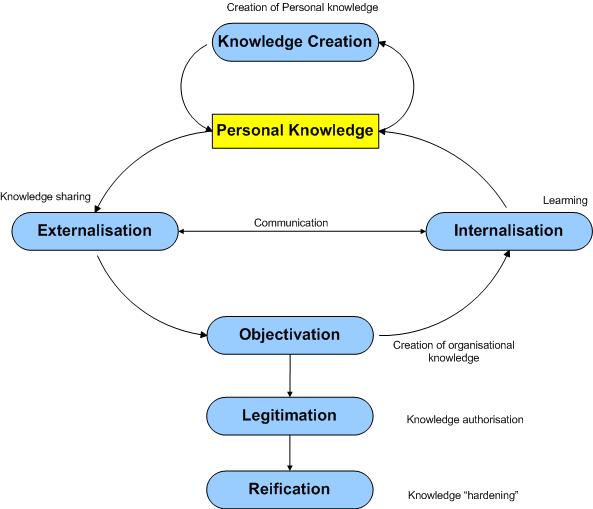
Figure 1: Knowledge creation/sharing model
The model describes how personal knowledge is created – personal knowledge being what an individual knows. Personal knowledge is built up using mental models of the world – these models are frameworks that individuals use to make sense of the world.
According to the Jackson-Klobas process model, personal knowledge is built up through a number of process including:
Internalisation: The absorption of knowledge by an individual
Knowledge creation: The construction of new knowledge through repetitive performance of tasks (learning skills) or becoming aware of new ideas, ways of thinking or frameworks. The latter corresponds to learning concepts and theories, or even new ways of perceiving the world. These correspond to a change in subjective reality for the individual.
Externalisation: The representation and description of knowledge using speech or symbols so that it can be perceived and internalized by others. Think of this as explaining ideas or procedures to other individuals.
Objectivation: The creation of a shared constructs that represent a group’s understanding of the world. At this point, knowledge is objectified – and is perceived as having an existence independent of individuals.
Legitimation: The authorization of objectified knowledge as being “correct” or “standard.”
Reification: The process by which objective knowledge assumes a status that makes it difficult to change or challenge. A familiar example of reified knowledge is any procedure or process that is “hardened” into a system – “That’s just the way things are done around here,” is a common response when such processes are challenged.
The links depicted in the figure show the relationships between these processes.
Jackson and Klobas suggest that knowledge creation in ISD projects is a social process, which occurs through continual communication between the business and IT. Sure, there are other elements of knowledge creation – design, prototyping, development, learning new skills etc. – but these amount to nought unless they are discussed, argued, agreed on and communicated through social interactions. These interactions occur in the wider context of the organization, so it is reasonable to claim that the resulting knowledge takes on a form that mirrors the social environment of the organization.
Clearly, this model of knowledge creation is very different from the usual interpretation of knowledge having an independent reality, regardless of whether it is known to the group or not.
An operational model
The above is good theory, which makes for interesting, but academic, discussions. What about practice? Can the model be operationalised? Jackson and Klobas describe an approach to creating to testing the utility (rather than the validity) of the model. I discuss this in the following sections.
Knowledge sharing heuristics
To begin with, they surveyed the literature on knowledge management to identify knowledge sharing heuristics (i.e. experience-based techniques to enable knowledge sharing). As an example, some of the heuristics associated with the externalization process were:
- We have standard documentation and modelling tools which make business requirements easy to understand
- Stakeholders and IS staff communicate regularly through direct face-to-face contact
- We use prototypes
The authors identified more than 130 heuristics. Each of these was matched with a process in the model. According to the authors, this matching process was simple: in most cases there was no doubt as to which process a heuristic should be attached to. This suggests that the model provides a natural way to organize the voluminous and complex body of research in knowledge creation and sharing. Why is this important? Well, because it suggests that the conceptual model (as illustrated in Fig. 1) can form the basis for a simple means to assess knowledge creation / sharing capabilities in their work environments, with the assurance that they have all relevant variables covered.
Validating the mapping
The validity of the matching was checked using twenty historical case studies of ISD projects. This worked as follows: explanations for what worked well and what didn’t were mapped against the model process areas (using the heuristics identified in the prior step). The aim was to answer the question: “is there a relationship between project failure and problems in the respective knowledge processes or, conversely, between project success and the presence of positive indicators?”
One of the case studies the authors use is the well-known (and possibly over-analysed) failure of the automated dispatch system for the London Ambulance Service. The paper has a succinct summary of the case study, which I reproduce below:
The London Ambulance Service (LAS) is the largest ambulance service in the world and provides accident and emergency and patient transport services to a resident population of nearly seven million people. Their ISD project was intended to produce an automated system for the dispatch of ambulances to emergencies. The existing manual system was poor, cumbersome, inefficient and relatively unreliable. The goal of the new system was to provide an efficient command and control process to overcome these deficiencies. Furthermore, the system was seen by management as an opportunity to resolve perceived issues in poor industrial relations, outmoded work practices and low resource utilization. A tender was let for development of system components including computer aided dispatch, automatic vehicle location, radio interfacing and mobile data terminals to update the status of any call-out. The tender was let to a company inexperienced in large systems delivery. Whilst the project had profound implications for work practices, personnel were hardly involved in the design of the system. Upon implementation, there were many errors in the software and infrastructure, which led to critical operational shortcomings such as the failure of calls to reach ambulances. The system lasted only a week before it was necessary to revert to the manual system.
Jackson and Klobas show how their conceptual model maps to knowledge-related factors that may have played a role in the failure project. For example, under the heading of personal knowledge, one can identify at least two potential factors: lack of involvement of end-users in design and selection of an inexperienced vendor. Further, the disconnect between management and employees suggests a couple of factors relating to reification: mutual negative perceptions and outmoded (but unchallenged) work practices.
From their validation, the authors suggest that the model provides a comprehensive framework that explains why these projects failed. That may be overstating the case – what’s cause and what’s effect is hard to tell, especially after the fact. Nonetheless, the model does seem to be able to capture many, if not all, knowledge-related gaps that could have played a role in these failures. Further, by looking at the heuristics mapped to each process, one might be able to suggest ways in which these deficiencies could have been addressed. For example, if externalization is a problem area one might suggest the use of prototypes or encourage face to face communication between IS and business personnel.
Survey-based tool
Encouraged by the above, the authors created a survey tool which was intended to evaluate knowledge creation/sharing effectiveness in project environments. In the tool, academic terms used in the model were translated into everyday language (for example, the term externalization was translated to knowledge sharing – see Fig 1 for translated terms). The tool asked project managers to evaluate their project environments against each knowledge creation process (or capability) on a scale of 1 to 10. Based on inputs, it could recommend specific improvement strategies for capabilities that were scored low. The tool was evaluated by four project managers, who used it in their work environment over a period of 4-6 weeks. At the end of the period, they were interviewed and their responses were analysed using content analysis to match their experiences and requirements against the designed intent of the tool. Unfortunately, the paper does not provide any details about the tool, so it’s difficult to say much more than paraphrase the authors comments.
Based on their evaluation, the authors conclude that the tool provides:
- A common framework for project managers to discuss issues pertaining to knowledge creation and sharing.
- A means to identify potential problems and what might be done to address them.
Field testing
One of the evaluators of the model tested the tool in the field. The tester was a project manager who wanted to identify knowledge creation/sharing deficiencies in his work environment, and ways in which these could be addressed. He answered questions based on his own evaluation of knowledge sharing capabilities in his environment and then developed an improvement plan based on strategies suggested by the tool along with some of his own ideas. The completed survey and plan were returned to the researchers.
Use of the tool revealed the following knowledge creation/sharing deficiencies in the project manager’s environment:
- Inadequate personal knowledge.
- Ineffective externalization
- Inadequate standardization (objectivation)
Strategies suggested by the tool include:
- An internet portal to promote knowledge capture and sharing. This included discussion forums, areas to capture and discuss best practices etc.
- Role playing workshops to reveal how processes worked in practice (i.e. surface tacit knowledge).
Based on the above, the authors suggest that:
- Technology can be used to promote support knowledge sharing and standardization, not just storage.
- Interventions that make tacit knowledge explicit can be helpful.
- As a side benefit, they note that the survey has raised consciousness about knowledge creation/sharing within the team.
Reflections and Conclusions
In my opinion, the value of the paper lies not in the model or the survey tool, but the conceptual framework that underpins them – namely, the idea knowledge depends on, and is shaped by, the social environment in which it evolves. Perhaps an example might help clarify what this means. Consider an organisation that decides to implement project management “best practices” as described by <fill in any of the popular methodologies here>. The wrong way to do this would be to implement practices wholesale, without regard to organizational culture, norms and pre-existing practices. Such an approach is unlikely to lead to the imposed practices taking root in the organisation. On the other hand, an approach that picks the practices that are useful and tailors these to organizational needs, constraints and culture is likely to meet with more success. The second approach works because it attempts to bridge gap between the “ideal best practice” and social reality in the organisation. It encourages employees to adapt practices in ways that make sense in the context of the organization. This invariably involves modifying practices, sometimes substantially, creating new (socially constructed!) knowledge in the bargain.
Another interesting point the authors make is that several knowledge sharing heuristics (130, I think the number was) could be classified unambiguously under one of the processes in the model. This suggests that the model is a reasonable view of the knowledge creation/sharing process. If one accepts this conclusion, then the model does indeed provide a common framework for discussing issues relating knowledge creation in project environments. Further, the associated heuristics can help identify processes that don’t work well.
I’m unable to judge the usefulness of the survey-based tool developed by the authors because they do not provide much detail about it in the paper. However, that isn’t really an issue; the field of project management has too many “tools and techniques” anyway. The key message of the paper, in my opinion, is the that every project has a unique context, and that the techniques used by others have to be interpreted and applied in ways that are meaningful in the context of the particular project. The paper is an excellent counterpoint to the methodology-oriented practice of knowledge management in projects; it should be required reading for methodologists and project managers who believe that things need to be done by The Book, regardless of social or organizational context.


 Eight to Late