Archive for the ‘portfolio management’ Category
Capturing project knowledge using issue maps
Here’s a question that’s been on my mind for a while: Why do organisations find it difficult to capture and transmit knowledge created in projects?
I’ll attempt an answer of sorts in this post and point to a solution of sorts too – taking a bit of a detour along the way, as I’m often guilty of doing…
Let us first consider how knowledge is generated on projects. In project environments, knowledge is typically created in response to a challenge faced. The challenge may be the project objective itself, in which case the knowledge created is embedded in the product or service design. On the other hand it could be a small part of the project: say, a limitation of the technology used, in which case the knowledge might correspond to a workaround discovered by a project team member. In either case, the existence of an issue or challenge is a precondition to the creation of knowledge. The project team (or a subset of it) decides on how the issue should be tackled. They do so incrementally; through exploration, trial and error and discussion – creating knowledge in the bargain.
In a nutshell: knowledge is created as project members go through a process of discovery. This process may involve the entire team (as in the first example) or a very small subset thereof (as in the second example, where the programmer may be working alone). In both cases, though, the aim is to understand the problem, explore potential solutions and find the “best” one thus creating new knowledge.
Now, from the perspective of project and organisational learning, project documentation must capture the solution and the process by which it was developed. Typically, most documentation tends to focus on the former, neglecting the latter. This is akin to presenting a solution to a high school mathematics problem without showing the intervening steps. My high school maths teacher would’ve awarded me a zero for such an effort regardless of the whether or not my answer was right. And with good reason too: the steps leading up to a solution are more important than the solution itself. Why? Because the steps illustrate the thought processes and reasoning behind the solution. So it is with project documentation. Ideally, documentation should provide the background, constraints, viewpoints, arguments and counter-arguments that go into the creation of project knowledge.
Unfortunately, it seldom does.
Why is this so? An answer can be found in a farsighted paper, entitled Designing Organizational Memory: Preserving Intellectual Assets in a Knowledge Economy, published by Jeff Conklin 1997. In the paper Conklin draws a distinction between formal and informal knowledge; terms that correspond to the end-result and the process discussed in the previous paragraph.To quote from his paper, formal knowledge is the “…stuff of books, manuals, documents and training courses…the primary work product of the knowledge worker…” Conklin notes that, “Organisations routinely capture formal knowledge; indeed, they rely on it – without much success – as their organizational memory.” On the other hand, informal knowledge is, “the knowledge that is created and used in the process of creating formal results…It includes ideas, facts, assumptions, meanings, questions, decisions, guesses, stories and points of view. It is as important in the work of the knowledge worker as formal knowledge is, but it is more ephemeral and transitory…” As a consequence, informal knowledge is elusive; it rarely makes it into documents.
Dr. Conklin lists two reasons why organisations (which includes temporary organisations such as projects) fail to capture informal knowledge. These are:
- Business culture values results over process. In his words, “One reason for the widespread failure to capture informal knowledge is that Western culture has come to value results – the output of work process – far above the process itself, and to emphasise things over relationships.”
- The tools of knowledge workers do not support the process of knowledge work – that is, most tools focus on capturing formal knowledge (the end result of knowledge work) rather than informal knowledge (how that end result was achieved – the “steps” in the solution, so to speak).
The key to creating useful documentation thus lies in capturing informal knowledge. In order to do that, this elusive form of knowledge must first be made explicit – i.e. expressible in words and pictures. Here’s where the notion of shared understanding, discussed in my previous post comes into play.
To quote again from Conklin’s paper, “One element of creating shared understanding is making informal knowledge explicit. This means surfacing key ideas, facts, assumptions, meanings, questions, decisions, guesses, stories, and points of view. It means capturing and organizing this informal knowledge so that everyone has access to it. It means changing the process of knowledge work so that the focus is on creating and managing a shared display of the group’s informal thinking and learning. The shared display is the transparent vehicle for making informal knowledge explicit.”
The notion of a shared display is central to the technique of dialogue mapping, a group facilitation technique that can help a diverse group achieve a shared understanding of a problem. Dialogue mapping uses a visual notation called IBIS (short for Issue Based Information System) to capture the issues, ideas and arguments that come up in a meeting (see my previous post for a quick introduction to dialogue mapping and a crash-course in IBIS). As far as knowledge capture is concerned, I see two distinct uses of IBIS . They are:
- As Conklin suggests, IBIS maps can be used to surface and capture informal knowledge in real-time, as it is being generated in a discussion between two or more people.
- It can also be used in situations where one person researches and finds a solution to a challenge. In this case the person could use IBIS to capture background, approaches tried, the pros and cons of each – i.e. the process by which the solution was arrived at.
This, together with the formal stuff – which most project organisations capture more than adequately – should result in documents that provide a more complete view of the knowledge generated in projects.
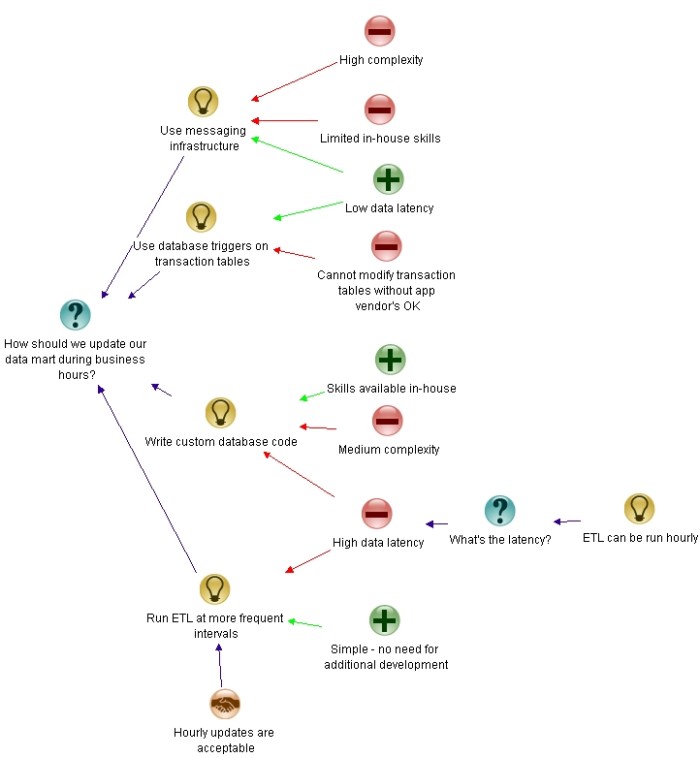
Now, in a previous post (linked above) I discussed an example of how dialogue mapping was used on a real-life project challenge: how best to implement near real-time updates to a finance data mart. The final issue map, which was constructed using a mapping tool called Compendium, is reproduced below:
Example Issue Map
The map captures not only the decisions made, but also the options discussed and the arguments for and against each of the options. As such, it captures the decision along with the context, process and rationale behind it. In other words, it captures formal and informal knowledge pertaining to the decision. In this simple case, IBIS succeeded in making informal knowledge explicit. Project teams down the line can understand why the decision was made, from both a technical and business perspective.
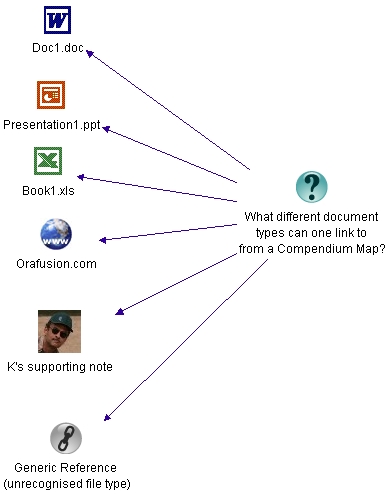
It is worth noting that Compendium maps can reference external documents via Reference Nodes, which, though less important for argumentation, are extremely useful for documentation. Here is an illustration of how references to external documents can be inserted in an IBIS map through reference node:
Links to external docs
As illustrated, this feature can be used to link out to a range of external documents – clicking on the reference node in a map (not the image above!) opens up the external document. Exploiting this, a project document can operate at two levels: the first being an IBIS map that depicts the relationships between issues, ideas and arguments, and the second being supporting documents that provide details on specific nodes or relationships. Much of the informal knowledge pertaining to the issue resides in the first level – i.e. in the relationships between nodes – and this knowledge is made explicit in the map.
To conclude, it is perhaps worth summarising the main points of this post. Projects generate new knowledge through a process in which issues and ideas are proposed, explored and trialled. Typically, most project documentation captures the outcome (formal knowledge), neglecting much of the context, background and process of discovery (informal knowledge). IBIS maps offer the possibility of capturing both aspects of knowledge, resulting in a greatly improved project (and hence organisational) memory.
Fostering cross-project learning and continuous improvement in projectised environments.
Introduction
There’s much angst and hand-wringing about how difficult it is to engender a learning environment in projectised organisations. In an earlier post I made a case for an emphasis on learning rather than efficiency in project execution. That discussion focussed on challenges around learning within a project. These challenges are magnified in the case of learning across projects. In most organisations, the responsibility for cross-project learning typically rests with the project management office (PMO) or its equivalent – whether or not it exists as a formal entity. In a paper entitled, How Project Management Office Leaders Foster Cross-Project Learning and Continuous Improvement, published in the Project Management Journal, Jerry Julian investigates how project management office leaders facilitate cross-project learning. Based on his findings, he also presents some recommendations for improving cross-project learning and foster continuous improvement. I summarise and discuss the paper below.
The paper begins with the observation that, “…project teams often start solving problems anew rather than learning from previous projects within the same organisation. This often means that the end of a project is the end of collective learning…” As they are the focal point for all project work within the organisation, PMOs are best placed to foster cross-project learning. Further, since they serve as a repository for project documentation, they are also well placed to identify potential improvements and implement these after due consideration. The paper explores how PMO leaders perceive their role in fostering learning and continuous improvement. The specific questions addressed are:
- What do PMO leaders see as their responsibilities in fostering learning and continuous improvement?
- How do they foster cross-project learning?
- What are the enablers and barriers (as perceived by them) to cross project learning and continuous improvement.
The author attempts to answer these based on data gathered from surveys and subsequently validated through focus groups. Regardless of the validity of the author’s methodology, the paper serves to inform PMO leaders about what their peers are doing to foster cross-project learning. It therefore merits attention from PMO or program/portfolio managers.
Background
One of the most common activities associated with cross-project learning is the practice of conducting project post-mortems aimed at finding out what went well and what didn’t. From his review of the literature, the author finds that although the value of such “lessons learned” sessions is widely acknowledged, many organisations fail to conduct them in practice (see this paper by Maximilian von Zedtwitz, for example). Amongst those that do, there is general dissatisfaction with the process. As Anne Keegan and Rodney Turner state in this paper, “…Project team members frequently do not have the time for meetings, or for sessions to review lessons learned. Often project team members are immediately reassigned to new projects before they have had time for lessons learned sessions or after action reviews. In no single company did respondents express satisfaction with this process, and all claimed that time pressures exert enormous pressure, and reduce the effectiveness of these learning practices.”
However, the problem is deeper than time pressures. As Jacky Swan and coworkers point out in this paper, the assumption that knowledge can be captured and transferred in textual form is itself questionable, basically because it ignores that knowledge is often embedded in practice, and hence cannot be understood independently of that practice. If this is true – and most experienced project managers would recognise that it is – then the traditional lessons learned document is less useful than it is thought to be. What might be more useful is in knowledge is transferred in other ways, such as narration and joint work. In essence, many lessons can only be learned by doing – furthermore, doing in the right context. This isn’t new: it is central to the idea of reflective practice articulated by Donald Schon in his 1983 classic entitled The Reflective Practitioner . It is also central to Jean Lave and Etienne Wengers ‘ ideas on communities of practice. Accordingly, the author uses these concepts in developing a framework to study the role of PMO leaders in cross-project learning.
Framework and Methodology
Following, Wenger the author views (cross-functional) project teams as being made up of people from multiple communities of practice, and a PMO as being embedded in a “constellation of practices” through which knowledge about past projects must be negotiated and shared. In this framework a PMO leader can be seen as a broker between various communities of practice – which may include senior management, project teams and the PMO itself. A PMO leader would do things that promote communication between various communities of practice. Specifics of what those “things” might be include: alignment (ensure everyone’s “on the same page”), translation (for instance, between IT and business-speak), coordination (ensure people’s efforts are directed to the same end) etc. The PMO leader, being at the boundary between multiple communities of practice, has a particular responsibility in managing boundaries between these communities. A PMO leader manages these boundaries by:
- Promoting boundary encounters (single or discrete encounters that provide connections across practices)
- Developing effective boundary practices (practices that sustain connections across boundaries)
- Creating / archiving useful boundary objects (artefacts – documents, stories etc.- that organise interconnections across communities).
In addition to managing boundaries, the PMO leader should reflect on the knowledge gained in boundary encounters. Such reflection could be at the level of
- Content: review how ideas have been applied to solving problems.
- Process: review the problem solving process.
- Premise: review the assumptions underlying the process.
Ideally reflection should occur at all three levels. In this view, the PMO leader is not just the custodian of project-related processes, but also a driver of process improvement. The author uses the aforementioned concepts of communities of practice (and the boundaries between them) and reflection (or reflective learning) to frame his research methodology and subsequent analysis. To gather data, the author interviewed several PMO leaders drawn from various industries. Prospective interviewees were identified through 20 initial contacts and then using a snowball sampling strategy whereby initial contacts and others were asked to provide referrals to individuals who met the author’s selection criteria. Data collection was done through a pre-interview questionnaire followed by an in-depth interview. The paper has a fairly detailed description of the methodology, so I’ll leave it at that and proceed on to the findings which are likely to be of greater interest to my readers.
Findings
The author’s results are best discussed in the context of the research questions posed in the introduction:
Perceptions of PMO leader responsibilities relating to cross-project learning
- 75% of participants said that their primary responsibility was to ensure that projects were delivered on time and within budget and expectations.
- 60% required project teams to identify lessons learned.
- 45% said that continuous improvement of project performance was an important part of their job.
- 45% felt that they were responsible for consistent adoption of project management practices across the organisation.
- 20% said that their responsibilities included providing a learning and development environment for project managers.
How PMO leaders foster cross-project learning
Unsurprisingly, every interviewee claimed that they facilitated cross-project learning by brokering connections between senior management, project teams and other communities. They do this through a variety of boundary practices, objects and encounters. Specific boundary practices include:
- Lessons learned practices (85%)
- Status and project reports to senior management and other governance processes (85%)
- Common project management practices (80%)
- Knowledge sharing forums (40%)
Boundary objects used to foster connections across projects include:
- Tools and templates (85%)
- Systems (65%)
- Documents (40%)
Boundary encounters included meetings to
- Intervene when projects were going off-track
- Transfer project management knowledge to project teams
- Improve processes used on projects.
In addition it was found that about half the interviewed PMO leaders engaged in content and process reflection to diagnose project-related problems and to help project staff and other stakeholders learn from prior projects.
Enablers of cross-project learning
The following were the major findings relating to enablers of cross-project learning:
- 60% of those interviewed believed that a network of strong relationships is important to enabling cross-project learning.
- 6% thought that senior management support is important.
- 30% believed that organizational culture plays an important role.
- 25% believed that it is important to have a neutral facilitator
- 25% emphasised the importance of professional development of project managers via training, apprenticeships etc.
- 10% believed that reflection throughout the course of the project (rather than just at the end) is critical.
Barriers to cross-project learning
The following were the author’s findings relating to barriers to cross-project learning:
- 55% identified the lack of direct authority over project managers as a major barrier.
- 45% thought that time pressures were an important factor.45% reckoned that frequent staff rotation hindered cross project learning.
- 35% felt that fear of reprisals prevented staff from airing or owning up to mistakes.
- 20% thought that lack of senior management support played a role.
- 20% identified the deferral of learning to the end of the project – i.e. lack of continuous reflection and improvement – reduced the effectiveness of learning.
Analysis and discussion
On analysing his data, the author finds that PMO leaders broker learning through a variety of activities, including:
- Project intervention – 35%
- Status reporting and governance – 17%
- Lessons learned practices -16%
- Process improvement -12 %
- Transfer of standards and practices -12 %
- Knowledge sharing fora – 7%
The author acknowledges that the large percentage associated with the first item might be due to a framing effect – the questions asked in the interview specifically solicited critical incidents in which intervention was required. He also suggests that the relative importance of the reporting/governance item is due to the fact that most PMO leaders consider project performance to be their primary responsibility. Since PMO leaders are often judged on project performance, it is common for them to dashboards to keep track of project statuses. In these, statuses are monitored through traffic light reports, wherein projects that are going well are coded green; those in potential difficulty, yellow; and those in trouble, red. Most often, projects doing well are ignored and only those in trouble are given attention. This leads to what the researcher calls “red-light learning” wherein lessons are learnt only in the context of something going wrong. Potentially useful information pertaining to “what went right” is ignored.
Based on the findings described in the previous section, the author posits that social capital is a key enabler of cross-project learning. In the present context of cross-project learning, it is important for PMO leaders to build social capital by developing connections to individuals and other social networks (project teams, expert groups etc.) both within and outside their organisations. On the other hand the findings suggest that, defensive routines are barriers to cross-project learning. The term defensive routine was coined by Chris Argyris, who defined it as, “..actions or policies that prevent individuals or teams of the organization from experiencing embarrassment or threat…” An example of this, familiar to those working in projectised environments, is the unwillingness of project team members to talk about things that didn’t go so well. Most often such defensive routines point to a deeper malaise – in the case of the example, unwillingness to discuss what went wrong may be due to a “blame culture” within the organisation.
The findings indicate that PMO leaders broker learning through a variety of boundary practices. The author classifies these into two categories: retrospective and prospective. The former includes activities aimed at generating and reviewing knowledge from past projects (e.g. lessons learned, status reporting), whereas the latter is aimed at applying knowledge gained in past projects to future ones (e.g. process improvement, knowledge forums). The author refers to these practices as “collective brokering.” In his words, “PMO leaders can be viewed as knowledge brokers who, through the establishment of retrospective and prospective brokering practices, help their organizations learn from past project experiences by embedding process knowledge into organizational routines that can be transferred to new or existing projects.” In my opinion, the reference to organizational routines is unfortunate, as routines imply rigidity. Perhaps the term “organizational practices” may be more appropriate here – implying a degree of flexibility and adaptability. See this post by Nikolai Foss for more on organizational routines versus organizational practices.
Concluding Remarks
The paper ends with some conclusions and recommendations. I list these below, along with some comments. Conclusions first:
- PMO leaders are knowledge brokers who facilitate organizational learning and continuous improvement.
- Organizational routines that incorporate knowledge gained from past projects provide a vehicle for improving an organisation’s everyday processes.
- Defensive routines can hinder organisational learning from projects.
The view of PMO leaders as knowledge brokers is a useful one: PMO leaders, by virtue of their involvement in diverse projects across the organisation, are uniquely placed to serve as catalysts for learning and improvement. The second conclusion merely states that knowledge gained from projects should, where possible, be incorporated into an organisation’s day-to-day work processes. I’m sure many project and program managers will concur with the third conclusion. I suspect it is the main reason why – so often – not much is learnt from lessons learned sessions. Finally, the author presents some recommendations for PMO leaders. These are:
- To focus on building up social capital across multiple communities (within and outside the organisation) through the development of relationships based on trust, professional development and mutual understanding.
- To focus on learning from both successful and failed projects.
- To reflect throughout the course of a project, not just at the end.
- To use neutral facilitators in order to get the most out of project retrospectives.
The recommendations range from the very general (the first one) to the very specific (the fourth one). It is all good advice, no doubt. However, I can’t help but feel that it isn’t really new: most PMO managers who understand their role in fostering cross-project learning already know this from experience.
Julian, Jerry., How project management office leaders facilitate cross-project learning and continuous improvement, Project Management Journal, 39 (3), 43-58. (2008).
Project portfolio management for the rest of us
Introduction
In small organisations, projects are often handled on a case-by-case basis, with little or no regard to the wider ramifications of the effort. As such organisations grow, there comes a point where it becomes necessary to prioritise and manage the gamut of projects from a strategic viewpoint. Why? Well, because if not, projects are undertaken on a first-come-first-served basis or worse, based on who makes the most noise (also known as the squeakiest wheel). Obviously, neither of these approaches serves the best interests of the organisation. The issue of prioritising projects is addressed by Project Portfolio Management or PPM (which should be distinguished from IT Portfolio Management). This post presents a simple approach to PPM; one that can be put to immediate use in smaller organisations which have grown to a point where an ad-hoc approach to multiple projects is starting to hurt.
Let’s begin with a few definitions:
Portfolio: The prioritised set of all projects and programs in an organisation.
Program: A set of multiple, interdependent projects which (generally, but not always) contribute to a single (or small number of) strategic objectives.
Project: A unique effort with a defined beginning and end, aimed at creating specific deliverables using defined resources.
As per the definition, an organisation’s project portfolio spans the entire application and infrastructure development effort within the organisation. In a nutshell: the basic aim of PPM is to ensure that the projects undertaken are aligned with the strategic objectives of the organisation. Clearly then, strategy precedes PPM – one can’t, by definition, have the latter without the former. This is a critical issue that is sometimes overlooked: the executive board is unlikely to be enthused by PPM unless there are demonstrable strategic benefits that flow from it.
It is worth pointing out that there are several program and portfolio management methodologies, each appropriate for a particular context. This post outlines a light-weight approach, geared towards smaller organisations.
Project portfolio management in three minutes
The main aim of PPM is to ensure that the projects undertaken within the organisation are aligned with its strategy. Outlined below is an approach to PPM that is aimed at doing this.
The broad steps in managing a project portfolio are:
- Develop project evaluation criteria.
- Develop project balancing criteria. Note: Steps (1) and (2) are often combined into a single step.
- Compile a project inventory.
- Score projects in inventory according to criteria developed in step (1)
- Balance the portfolio based on criteria developed in step (2). Note: Steps (4) and (5) are often combined into one step.
- Authorise projects based on steps (4) and (5) subject to resource constraints and interdependencies
- Review the portfolio
I elaborate on these briefly below
1. Develop project evaluation criteria: The criteria used to evaluate projects are obviously central to PPM, as they determine which projects are given priority. Suggested criteria include:
- Fit with strategic objectives of company.
- Improved operational efficiency
- Improved customer satisfaction
- Cost savings
Typically most organisations use a numerical scale for each criterion (1-5 or 1-10) with a weighting assigned to each (0<weighting<1). The weightings should add up to 1. Note that the above criteria are only examples. Appropriate criteria would need to be drawn up in consultation with senior management.
2. Develop balancing criteria: These criteria are used to ensure that the portfolio is balanced, very much like a balanced financial portfolio (on second thoughts, perhaps, this analogy doesn’t inspire much confidence in these financially turbulent times). Possible criteria include:
- Risk vs. reward.
- Internal focus vs. External (market) focus.
- External vs. internal development
3. Compile a project inventory: At its simplest this is a list of projects. Ideally the inventory should also include a business case for each project, outlining the business rationale, high level overview of implementation alternatives, cost-benefit analysis etc. Further, some organisations also include a high-level plan (including resource requirements) in the inventory.
4. Score projects: Ideally this should be done collaboratively between all operational and support units within the organisation. However, if scoring and balancing criteria set are set collaboratively, scoring projects may be a straightforward, non-controversial process. The end-result is a ranked list of projects.
5. Balance the portfolio: Adjust rankings arrived at in (4) based on the balancing criteria. The aim here is to ensure that the active portfolio contains the right mix of projects.
6. Authorise projects: Projects are authorised based on rankings arrived at in the previous step, subject to constraints (financial, resource etc.) and interdependencies. Again, this process should be uncontroversial providing the previous steps are done using a consultative approach. Typically, a cut-off score is set, and all projects above the cut-off are authorised. Sounds easy enough and it is. But it can be an exercise in managing disappointment, as executives whose projects don’t make the cut are prone to go into a sulk.
7. Review the portfolio: The project portfolio should be reviewed at regular intervals, monitoring active project progress and looking at what’s in the project pipeline. The review should evaluate active projects with a view to determining whether they should be continued or not. Projects in the pipeline should be scored and added to the portfolio, and those above the cut-off score should be authorised subject to resource availability and interdependencies.
The steps outlined above provide an overview of a suggested first approach to PPM for organisations beginning down the portfolio management path. As mentioned earlier, this is one approach; there are many others.
Conclusion
Organisational strategy is generally implemented through initiatives that translate to a number of programs and projects. Often these initiatives have complex interdependencies and high risks (not to mention a host of other characteristics). Project portfolio management, as outlined in this note, offers a transparent way to ensure that the organisation gets the most bang for its project buck – i.e that projects are implemented in order of strategic priority.


 Eight to Late