Archive for the ‘Project Management’ Category
Dialogue Mapping: a book review
I’ll say it at the outset: once in a while there comes along a book that inspires and excites because it presents new perspectives on old, intractable problems. In my opinion, Dialogue Mapping : Building a Shared Understanding of Wicked Problems by Jeff Conklin falls into this category. This post presents an extensive summary and review of the book.
Before proceeding, I think it is only fair that I state my professional views (biases?) upfront. Some readers of this blog may have noted my leanings towards the “people side” of project management (see this post , for example). Now, that’s not to say that I don’t use methodologies and processes. On the contrary, I use project management processes in my daily work, and appreciate their value in keeping my projects (and job!) on track. My problem with processes is when they become the only consideration in managing projects. It has been my long-standing belief (supported by experience) that if one takes care of the people side of things, the right outcomes happen more easily; without undue process obsession on part of the manager. (I should clarify that I’m not encouraging some kind of a laissez-faire, process-free approach, merely one that balances both people and processes). I’ve often wondered if it is possible to meld these two elements into some kind of “people-centred process”, which leverages the collective abilities of people in a way that facilitates and encourages their participation. Jeff Conklin’s answer is a resounding “Yes!”
Dialogue mapping is a process that is aimed at helping groups achieve a shared understanding of wicked problems – complex problems that are hard to understand, let alone solve. If you’re a project manager that might make your ears perk up; developing a shared understanding of complex issues is important in all stages of a project: at the start, all stakeholders must arrive at a shared understanding of the project goals (eg, what are we trying to achieve in this project?); in the middle, project team members may need to come to a common understanding (and resolution) of tricky implementation issues; at the end, the team may need to agree on the lessons learned in the course of the project and what could be done better next time. But dialogue mapping is not restricted to project management – it can be used in any scenario involving diverse stakeholders who need to arrive at a common understanding of complex issues. This book provides a comprehensive introduction to the technique.
Although dialogue mapping can be applied to any kind of problem – not just wicked ones – Conklin focuses on the latter. Why? Because wickedness is one of the major causes of fragmentation: the tendency of each stakeholder to see a problem from his or her particular viewpoint ignoring other, equally valid, perspectives. The first chapter of this book discusses fragmentation and its relationship to wickedness and complexity. Fragmentation is a symptom of complexity- one would not have diverse, irreconcilable viewpoints if the issues at hand were simple. According to Conklin, fragmentation is a function of problem wickedness and social complexity, i.e. the diversity of stakeholders. Technical complexity is also a factor, but a minor one compared to the other two. All too often, project managers fall into the trap of assuming that technical complexity is the root cause of many of their problems, ignoring problem complexity (wickedness) and social complexity. The fault isn’t entirely ours; the system is partly to blame: the traditional, process driven world is partially blind to the non-technical aspects of complexity. Dialogue mapping helps surface issues that arise from these oft ignored dimensions of project complexity.
Early in the book, Conklin walks the reader through the solution process for a hypothetical design problem. His discussion is aimed at highlighting some limitations of the traditional approach to problem solving. The traditional approach is structured; it works methodically through gathering requirements, analysing them, formulating a solution and finally implementing it. In real-life, however, people tend to dive headlong into solving the problem. Their approach is far from methodical – it typically involves jumping back and forth between hypothesis formulation, solution development, testing ideas, following hunches etc. Creative work, like design, cannot be boxed in by any methodology, waterfall or otherwise. Hence the collective angst on how to manage innovative product development projects. Another aspect of complexity arises from design polarity; what’s needed (features requested) vs. what’s feasible(features possible) – sometimes called the marketing and development views. Design polarity is often the cause of huge differences of opinion within a team; that is, it manifests itself as social complexity.
Having set the stage in the first chapter, the rest of the book focuses on describing the technique of dialogue mapping. Conklin’s contention is that fragmentation manifests itself most clearly in meetings – be they project meetings, design meetings or company board meetings. The solution to fragmentation must, therefore, focus on meetings. The solution is for the participants to develop a shared understanding of the issues at hand, and a shared commitment to a decision and action plan that addresses them. The second chapter provides an informal discussion of how these are arrived at via dialogue that takes place in meetings. Dialogue mapping provides a process – yes, it is a process – to arrive at these.
The second chapter also introduces some of the elements that make up the process of dialogue mapping. The first of these is a visual notation called IBIS (Issue Based Information System). The IBIS notation was invented by Horst Rittel, the man who coined the term wicked problem. IBIS consists of three elements depicted in Figure 1 below – Issues (or questions), Ideas (that generally respond to questions) and Arguments (for and against ideas – pros and cons) – which can be connected according to a specified grammar (see this post for a quick introduction to IBIS or see Paul Culmsee’s series of posts on best practices for a longer, far more entertaining one). Questions are at the heart of dialogues (or meetings) that take place in organisations – hence IBIS, with its focus on questions, is ideally suited to mapping out meeting dialogues.
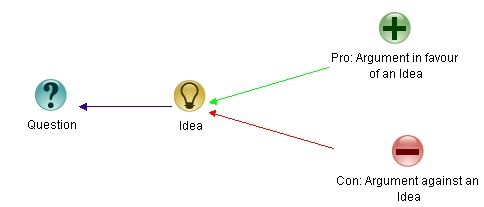
Figure 1: IBIS Elements
The basic idea in dialogue mapping is that a skilled facilitator maps out the core points of the dialogue in real-time, on a shared display which is visible to all participants. The basic idea is that participants see their own and collective contributions to the debate, while the facilitator fashions these into a coherent whole. Conklin’s believes that this can be done, no matter how complex the issues are or how diverse and apparently irreconcilable the opinions. Although I have limited experience with the technique, I believe he is right: IBIS in the hands of a skilled facilitator can help a group focus on the real issues, blowing away the conversational chaff. Although the group as a whole may not reach complete agreement, they will at least develop a real understanding of other perspectives. The third chapter, which concludes the first part of the book, is devoted to an example that illustrates this point.
The second part of the book delves into the nuts and bolts of dialogue mapping. It begins with an introduction to IBIS – which Conklin calls a “tool for all reasons.” The book provides a nice informal discussion, covering elements, syntax and conventions of the language. The coverage is good, but I have a minor quibble : one has to read and reread the chapter a few times to figure out the grammar of the language. It would have been helpful to have an overview of the grammar collected in one place (say in a diagram, like the one shown in Figure 2). Incidentally, Figures 1 and 2 also show how an IBIS map is structured: starting from a root question (placed on the left of the diagram) and building up to the right as the discussion proceeds.

Figure 2: Legal Links in IBIS
A good way to gain experience with IBIS is to use it to create issue maps of arguments presented in articles. See this post for an example of an issue map based on Fred Brooks’ classic article, No Silver Bullet.
Dialogue mapping is issue mapping plus facilitation. The next chapter – the fifth one in the book – discusses facilitation skills required for dialogue mapping. The facilitator (or technographer, as the person is sometimes called) needs to be able to listen to the conversation, guess at the intended meaning, write (or update) the map and validate what’s written; then proceed through the cycle of listening, guessing, writing and validating again as the next point comes up and so on. Conklin calls this the dialogue mapping listening cycle (see Figure 3 below). As one might imagine, this skill, which is the key to successful dialogue mapping, takes lots of practice to develop. In my experience, a good way to start is by creating IBIS maps of issues discussed in meetings involving a small number of participants. As one gains confidence through practice, one shares the display thereby making the transition from issue mapper to dialogue mapper.
One aspect of the listening cycle is counter-intuitive – validation may require the facilitator to interrupt the speaker. Conklin emphasises that it is OK to do so as long as it is done in the service of listening. Another important point is that when capturing a point made by someone, the technographer will need to summarise or interpret the point. The interpretation must be checked with the speaker. Hence validation – and the interruption it may entail – is not just OK, it is absolutely essential. Conklin also emphasises that the facilitator should focus on a single person in each cycle – it is possible to listen to only one person at a time.
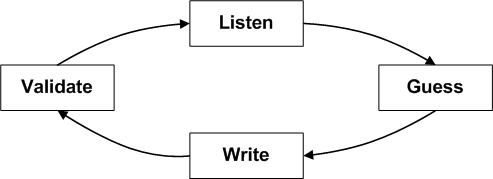
Figure 3: Dialogue Mapping Listening Cycle
A side benefit of interrruption is that it slows downs the dialogue. This is a good thing because everyone in the group gets more time to consider what’s on the screen and how it relates (or doesn’t) to their own thoughts. All too often, meetings are rushed, things are done in a hurry, and creative creative ideas and thoughts are missed in the bargain. A deliberate slowing down of the dialogue counters this.
The final part of the book – chapters six through nine – are devoted to advanced dialogue mapping skills.
The sixth chapter presents a discussion of the types of questions that arise in most meetings. Conklin identifies seven types of questions:
Deontic: These are questions that ask what should be done in order to deal with the issue at hand. For example: What should we do to improve our customer service? The majority of root questions (i.e. starting questions) in an IBIS map are deontic.
Instrumental: These are questions that ask how something should be done. For example: How can we improve customer service? These questions generally follow on from deontic questions. Typically root questions are either deontic or instrumental.
Criterial: These questions ask about the criteria that any acceptable ideas must satisfy. Typically ideas that respond to criterial questions will serve as a filter for ideas that might come up. Conklin sees criterial and instrumental questions as being complementary. The former specify high-level constraints (or criteria) for ideas whereas the latter are nuts-and-bolts ideas on how something is to be achieved. For example, a criterial question might ask: what are the requirements for improving customer service or how will we know that we have improved customer service.
Conklin makes the point that criterial questions typically connect directly to the root question. This makes sense: the main issue being discussed is usually subject ot criteria or constraints. Further, ideas that respond to criterial questions (in other words, the criteria) have a correspondence with arguments for and against the root questions. This makes sense: the pros and cons that come up in a meeting would generally correspond to the criteria that have been stated. This isn’t an absolute requirement – there’s nothing to say that all arguments must correspong to at least one criterion – but it often serves as a check on whether a discussion is taking all constraints into account.
Conceptual: These are questions that clarify the meaning of any point that’s raised. For example, what do we mean by customer service? Conklin makes the point that many meetings go round in circles because of differences in understanding of particular terms. Conceptual questions surface such differences.
Factual: These are questions of fact. For example: what’s the average turnaround time to respond to customer requests? Often meetings will debate such questions without having any clear idea of what the facts are. Once a factual question is identified as such, it can be actioned for someone to do research on it thereby saving a lot of pointless debate
Background: These are questions of context surrounding the issue at hand. An example is: why are we doing this initiative to improve customer service? Ideas responding to such questions are expected to provide the context as to why something has become an issue.
Stakeholder: These are the “who” questions. An example: who should be involved in the project? Such questions can be delicate in situations where there are conflicting interests (cross-functional project, say), but need to be asked in order to come up with a strategy to handle differences opinion. One can’t address everyone’s concerns until one knows who all constitute “everyone”.
Following the classification of questions, Conklin discusses the concept of a dialogue meta-map – an overall pattern of how certain kinds of questions naturally follow from certain others. The reader may already be able to discern some of these patterns from the above discussion of question types. Also relevant here are artful questions – open questions that keep the dialogue going in productive directions.
The seventh chapter is entitled Three Moves of Discourse. It describes three conversational moves that propel a discussion forward, but can also upset the balance of power in the discussion and evoke strong emotions. These moves are:
- Making an argument for an idea or proposal (a Pro)
- Making an argument against an idea (a Con)
- Challenging the context of the entire discussion.
Let’s look at the first two moves to start with. In an organisation, these moves have a certain stigma attached to them: anyone making arguments for or against an idea might be seen as being opinionated or egotistical. The reason is because these moves generally involve contradicting someone else in the room. Conklin contends that dialogue mapping takes removes these negative connotations because the move is seen as just another node in the map. Once on the map, it is no longer associated with any person – it is objectified as an element of the larger discussion. It can be discussed or questioned just as any other node can.
Conklin refers to the last move – challenging the context of a discussion – as “grenade throwing.” This is an apt way of describing such questions because they have the potential to derail the discussion entirely. They do this by challenging the relevance of the root question itself. But dialogue mapping takes these grenades in its stride; they are simply captured as any another conversational move – i.e. a node on the map, usually a question. Better yet, in many cases further discussion shows how these questions might connect up with the rest of the map. Even if they don’t, these “grenade questions” remain on the map, in acknowledgement of the dissenter and his opinion. Dialogue mapping handles such googlies (curveballs to baseball aficionados) with ease, and indicates how they might connect up with the rest of the discussion – but connection is neither required nor always desirable. It is OK to disagree, as long as it is done respectfully. This is a key element of shared understanding – the participants might not agree, but they understand each other.
Related to the above is the notion of a “left hand move”. Occasionally a discussion can generate a new root question which, by definition, has to be tacked on to the extreme left of the map. Such a left hand move is extremely powerful because it generally relates two or more questions or ideas that were previously unrelated (some of them may even have been seen as a grenade).
By now it should be clear that dialogue mapping is a technique that promotes collaboration – as such it works best in situations where openness, honesty and transparency are valued. In the penultimate chapter, the author discusses some situations in which it may not be appropriate to use the technique. Among these are meetings in which decisions are made by management fiat. Other situations in which it may be helpful to “turn the display off” are those which are emotionally charged or involve interpersonal conflict. Conklin suggests that the facilitator use his or her judgement in deciding where it is appropriate and where it isn’t.
In the final chapter, Conklin discusses how decisions are reached using dialogue mapping. A decision is simply a broad consensus to mark one of the ideas on the map as a decision. How does one choose the idea that is to be anointed as the group’s decision? Well quite obviously: the best one. Which one is that? Conklin states, the best decision is the one that has the broadest and deepest commitment to making it work. He also provides a checklist for figuring out whether a map is mature enough for a decision to be made. But the ultimate decision on when a decision (!) is to be made is up to group. So how does one know when the time is right for a decision? Again, the book provides some suggestions here, but I’ll say no more except to hint at them by paraphrasing from the book: “What makes a decision hard is lack of shared understanding. Once a group has thoroughly mapped a problem (issues) and its potential solutions (ideas) along with their pros and cons, the decision itself is natural and obvious.”
Before closing, I should admit that my experience with dialogue mapping is minimal – I’ve done it a few times in small groups. I’m not a brilliant public speaker or facilitator, but I can confirm that it helps keep a discussion focused and moving forward. Although Conklin’s focus is on dialogue mapping, one does not need to be a facilitator to benefit from this book; it also provides a good introduction to issue mapping using IBIS. In my opinion, this alone is worth the price of admission. Further, IBIS can also be used to augment project (or organisational) memory. So this book potentially has something for you, even if you’re not a facilitator and don’t intend to use IBIS in group settings.
This brings me to the end of my long-winded summary and review of the book. My discussion, as long as it is, does not do justice to the brilliance of the book. By summarising the main points of each chapter (with some opinions and annotations for good measure!), I have attempted to convey a sense of what a reader can expect from the book. I hope I’ve succeeded in doing so. Better yet, I hope I have convinced you that the book is worth a read, because I truly believe it is.
On the emotions evoked by project management artefacts
Introduction
The day-to-day practice of project management involves the use of several artefacts: from the ubiquitous Gantt chart to the less commonly used trend chart. It is of interest to understand the practical utility of these artefacts; consequently there is a fair bit of published work devoted to answering questions such as “What percentage of project managers use this artefact?”, “How and why do they use it?” etc. (see this paper review, for example). Such questions address the cognitive aspects of these artefacts – the logic, reasoning and thought processes behind their use. There is a less well understood side to the use of the artefacts: the affective or emotional one; the yin to the yang of the cognitive or logical side. A paper by Jon Whitty entitled, Project management artefacts and the affective emotions they evoke, (to appear in the International Journal of Managing Projects in Business in 2010) looks into the emotional affects (on practitioners) caused by (the use of) project management artefacts (see the note in the following paragraph for more on the term affect). This post presents an annotated summary of the paper.
[Note on the difference between affect and emotion. As I understand it, the term affect refers to automatic emotional responses which may amount to no more than a quick feeling of something being good or bad. This is in contrast to a full-blown emotion in which feelings are more intense. Unlike emotions, affective responses occur within a fraction of a second and may dissipate just as quickly. Furthermore, affect lacks the range and variety of conscious emotions.]
Like some of Whitty’s previous work, the paper presents an unusual – dare I say, challenging – perspective on the reasons why project managers use artefacts. I use the word “challenging” here in the sense of “questioning the rationale behind their use”, not in the sense of “difficulty.” To put the work in a wider context, it builds on the evolutionary view of project management advanced by Whitty and Schulz in an earlier paper. The evolutionary view holds that project management practices and principles give organisations (and hence individual project managers) certain survival advantages. The current paper studies how project management artefacts – through the emotions they evoke in project managers – “create” behaviours that “cause” project managers to sustain and propagate the practice of project management within their organisations.
Study Objectives
Whitty begins by framing two hypotheses which serve to outline the objectives of his study. They are:
- Project managers obtain an emotional affect from aspects of the project management experiences.
- Project managers use the emotional affects of project management artefacts to increase their competitive advantage.
The first examines whether project managers’ behaviours are driven by the experience of managing projects; the second examines whether project managers – through their use of artefacts – manipulate their environment to their advantage. The paper “tests” these hypotheses empirically (the reason for the enclosing quotes will become clearer later), and also examines some implications of the results.
Background
The paper contains an extensive review of the literature on the evolutionary view of project management and emotions / affect. I found the review very useful; not only did it help me appreciate the context of the research, it also gave me some new insights into professional practice. I summarise the review below, so you can judge for yourself.
In their paper entitled, The PM_BOK Code, Whitty and Schulz argue that, in order to survive in an organisational environment, project managers are driven to put on a performance – much like stage actors – of managing projects. They recite lines (use project management terminology, deliver status reports) and use props (project management artefacts) before an audience of stakeholders ranging from senior sponsors to team members.
Subscribing to, and practising the ideals of, project management enables practitioners to gain a competitive advantage in the organisational jungle. One aim of the paper is to clarify the role of artefacts in the evolutionary framework: specifically, how does the use of artefacts confer survival benefits, and what affects evoked in practitioners (who are using artefacts) cause the artefacts themselves to be passed on (i.e. survive).
As far as emotion or affect is concerned, Whitty mentions that much of the work done to date focuses on the management of positive and negative emotions (felt by both the project manager and the team) so as to achieve a successful project outcome. And although there is a significant body of work on the effectiveness of project management artefacts, there is virtually nothing on the emotional affect of artefacts as they are being used. Nevertheless, research in other areas suggests a strong connection between the creation/ use of artefacts, emotions evoked and the consequences thereof. An example is the affective response evoked by building architecture in a person and the consequent effect on the person’s mood. Changes in mood in turn might predispose the person to certain ideals and values. Although the emotional response caused by artefacts has been studied in other organisational contexts, it has not been done heretofore in project management. For this reason alone, this paper merits attention from project management practitioners.
Methodology
Unlike research into the utility of artefacts – where an objective definition of utility is possible – any questions relating to the emotions evoked by artefacts can only be answered subjectively: I can tell you how I feel when I do something, you may even be able to tell how I feel by observing me, but you can never feel what I feel. Hence the only possible approach to answering such questions is a phenomenological one – i.e. attempting to understand reality as seen by others through their perceptions and subjective experience. Whitty uses an approach based on empirical phenomenology – a research methodology that aims to produce accurate descriptions of human experience through observation of behaviour.
[Note on phenomenological approaches to management research: There are two phenomenological research methods in management: hermeneutic and empirical. The empirical approach follows fairly strict data collection and analytical methods whereas the hermeneutic approach is less prescriptive about techniques used . Another difference between the two is that the hermeneutic approach uses a range of sources including literary texts (since these are considered to reflect human experience) whereas empirical phenomenology is based on the analysis of factual data only. In essence the latter is closer to being a scientific/analytical approach to studying human experience than the former. See the very interesting paper – Revisiting Phenomenology: its potential for management research – by Lisa Ehrich for more.]
For his study, Whitty selected a group of about 50 project managers drawn from the ranks of professional bodies. The participants were asked to answer questions regarding what project management tools they enjoyed using, the emotions elicited by these tools and how they would feel if they weren’t allowed to use them. Additionally, they were also asked to imagine their ideal project management tool / process. Based on the answers provided, Whitty selected a small number of subjects for detailed, face-to-face interviews. The interviews probed for details on the responses provided in the survey. Audio and videotapes of the interviews were analysed to understand what the use of each artefact meant to the user, what emotions were evoked during its use and common gestures used while working with these tools – with the aim of understanding the essence of the experience of using a particular tool or process.
Whitty acknowledges some limitations of his approach, most of which are common to organisational studies. Some of these include: problems with self-reported data, limited (and potentially non-representative) sample size. I have discussed some of these limitations in my posts on the role of social desirability bias and the abuse of statistics in project management research.
Results
From his analysis, Whitty found that eleven artefacts came up more often than others. These could be divided into conceptual and tangible artefacts. The former includes the following:
- Project
- Deadline
- Team
- Professional persona of a project manager
The latter includes:
- Gantt Chart
- WBS
- Iron Triangle
- S-Curve
- Project management post-nominals (certifications, degrees, titles)
- PMBOK Guide & Project management methodologies
- Professional bodies
The paper contains detailed descriptions of the results, including interesting comments by the participants. I can do no better than refer the reader to the original paper for these. Here, in the interests of space, I’ll present only a selection of the artefacts analysed, relying heavily on quotations from the paper. My choice is based entirely on the items and interpretations that I found particularly striking.
Project
From the responses received, Whitty concludes that:
Projects appear to be emotionally perceived as though they are composed of two opposing forces or elements which were not as dichotomistic as good and bad. Rather, these forces are more complementary or completing aspects of the one phenomenon such as in the concept of Yin – Yang, though this term was only mentioned by one participants. All of the participants described the most difficult parts of their roles as “challenges”, and felt they gained a sense of achievement and learning from their projects.
Participants described the experience of managing a project in terms of a duality between thrill and excitement, even fear and personal satisfaction…Furthermore, many believed in some sort of karmic effect where the benefits of a good work ethic today would be paid back in future project success.
Team
When asked about the concept of a team, most of the respondents felt that there was a sense of mutual commitment between the project manager and team, but not necessarily one of mutual responsibility. One project manager said, “If they (the team) shine I shine, but if it all goes wrong I take the heat.”
On the other hand, most respondents seemed to be appreciative of their teams. Many used the gesture of a circle (tracing out a circle with a finger, for example) when talking about their teams. Whitty writes,
…As an expression of emotion the circle gesture has a limitless or boundless aspect with no beginning, no end, and no division. It symbolises wholeness and completeness, and it is possibly used by project managers to express their feelings of mutual commitment and fidelity to the team and the project.
Despite the general feeling that the project manager takes the blame if things go wrong, most respondents thought that there was a strong mutual committment between the team and project manager.
Project Manager Persona
This one is very interesting. When asked to describe what a successful project manager would look like, some responses were, “mid 20s to mid 40s”, “businesslike”, “must wear a business suit”, “confident and assertive”. Some commented on how they personally and actively used the persona. On the other hand, Whitty states,
There appears to be a tension or anxiety when creating and maintaining the façade of control…
He also suggests a metaphor for the persona:
…that beneath the external impression of the graceful swan are furiously paddling legs…
I think that’s an absolutely marvellous characterisation of a project manager under stress.
Gantt Chart
The Gantt Chart is perhaps the most well-known (and over-exposed) tangible project management artefact. For this reason alone, it is interesting to look into the emotional responses evoked by it. To quote from the paper,
It seems that project managers cannot talk about PM without mentioning the Gantt chart. Project managers appear to be compelled to make them to create and maintain their professional persona.
On the other hand,
Though the Gantt chart is closely associated with PM, many participants regarded this association as a burden…Even though project managers feel frustration that they are expected, even forced to use Gantt charts, they also manipulate this situation to their advantage and use Gantt charts to placate senior management and clients.
Stress and hopefulness appear to be two emotions linked with Gantt Charts (duality again!). One participant said “the Gantt charts you’re showing me don’t mean anything to me I feel pretty neutral about them. But my Gantt charts can really stress me out.” And another, “When I look at it (the Gantt chart) all finished, (heavy sigh) I suppose I’m hoping that’s how it will all turn out…”
As I see it, the Gantt chart – much like the PERT chart – is used more to manage management than to manage projects, and hence the mixed emotions evoked by its use.
Work Breakdown Structure
Whitty mentions that over two-thirds of the participants said they used WBS in one form or another. He states,
All participants view work in packets or as bounded objects. As one put it, “I like to break the work down into nice crisp chunks, and then connect them all up together again.” This behaviour support Gestalt theories that in order to interpret what we receive through our senses we attempt to organize information into certain groups which include: similarity, proximity, continuity, and closure….
Through his reference to Gestalt theories, Whitty suggests that breaking the project up into chunks of work and then putting it back together again helps the project manager grok the project – i.e. understand the interconnections between project elements and the totality of the project in a deep way. A little later he states,
Many experience satisfaction, contentment, even a sense of control from the WBS process.
I can’t help but wonder – does the popularity of the tool stem, at least in part, from its ability to evoke positive affect?
PMBOK Guide and Methodologies
Based on the responses received, Whitty mentions,
It is apparent that some PM methodologies are PM artefacts in themselves and are used as currency to gain a competitive advantage.”
Yet the profession appears to be divided about the utility of methodologies,
All the participants were aware of the PMBOK® Guide, and all of them utilised a PM methodology of some sort, whether it were an off-the-shelf brand or a company-grown product. Participants appeared to be either for or against PM methodologies, some even crossed over the dividing line mid-sentence (!)
Another theme that arose is that methodologies are “something to hide behind” should things go wrong: “Don’t blame me, I did things by the Book.” Methodologies thus offer two side benefits (apart from the man one of improving chances of project success!): they help “certify” to a project manager’s competence and act as a buffer if things go wrong.
Discussion
Whitty concludes that the data supports his hypothesis that project managers obtain an emotional affect from aspects of project management experience. In his words:
This study has shown that project managers are drawn to project work. The participants in this study forage for projects because they can obtain or experience an emotional affect or more informally stated a favourable emotional fix from the challenge they present…. they are stimulated by the challenges the construct of a project has to offer. Furthermore, they appear to be fairly sure they can handle these challenges with their existing skill and abilities…
The data also suggests that despite the dominant deterministic approach to project management, project managers also,
…operate under the cognitive logic of yin-yang. They conceptualise the emotional experience of managing a project in terms of two possible states or statuses of events that ebb and flow; one state gradually transforming into the other state along a time dimension. What is also interesting is that these project managers find it necessary to conceal this behaviour for survival reasons.
The data also supports the second hypothesis: that project managers use the emotional affects of the project management experience to increase their competitive advantage. This is clear, for example, from the discussions of the Project Manager Persona, Gantt Chart and methodologies.
Concluding remarks
This is an important study because it has implications for how project management is taught, practised and researched. For example, most project management courses teach tools and techniques – such as Gantt Charts – with the implicit assumption that using them will improve chances of project success. However, from this research it is clear, and I quote
…some practitioners create Gantt charts because they enjoy the Gantt charting process, and some create them to placate others and/or to be viewed favourably by others. It is simply not clear how Gantt charts or the scheduling process in general contributes to the overall performance of a project…
Using this as an example, Whitty makes a plea for an objective justification of project management practices. It’s just not good enough to say we must use something because so-and-so methodology says so (see my piece entitled, A PERT myth, for another example of a tool that, though well entrenched, has questionable utility). The research also indicates that a project manager’s behaviours are influenced by the physical and cultural environment in which he or she operates: some practices are followed because they give the project manager a sense of control; others because they help gain a competitive advantage. Whitty suggests that senior managers would get more out of their project managers if they understood how project managers are affected by their environment. Further, he recommends that project managers should be encouraged to adopt only those techniques, practices and norms that are demonstrably useful. Those that aren’t should be abandoned.
So what are the implications for profession? In a nutshell: it is to think critically about the way we manage projects. Practices recommended by a particular methodology or authority are sometimes followed without critical analysis or introspection. So the next time you invoke a tool, technique or practice – stop for a minute and reflect on what you’re doing and why. An honest answer may hold some surprises.
Why visual representations of reasoning are more effective than prose
At work I’m often saddled with tasks that involve writing business documents such as project proposals, business cases, technology evaluations etc. Typically these are aimed at conveying positions or ideas to a specific audience. For example, a business case might detail the rationale behind (and hence the justification for) a project to executive management. The hardest part of composing these documents is the flow: how ideas are introduced, explained and transitioned one after the other. (Incidentally, writing business documents is composition – like music or art – let no one tell you otherwise.) The organisation of a document has to be carefully thought through because it is hard to convey complex, interconnected ideas in writing. Anyone who has laboured through a piece of reasoning in prose form is familiar with this problem. In an earlier post I discussed, via example, the utility of issue mapping – a visual representation of reasoning – in clarifying complex issues that are presented in writing. In this post I explore reasons why issue maps – or other visual representations of reasoning – are superior to prose when it comes to conveying ideas. Towards the end, I also highlight some potential uses of visual representations in project management.
The basic problem with prose is that the relationships between ideas are not immediately evident. In a paper entitled Enhancing Deliberation Through Computer Supported Argument Mapping Tim van Gelder states,
Extracting the structure of evidential relationships from reasoning as typically presented in prose is very difficult and most of the time we do it badly. This can be easily illustrated, in a kind of exercise we have done informally many times in workshops. Take any group of people sufficiently trained in reasoning and argument mapping that they are quite able to create argument maps to make explicit whatever reasoning they have in mind. Now give them a sample of good argumentative prose, such as a well-argued opinion piece from the newspaper. Ask them to figure out what the reasoning is, and to re-present it in an argument map. This usually takes about 20-30 minutes, during which time you can enjoy watching the participants strike various Rodinesque postures of intense concentration, wipe their sweaty palms, etc.. Then compare the resulting argument maps. You’ll find that you have as many different argument maps as there are people doing the exercise; in many cases the maps will be wildly different…
Although the paper is talks about argument mapping, the discussion applies just as well to issue mapping. He goes on to say,
Take any group of people sufficiently trained to be able to be read argument maps. (This training usually takes not more than a few minutes.) Present them with an argument map, and ask them to identify the reasoning presented in the map, and represent it in whatever form they like (map, prose, point-form etc.). This is a very simple task and usually takes almost no time; indeed, it is so trivial that the hard part is getting the participants to go through the motions when no intellectual challenge is involved. Ask them questions designed to elicit the extent to which they have correctly identified the structure of the reasoning presented by the map (e.g., how many distinct reasons are presented for the main conclusion?). You’ll find that they all understand exactly what the reasoning is, and ipso facto all have the same sense of the reasoning…
The point is simple: visual representations of reasoning are designed to present reasoning; prose isn’t.
Van Gelder then asks the question: why are visual representations better than prose? In answer, he makes the following points:
1. Prose has to be interpreted: As prose is not expressly designed to represent reasoning, readers have to decode relationships and connections between ideas. The choices they make will depend on individual interpretations of the meaning of words used and the grammatical structure of the piece. These interpretations will in turn depend on facility with the language, vocabulary etc. In contrast, visual notations such as IBIS (used in issue mapping) have few elements and very simple grammars. Simplicity slays ambiguity.
2. Prose neglects representational resources: Prose is a stream of words – it does not use other visual elements such as colour, shape, position or any graphical structures (trees, nodes, connectors). The brain processes comprehends such elements – and the visually apparent relationships between them – much faster than it can interpret prose. Hence the structured use of these can lead to faster comprehension. Van Gelder also adds that in the case of prose:
…Helpful authors (of prose) will assist readers in the difficult process of interpretation by providing verbal cues (for example, logical indicators such as “therefore”), although it is quite astonishing how frugal most authors are in providing such cues….
This is true, and I’d add that writers – particularly those who write analytical pieces – tend to be frugal because they are taught to be so.
3. Prose is sequential, arguments aren’t: Reasoning presented in written form flows linearly – i.e. concepts and ideas appear in sequence. A point that’s made on one page may be related to something that comes up five pages later, but the connections will not be immediately apparent unless the author specifically draws attention to it. Jeff Conklin makes the same point about conversations in this presentation: conversations are linear, one comment follows the other; however the issues that come up in a conversation are typically related in a non-linear way. Visual maps of reasoning expose these non-linear connections between issues in a very apparent and easy-to-follow way. See this map of a prose piece or this map of a conversation, for example.
4. Metaphors cannot be visually displayed in prose: According to the linguist / philosopher George Lakoff, metaphors are central to human understanding. Further, metaphors are grounded in our physical experience because our brains take input from the rest of our bodies (see this interview with Lakoff for more). For this reason, most of the metaphors we use to express reasoning relate to physical experience and sensation: strength or weakness of an argument, support for a position, weight of an idea, external pressure etc. Van Gelder claims that visual representations can depict these metaphors in a more natural way: for instance, in IBIS maps, cons are coloured red (Stop) whilst pros are green (Go).
The above points are taken from van Gelder’s paper, but I can think of a few more:
5. Visual representations have less ambiguity: All visual representations of reasoning that I’ve come across – mind maps, issue maps, argument maps etc – excel at displaying relationships between ideas in an unambiguous manner. One reason for this is that visual representations generally have a limited syntax and grammar, as a consequence of which a given relationship can be expressed in only a small number of ways (usually one!). Hence there is little or no ambiguity in depicting or interpreting relationships in a visual representation. This is not the case with prose, where much depends on the skill and vocabulary of the writer and reader.
6. Visual representations can present reasoning “at a glance”: A complex argument which takes up several pages of prose can often be captured in a single page using visual notations. Such visual representations -if properly constructed – are also more intuitive than the corresponding prose representation. See my post entitled, Beyond words: visualising arguments using issue maps for an example.
7. Visual representations can augment organisational memory A well structured archive of knowledge maps is so much more comprehensible than reams of documentation. Here are a couple of reasons why:
- Maps, unlike written documents, can capture the essence of a discussion minus all the conversational chaff.
- Maps can be structured to show the logical relationships or interconnections between multiple documents: i.e. as maps of organisational knowledge. Much like geographical maps, these can help knowledge workers navigate their way through vast tracts of organisational knowledge
See my post on knowledge capture using issue maps for much more on this.
8. Visual representations can catalyse knowledge creation: Visual representations, when used collaboratively, can catalyse the creation of knowledge. This is the basis of the technique of dialogue mapping – see this post for a simple example of dialogue mapping using IBIS. A visual representation serves as a focal point that captures a group’s collective reasoning and understanding of an issue as it evolves. Even more, the use of such representations in design discussions can foster creativity in much the same way as in art. In fact, Al Selvin refers to Compendium – the tool and methodology used in dialogue mapping – as an enabler of Knowledge Art. I’m currently reading some of Selvin’s writings on this, and will soon write a post summarising some of his ideas. Stay tuned.
If you’re a project manager and have read this far, perhaps you’re wondering how this stuff might be relevant to your day-to-day work. Well, in a couple of ways at least:
- Visual representations can serve as a succinct project memory. A practical way to start is by using issue mapping to capture meeting minutes. One can also use it to summarise meetings after they have taken place, but doing it in real-time is better because one can seek clarifications on the spot. Better still – project the map on to a screen and become a dialogue mapper.
- Maps can be used in real-time to to facilitate collaborative design – or create knowledge art – as discussed in point 8 above.
To summarise, then: visual representations of reasoning are more effective than prose because they are better at capturing the nonlinear structure of arguments; easier to interpret; leverage visual metaphors; depict relationships effectively and present arguments in a succinct yet intuitively appealing way. Above all, visual representations can facilitate collaborative creativity – something that prose simply cannot do.


 Eight to Late