Archive for the ‘Project Management’ Category
The Risk – a dialogue mapping vignette
Foreword
Last week, my friend Paul Culmsee conducted an internal workshop in my organisation on the theme of collaborative problem solving. Dialogue mapping is one of the tools he introduced during the workshop. This piece, primarily intended as a follow-up for attendees, is an introduction to dialogue mapping via a vignette that illustrates its practice (see this post for another one). I’m publishing it here as I thought it might be useful for those who wish to understand what the technique is about.
Dialogue mapping uses a notation called Issue Based Information System (IBIS), which I have discussed at length in this post. For completeness, I’ll begin with a short introduction to the notation and then move on to the vignette.
—
A crash course in IBIS
The IBIS notation consists of the following three elements:
- Issues(or questions): these are issues that are being debated. Typically, issues are framed as questions on the lines of “What should we do about X?” where X is the issue that is of interest to a group. For example, in the case of a group of executives, X might be rapidly changing market condition whereas in the case of a group of IT people, X could be an ageing system that is hard to replace.
- Ideas(or positions): these are responses to questions. For example, one of the ideas of offered by the IT group above might be to replace the said system with a newer one. Typically the whole set of ideas that respond to an issue in a discussion represents the spectrum of participant perspectives on the issue.
- Arguments: these can be Pros (arguments for) or Cons (arguments against) an issue. The complete set of arguments that respond to an idea represents the multiplicity of viewpoints on it.
Compendium is a freeware tool that can be used to create IBIS maps– it can be downloaded here.
In Compendium, IBIS elements are represented as nodes as shown in Figure 1: issues are represented by blue-green question marks; positions by yellow light bulbs; pros by green + signs and cons by red – signs. Compendium supports a few other node types, but these are not part of the core IBIS notation. Nodes can be linked only in ways specified by the IBIS grammar as I discuss next.

Figure 1: IBIS node types
The IBIS grammar can be summarized in three simple rules:
- Issues can be raised anew or can arise from other issues, positions or arguments. In other words, any IBIS element can be questioned. In Compendium notation: a question node can connect to any other IBIS node.
- Ideas can only respond to questions– i.e. in Compendium “light bulb” nodes can only link to question nodes. The arrow pointing from the idea to the question depicts the “responds to” relationship.
- Arguments can only be associated with ideas– i.e. in Compendium “+” and “–“ nodes can only link to “light bulb” nodes (with arrows pointing to the latter)
The legal links are summarized in Figure 2 below.

Figure 2: Legal links in IBIS
…and that’s pretty much all there is to it.
The interesting (and powerful) aspect of IBIS is that the essence of any debate or discussion can be captured using these three elements. Let me try to convince you of this claim via a vignette from a discussion on risk.
—
The Risk – a Dialogue Mapping vignette
“Morning all,” said Rick, “I know you’re all busy people so I’d like to thank you for taking the time to attend this risk identification session for Project X. The objective is to list the risks that we might encounter on the project and see if we can identify possible mitigation strategies.”
He then asked if there were any questions. The head waggles around the room indicated there were none.
“Good. So here’s what we’ll do,” he continued. “I’d like you all to work in pairs and spend 10 minutes thinking of all possible risks and then another 5 minutes prioritising. Work with the person on your left. You can use the flipcharts in the breakout area at the back if you wish to.”
Twenty minutes later, most people were done and back in their seats.
“OK, it looks as though most people are done…Ah, Joe, Mike have you guys finished?” The two were still working on their flip-chart at the back.
“Yeah, be there in a sec,” replied Mike, as he tore off the flip-chart page.
“Alright,” continued Rick, after everyone had settled in. “What I’m going to do now is ask you all to list your top three risks. I’d also like you tell me why they are significant and your mitigation strategies for them.” He paused for a second and asked, “Everyone OK with that?”
Everyone nodded, except Helen who asked, “isn’t it important that we document the discussion?”
“I’m glad you brought that up. I’ll make notes as we go along, and I’ll do it in a way that everyone can see what I’m writing. I’d like you all to correct me if you feel I haven’t understood what you’re saying. It is important that my notes capture your issues, ideas and arguments accurately.”
Rick turned on the data projector, fired up Compendium and started a new map. “Our aim today is to identify the most significant risks on the project – this is our root question” he said, as he created a question node. “OK, so who would like to start?”

Figure 3: The root question
“Sure,” we’ll start, said Joe easily. “Our top risk is that the schedule is too tight. We’ll hit the deadline only if everything goes well, and everyone knows that they never do.”
“OK,” said Rick, “as he entered Joe and Mike’s risk as an idea connecting to the root question. “You’ve also mentioned a point that supports your contention that this is a significant risk – there is absolutely no buffer.” Rick typed this in as a pro connecting to the risk. He then looked up at Joe and asked, “have I understood you correctly?”
“Yes,” confirmed Joe.
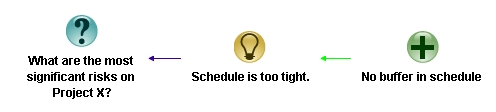
Figure 4: Map in progress
“That’s pretty cool,” said Helen from the other end of the table, “I like the notation, it makes reasoning explicit. Oh, and I have another point in support of Joe and Mike’s risk – the deadline was imposed by management before the project was planned.”
Rick began to enter the point…
“Oooh, I’m not sure we should put that down,” interjected Rob from compliance. “I mean, there’s not much we can do about that can we?”
…Rick finished the point as Rob was speaking.

Figure 5: Two pros for the idea
“I hear you Rob, but I think it is important we capture everything that is said,” said Helen.
“I disagree,” said Rob. “It will only annoy management.”
“Slow down guys,” said Rick, “I’m going to capture Rob’s objection as “this is a management imposed-constraint rather than risk. Are you OK with that, Rob?”
Rob nodded his assent.
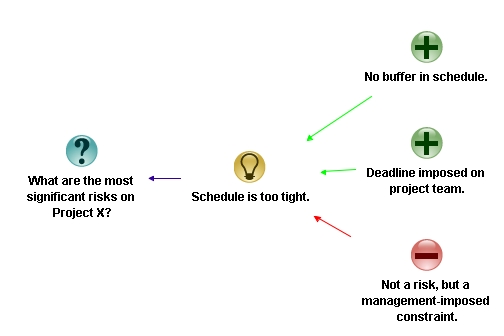
Fig 6: A con enters the picture
I think it is important we articulate what we really think, even if we can’t do anything about it,” continued Rick. There’s no point going through this exercise if we don’t say what we really think. I want to stress this point, so I’m going to add honesty and openness as ground rules for the discussion. Since ground rules apply to the entire discussion, they connect directly to the primary issue being discussed.”

Figure 7: A “criterion” that applies to the analysis of all risks
“OK, so any other points that anyone would like to add to the ones made so far?” Queried Rick as he finished typing.
He looked up. Most of the people seated round the table shook their heads indicating that there weren’t.
“We haven’t spoken about mitigation strategies. Any ideas?” Asked Rick, as he created a question node marked “Mitigation?” connecting to the risk.

Figure 8: Mitigating the risk
“Yeah well, we came up with one,” said Mike. “we think the only way to reduce the time pressure is to cut scope.”
“OK,” said Rick, entering the point as an idea connecting to the “Mitigation?” question. “Did you think about how you are going to do this? He entered the question “How?” connecting to Mike’s point.
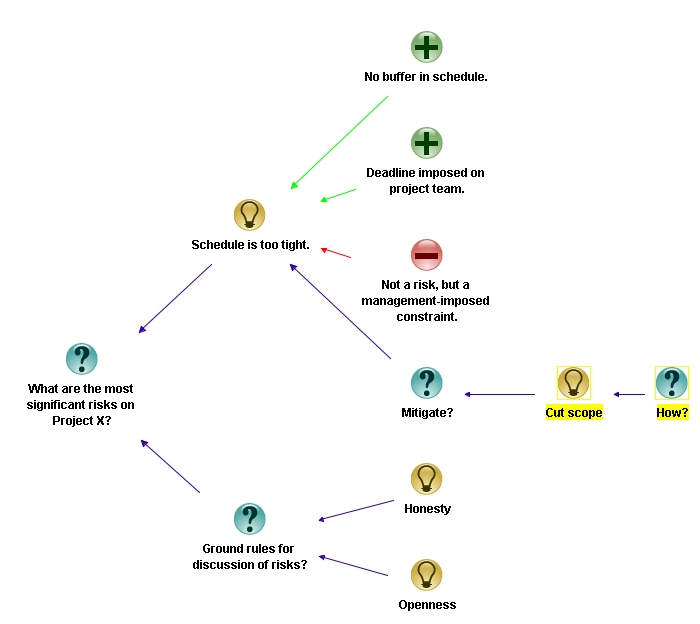
Figure 9: Mitigating the risk
“That’s the problem,” said Joe, “I don’t know how we can convince management to cut scope.”
“Hmmm…I have an idea,” said Helen slowly…
“We’re all ears,” said Rick.
“…Well…you see a large chunk of time has been allocated for building real-time interfaces to assorted systems – HR, ERP etc. I don’t think these need to be real-time – they could be done monthly…and if that’s the case, we could schedule a simple job or even do them manually for the first few months. We can push those interfaces to phase 2 of the project, well into next year.”
There was a silence in the room as everyone pondered this point.
“You know, I think that might actually work, and would give us an extra month…may be even six weeks for the more important upstream stuff,” said Mike. “Great idea, Helen!”
“Can I summarise this point as – identify interfaces that can be delayed to phase 2?” asked Rick, as he began to type it in as a mitigation strategy. “…and if you and Mike are OK with it, I’m going to combine it with the ‘Cut Scope’ idea to save space.”
“Yep, that’s fine,” said Helen. Mike nodded OK.
Rick deleted the “How?” node connecting to the “Cut scope” idea, and edited the latter to capture Helen’s point.

Figure 10: Mitigating the risk
“That’s great in theory, but who is going to talk to the affected departments? They will not be happy.” asserted Rob. One could always count on compliance to throw in a reality check.
“Good point,” said Rick as he typed that in as a con, “and I’ll take the responsibility of speaking to the department heads about this,” he continued entering the idea into the map and marking it as an action point for himself. “Is there anything else that Joe, Mike…or anyone else would like to add here,” he added, as he finished.

Figure 11: Completed discussion of first risk (click to view larger image)
“Nope,” said Mike, “I’m good with that.”
“Yeah me too,” said Helen.
“I don’t have anything else to say about this point,” said Rob, “ but it would be great if you could give us a tutorial on this technique. I think it could be useful to summarise the rationale behind our compliance regulations. Folks have been complaining that they don’t understand the reasoning behind some of our rules and regulations. ”
“I’d be interested in that too,” said Helen, “I could use it to clarify user requirements.”
“I’d be happy to do a session on the IBIS notation and dialogue mapping next week. I’ll check your availability and send an invite out… but for now, let’s focus on the task at hand.”
The discussion continued…but the fly on the wall was no longer there to record it.
—
Afterword
I hope this little vignette illustrates how IBIS and dialogue mapping can aid collaborative decision-making / problem solving by making diverse viewpoints explicit. That said, this is a story, and the problem with stories is that things go the way the author wants them to. In real life, conversations can go off on unexpected tangents, making them really hard to map. So, although it is important to gain expertise in using the software, it is far more important to practice mapping live conversations. The latter is an art that requires considerable practice. I recommend reading Paul Culmsee’s series on the practice of dialogue mapping or <advertisement> Chapter 14 of The Heretic’s Guide to Best Practices</advertisement> for more on this point.
That said, there are many other ways in which IBIS can be used, that do not require as much skill. Some of these include: mapping the central points in written arguments (what’s sometimes called issue mapping) and even decisions on personal matters.
To sum up: IBIS is a powerful means to clarify options and lay them out in an easy-to-follow visual format. Often this is all that is required to catalyse a group decision.
Sherlock Holmes and the case of the management fetish
As narrated by Dr. John Watson, M.D.…
As my readers are undoubtedly aware, my friend Sherlock Holmes is widely feted for his powers of logic and deduction. With all due modesty, I can claim to have played a small part in publicizing his considerable talents, for I have a sense for what will catch the reading public’s fancy and, perhaps more important, what will not. Indeed, it could be argued that his fame is in no small part due to the dramatic nature of the exploits which I have chosen to publicise.
Management consulting, though far more lucrative than criminal investigation, is not nearly as exciting. Consequently my work has become that much harder since Holmes reinvented himself as a management expert. Nevertheless, I am firmly of the opinion that the long-standing myths exposed by his recent work more than make up for any lack of suspense or drama.
A little known fact is that many of Holmes’ insights into flawed management practices have come after the fact, by discerning common themes that emerged from different cases. Of course this makes perfect sense: only after seeing the same (or similar) mistake occur in a variety of situations can one begin to perceive an underlying pattern.
The conversation I had with him last night is an excellent illustration of this point.
—
We were having dinner at Holmes’ Baker Street abode when, apropos of nothing, he remarked, “It’s a strange thing, Watson, that our lives are governed by routine. For instance, it is seven in the evening, and here we are having dinner, much like we would on any other day.”
“Yes, it is,” I said, intrigued by his remark. Dabbing my mouth with a napkin, I put down my fork and waited for him to say more.
He smiled. “…and do you think that is a good thing?”
I thought about it for a minute before responding. “Well, we follow routine because we like…or need… regularity and predictability,” I said. “Indeed, as a medical man, I know well that our bodies have built in clocks that drive us to do things – such as eat and sleep – at regular intervals. That apart, routines give us a sense of comfort and security in an unpredictable world. Even those who are adventurous have routines of their own. I don’t think we have a choice in the matter, it’s the way humans are wired.” I wondered where the conversation was going.
Holmes cocked an eyebrow. “Excellent, Watson!” he said. “Our propensity for routine is quite possibly a consequence of our need for security and comfort ….but what about the usefulness of routines – apart from the sense of security we get from them?”
“Hmmm…that’s an interesting question. I suppose a routine must have a benefit, or at least a perceived benefit…else it would not have been made into a routine.”
“Possibly,” said Holmes, “ but let me ask you another question. You remember the case of the failed projects do you not?”
“Yes, I do,” I replied. Holmes’ abrupt conversational U-turns no longer disconcert me, I’ve become used to them over the years. I remembered the details of the case like it had happened yesterday…indeed I should, as it was I who wrote the narrative!
“Did anything about the case strike you as strange?” he inquired.
I mulled over the case, which (in hindsight) was straightforward enough. Here are the essential facts:
The organization suffered from a high rate of project failure (about 70% as I recall). The standard prescription – project post-mortems followed by changes in processes aimed at addressing the top issues revealed – had failed to resolve the issue. Holmes’ insightful diagnosis was that the postmortems identified symptoms, not causes. Therefore the measures taken to fix the problems didn’t work because they did not address the underlying cause. Indeed, the measures were akin to using brain surgery to fix a headache. In the end, Holmes concluded that the failures were a consequence of flawed organizational structures and norms.
Of course flawed structures and norms are beyond the purview of a mere project or program manager. So Holmes’ diagnosis, though entirely correct, did not help Bryant (the manager who had consulted us).
Nothing struck me as unduly strange as went over the facts mentally. No,” I replied, “but what on earth does that have to do with routine?”
He smiled. “I will explain presently, but I have yet another question for you before I do so. Do you remember one of our earliest management consulting cases – the affair of the terminated PMO?”
I replied in the affirmative.
“Well then, you see the common thread running through the two cases, don’t you?” Seeing my puzzled look, he added, “think about it for a minute, Watson, while I go and fetch dessert.”
He went into the kitchen, leaving me to ponder his question.
The only commonality I could see was the obvious one – both cases were related to the failure of PMOs. (Editor’s note: PMO = Project Management Office)
He returned with dessert a few minutes later. “So, Watson,” he said as he sat down, “have you come up with anything?
I told him what I thought.
“Capital, Watson! Then you will, no doubt, have asked yourself the obvious next question. ”
I saw what he was getting at. “Yes! The question is: can this observation be generalised? Do majority of PMOs fail? ”
“Brilliant, Watson. You are getting better at this by the day.” I know Holmes does not intend to sound condescending, but the sad fact is that he often does. “Let me tell you,” he continued, “Research suggests that 50% of PMOs fail within three years of being set up. My hypothesis is that failure rate would be considerably higher if the timeframe is increased to five or seven years. What’s even more interesting is that there is a single overriding complaint about PMOs: the majority of stakeholders surveyed felt that their PMOs are overly bureaucratic, and generally hinder project work.”
“But isn’t that contrary to the aim of a PMO – which, as I understand, is to facilitate project work?” I queried.
“Excellent, my dear Watson. You are getting close to the heart of the matter.
“I am?” To be honest, I was a little lost.
“Ah Watson, don’t tell me you do not see it,” said Holmes exasperatedly.
“I’m afraid you’ll have to explain,” I replied curtly. Really, he could insufferable at times.
“I shall do my best. You see, there is a fundamental contradiction between the stated mission and actual operation of a typical PMO. In theory, they are supposed to facilitate projects, but as far as executive management is concerned this is synonymous with overseeing and controlling projects. What this means is that in practice, PMOs inevitably end up policing project work rather than facilitating it.”
I wasn’t entirely convinced. “May be the reason that PMOs fail is that organisations do not implement them correctly,” I said.
“Ah, the famous escape clause used by purveyors of best practices – if our best practice doesn’t work, it means you aren’t implementing it correctly. Pardon me while I choke on my ale, because that is utter nonsense.”
“Why?”
“Well, one would expect after so many years, these so-called implementation errors would have been sorted out. Yet we see the same poor outcomes over and over again,” said Holmes.
“OK, but then why are PMOs are still so popular with management?”
“Now we come to the crux of matter, Watson,” he said, a tad portentously, “They are popular for reasons we spoke of at the start of this conversation – comfort and security.”
“Comfort and security? I have no idea what you’re talking about.”
“Let me try explaining this in another way,” he said. “When you were a small child, you must have had some object that you carried around everywhere…a toy, perhaps…did you not?”
“I’m not sure I should tell you this Holmes but, yes, I had a blanket”
“A security blanket, I would never have guessed, Watson,” smiled Holmes. “…but as it happens that’s a perfect example because PMOs and the methodologies they enforce are security blankets. They give executives and frontline managers a sense that they are doing something concrete and constructive to manage uncertainty…even though they actually aren’t. PMOs are popular , not because they work (and indeed, we’ve seen they don’t) but because they help managers contain their anxiety about whether things will turn out right. I would not be exaggerating if I said that PMOs and the methodologies they evangelise are akin to lucky charms or fetishes.”
“That’s a strong a statement to make on rather slim grounds,” I said dubiously.
“Is it? Think about it, Watson,” he shot back, with a flash of irritation. “Many (though I should admit, not all) PMOs and methodologies prescribe excruciatingly detailed procedures to follow and templates to fill when managing projects. For many (though again, not all) project managers, managing a project is synonymous with following these rituals. Such managers attempt to force-fit reality into standardised procedures and documents. But tell me, Watson – how can such project management by ritual work when no two projects are the same?”
“Hmm….”
“That is not all, Watson,” he continued, before I could respond, “PMOs and methodologies enable people to live in a fantasy world where everything seems to be under control. Methodology fetishists will not see the gap between their fantasy world and reality, and will therefore miss opportunities to learn. They follow rituals that give them security and an illusion of efficiency, but at the price of a genuine engagement with people and projects.”
“ I’ll have to think about it,” I said.
“You do that,” he replied , as he pushed back his chair and started to clear the table. Unlike him, I had a lot more than dinner to digest. Nevertheless, I rose to help him as I do every day.
Evening conversations at 221B Baker Street are seldom boring. Last night was no exception.
—
Acknowledgement:
This tale was inspired David Wastell’s brilliant paper, The fetish of technique: methodology as social defence (abstract only).
The danger within: internally-generated risks in projects
Introduction
In their book, Waltzing with Bears, Tom DeMarco and Timothy Lister coined the phrase, “risk management is project management for adults”. Twenty years on, it appears that their words have been taken seriously: risk management now occupies a prominent place in BOKs, and has also become a key element of project management practice.
On the other hand, if the evidence is to be believed (as per the oft quoted Chaos Report, for example), IT projects continue to fail at an alarming rate. This is curious because one would have expected that a greater focus on risk management ought to have resulted in better outcomes. So, is it possible at all that risk management (as it is currently preached and practiced in IT project management) cannot address certain risks…or, worse, that there are certain risks are simply not recognized as risks?
Some time ago, I came across a paper by Richard Barber that sheds some light on this very issue. This post elaborates on the nature and importance of such “hidden” risks by drawing on Barber’s work as well as my experiences and those of my colleagues with whom I have discussed the paper.
What are internally generated risks?
The standard approach to risk is based on the occurrence of events. Specifically, risk management is concerned with identifying potential adverse events and taking steps to reduce either their probability of occurrence or their impact. However, as Barber points out, this is a limited view of risk because it overlooks adverse conditions that are built into the project environment. A good example of this is an organizational norm that centralizes decision making at the corporate or managerial level. Such a norm would discourage a project manager from taking appropriate action when confronted with an event that demands an on-the-spot decision. Clearly, it is wrong-headed to attribute the risk to the event because the risk actually has its origins in the norm. In other words, it is an internally generated risk.
(Note: the notion of an internally generated risk is akin to the risk as a pathogen concept that I discussed in this post many years ago.)
Barber defines an internally generated risk as one that has its origin within the project organisation or its host, and arises from [preexisting] rules, policies, processes, structures, actions, decisions, behaviours or cultures. Some other examples of such risks include:
- An overly bureaucratic PMO.
- An organizational culture that discourages collaboration between teams.
- An organizational structure that has multiple reporting lines – this is what I like to call a pseudo-matrix organization 🙂
These factors are similar to those that I described in my post on the systemic causes of project failure. Indeed, I am tempted to call these systemic risks because they are related to the entire system (project + organization). However, that term has already been appropriated by the financial risk community.
Since the term is relatively new, it is important to draw distinctions between internally generated and other types of risks. It is easy to do so because the latter (by definition) have their origins outside the hosting organization. A good example of the latter is the risk of a vendor not delivering a module on time or worse, going into receivership prior to delivering the code.
Finally, there are certain risks that are neither internally generated nor external. For example, using a new technology is inherently risky simply because it is new. Such a risk is inherent rather than internally generated or external.
Understanding the danger within
The author of the paper surveyed nine large projects with the intent of getting some insight into the nature of internally generated risks. The questions he attempted to address are the following:
- How common are these risks?
- How significant are they?
- How well are they managed?
- What is the relationship between the ability of an organization to manage such risks and the organisation’s project management maturity level (i.e. the maturity of its project management processes)
Data was gathered through group workshops and one-on-one interviews in which the author asked a number of questions that were aimed at gaining insight into:
- The key difficulties that project managers encountered on the projects.
- What they perceived to be the main barriers to project success.
The aim of the one-on-one interviews was to allow for a more private setting in which sensitive issues (politics, dysfunctional PMOs and brain-dead rules / norms) could be freely discussed.
The data gathered was studied in detail, with the intent of identifying internally generated risks. The author describes the techniques he used to minimize subjectivity and to ensure that only significant risks were considered. I will omit these details here, and instead focus on his findings as they relate to the questions listed above.
Commonality of internally generated risks
Since organizational rules and norms are often flawed, one might expect that internally generated risks would be fairly common in projects. The author found that this was indeed the case with the projects he surveyed: in his words, the smallest number of non-trivial internally generated risks identified in any of the nine projects was 15, and the highest was 30! Note: the identification of non-trivial risks was done by eliminating those risks that a wide range of stakeholders agreed as being unimportant.
Unfortunately, he does not explicitly list the most common internally-generated risks that he found. However, there are a few that he names later in the article. These are:
- Resource allocation (see my article on the resource allocation syndrome for much more on this)
- Inadequate sponsorship (see my post on the systemic roots of project failure for more on this)
I suspect that experienced project managers would be able to name many more.
Significance of internally generated risks
Determining the significance of these risks is tricky because one has to figure out their probability of occurrence. The impact is much easier to get a handle on, as one has a pretty good idea of the consequences of such risks should they eventuate. (Question: What happens if there is inadequate sponsorship? Answer: the project is highly likely to fail!). The author attempted to get a qualitative handle on the probability of occurrence by asking relevant stakeholders to estimate the likelihood of occurrence. Based on the responses received, he found that a large fraction of the internally-generated risks are significant (high probability of occurrence and high impact).
Management of internally generated risks
To identify whether internally generated risks are well managed, the author asked relevant project teams to look at all the significant internal risks on their project and classify them as to whether or not they had been identified by the project team prior to the research. He found that in over half the cases, less than 50% of the risks had been identified. However, most of the risks that were identified were not managed!
The relationship between project management maturity and susceptibility to internally generated risk
Project management maturity refers to the level of adoption of standard good practices within an organization. Conventional wisdom tells us that there should be an inverse correlation between maturity levels and susceptibility to internally generated risk – the higher the maturity level, the lower the susceptibility.
The author assessed maturity levels by interviewing various stakeholders within the organization and also by comparing the processes used within the organization to well-known standards. The results indicated a weak negative correlation – that is, organisations with a higher level of maturity tended to have a smaller number of internally generated risks. However, as the author admits, one cannot read much into this finding as the correlation was weak.
Discussion
The study suggests that internally generated risks are common and significant on projects. However, the small sample size also suggests that more comprehensive surveys are needed. Nevertheless, anecdotal evidence from colleagues who I spoke with suggests that the findings are reasonably robust. Moreover, it is also clear (both, from the study and my conversations) that these risks are not very well managed. There is a good reason for this: internally generated risks originate in human behavior and / or dysfunctional structures. These tend to be a difficult topic to address in an organizational setting because people are unlikely to tell those above them in the hierarchy that they (the higher ups) are the cause of a problem. A classic example of such a risk is estimation by decree – where a project team is told to just get it done by a certain date. Although most project managers are aware of such risks, they are reluctant to name them for obvious reasons.
Conclusion
I suspect most project managers who work in corporate environments will have had to grapple with internally generated risks in one form or another. Although traditional risk management does not recognize these risks as risks, seasoned project managers know from experience that people, politics or even processes can pose major problems to smooth working of projects. However, even when recognised for what they are, these risks can be hard to tackle because they lie outside a project manager’s sphere of influence. They therefore tend to become those proverbial pachyderms in the room – known to all but never discussed, let alone documented….and therein lies the danger within.


 Eight to Late