The façade of expertise
Introduction
Since the 1980s, intangible assets, such as knowledge, have come to represent an ever-increasing proportion of an organisation’s net worth. One of the problems associated with treating knowledge as an asset is that it is difficult to codify in its entirety. This is largely because knowledge is context and skill dependent, and these are hard to convey by any means other than experience. This is the well-known tacit versus explicit knowledge problem that I have written about at length elsewhere (see this post and this one, for example). Although a recent development in knowledge management technology goes some way towards addressing the problem of context, it still looms large and is likely to for a while.
Although the problem mentioned above is well-known, it hasn’t stopped legions of consultants and professional organisations from attempting to codify and sell expertise: management consultancies and enterprise IT vendors being prime examples. This has given rise to the notion of a knowledge-intensive firm, an organization in which most work is said to be of an intellectual nature and where well-educated, qualified employees form the major part of the work force. However, the slipperiness of knowledge mentioned in the previous paragraph suggests that the notion of a knowledge intensive firm (and, by implication, expertise) is problematic. Basically, if it is true that knowledge itself is elusive, and hard-to-codify, it raises the question as to what exactly such firms (and their employees) sell.
In this post, I shed some light on this question by drawing on an interesting paper by Mats Alvesson entitled, Knowledge Work: Ambiguity, Image and Identity (abstract only), as well as my experiences in dealing with IT services and consulting firms.
Background: the notion of a knowledge-intensive firm
The first point to note is that the notion of a knowledge-intensive firm is not particularly precise. Based on the definition offered above, it is clear that a wide variety of organisations may be classified as knowledge intensive firms. For example, management consultancies and enterprise software companies would fall into this category, as would law, accounting and research & development firms. The same is true of the term knowledge work(er).
One of the implications of the vagueness of the term is that any claim to being a knowledge-intensive firm or knowledge worker can be contested. As Alvesson states:
It is difficult to substantiate knowledge-intensive companies and knowledge workers as distinct, uniform categories. The distinction between these and non- (or less) knowledge-intensive organization/non-knowledge workers is not self-evident, as all organizations and work involve “knowledge” and any evaluation of “intensiveness” is likely to be contestable. Nevertheless, there are, in many crucial respects, differences between many professional service and high-tech companies on the one hand, and more routinized service and industry companies on the other, e.g. in terms of broadly socially shared ideas about the significance of a long theoretical education and intellectual capacities for the work. It makes sense to refer to knowledge-intensive companies as a vague but meaningful category, with sufficient heuristic value to be useful. The category does not lend itself to precise definition or delimitation and it includes organizations which are neither unitary nor unique. Perhaps the claim to knowledge-intensiveness is one of the most distinguishing features…
The last line in the excerpt is particularly interesting to me because it resonates with my experience: having been through countless IT vendor and management consulting briefings on assorted products and services, it is clear that a large part of their pitch is aimed at establishing their credibility as experts in the field, even though they may not actually be so.
The ambiguity of knowledge work
Expertise in skill-based professions is generally unambiguous – an incompetent pilot will be exposed soon enough. In knowledge work, however, genuine expertise is often not so easily discernable. Alvesson highlights a number of factors that make this so.
Firstly, much of the day-to-day work of knowledge workers such as management consultants and IT experts involves routine matters – meetings, documentation etc. – that do not make great demands on their skills. Moreover, even when involved in one-off tasks such as projects, these workers are generally assigned tasks that they are familiar with. In general, therefore, the nature of their work requires them to follow already instituted processes and procedures. A somewhat unexpected consequence of this is that incompetence can remain hidden for a long time.
A second issue is that the quality of so-called knowledge work is often hard to evaluate – indeed evaluations may require the engagement of independent experts! This is true even of relatively mundane expertise-based work. As Alvesson states:
Comparisons of the decisions of expert and novice auditors indicate no relationship between the degree of expertise (as indicated by experience) and consensus; in high-risk and less standard situations, the experts’ consensus level was lower than that of novices. [An expert remarked that] “judging the quality of an audit is an extremely problematic exercise” and says that consumers of the audit service “have only a very limited insight into the quality of work undertaken by an audit firm”.
This is true of many different kinds of knowledge work. As Alvesson tells us:
How can anyone tell whether a headhunting firm has found and recruited the best possible candidates or not…or if an audit has been carried out in a high-quality way? Or if the proposal by strategic management consultants is optimal or even helpful, or not. Of course, sometimes one may observe whether something works or not (e.g. after the intervention of a plumber), but normally the issues concerned are not that simple in the context in which the concept of knowledge-intensiveness is frequently used. Here we are mainly dealing with complex and intangible phenomena. Even if something seems to work, it might have worked even better or the cost of the intervention been much lower if another professional or organization had carried out the task.
In view of the above, it is unlikely that market mechanisms would be effective in sorting out the competent from the incompetent. Indeed, my experience of dealing with major consulting firms (in IT) leads me believe that market mechanisms tend to make them clones of each other, at least in terms of their offerings and approach. This may be part of the reason why client firms tend to base their contracting decisions on the basis of cost or existing relationships – it makes sense to stick with the known, particularly when the alternatives offer choices akin to Pepsi vs Coke.
But that is not the whole story, experts are often hired for ulterior motives. On the one hand, they might be hired because they confer legitimacy – “no one ever got fired for hiring McKinsey” is a quote I’ve heard more than a few times in many workplaces. On the other hand, they also make convenient scapegoats when the proverbial stuff hits the fan.
Image cultivation
One of the consequences of the ambiguity of knowledge-intensive work is that employees in such firms are forced to cultivate and maintain the image of being experts, and hence the stereotype of the suited, impeccably-groomed Big 4 consultant. As Alvesson points out, though, image cultivation goes beyond the individual employee:
This image must be managed on different levels: professional-industrial, corporate and individual. Image may be targeted in specific acts and arrangements, in visible symbols for public consumption but also in everyday behavior, within the organization and in interaction with others. Thus image is not just of importance in marketing and for attracting personnel but also in and after production. Size and a big name are therefore important for many knowledge-intensive companies – and here we perhaps have a major explanation for all the mergers and acquisitions in accounting, management consultancy and other professional service companies. A large size is reassuring. A well-known brand name substitutes for difficulties in establishing quality.
Another aspect of image cultivation is the use of rhetoric. Here are some examples taken from the websites of Big 4 consulting firms:
“No matter the challenge, we focus on delivering practical and enduring results, and equipping our clients to grow and lead.” —McKinsey
“We continue to redefine ourselves and set the bar higher to continually deliver quality for clients, our people, and the society in which we operate.” – Deloitte
“Cutting through complexity” – KPMG
“Creating value for our clients, people and communities in a changing world” – PWC
Some clients are savvy enough not to be taken in by the platitudinous statements listed above. However, the fact that knowledge-intensive firms continue to use second-rate rhetoric to attract custom suggests that there are many customers who are easily taken in by marketing slogans. These slogans are sometimes given an aura of plausibility via case-studies intended to back the claims made. However, more often than not the case studies are based on a selective presentation of facts that depict the firm in the best possible light.
A related point is that such firms often flaunt their current client list in order to attract new clientele. Lines like, “our client list includes 8 of top ten auto manufacturers in the world,” are not uncommon, the unstated implication being that if you are an auto manufacturer, you cannot afford not to engage us. The image cultivation process continues well after the consulting engagement is underway. Indeed, much of a consultant’s effort is directed at ensuring that the engagement will be extended.
Finally, it is important to point out the need to maintain an aura of specialness. Consultants and knowledge workers are valued for what they know. It is therefore in their interest to maintain a certain degree of exclusivity of knowledge. Guilds (such as the Project Management Institute) act as gatekeepers by endorsing the capabilities of knowledge workers through membership criteria based on experience and / or professional certification programs.
Maintaining the façade
Because knowledge workers deal with intangibles, they have to work harder to maintain their identities than those who have more practical skills. They are therefore more susceptible to the vagaries and arbitrariness of organisational life. As Alvesson notes,
Given the high level of ambiguity and the fluidity of organizational life and interactions with external actors, involving a strong dependence on somewhat arbitrary evaluations and opinions of others, many knowledge-intensive workers must struggle more for the accomplishment, maintenance and gradual change of self-identity, compared to workers whose competence and results are more materially grounded…Compared with people who invest less self- esteem in their work and who have lower expectations, people in knowledge-intensive companies are thus vulnerable to frustrations contingent upon ambiguity of performance and confirmation.
Knowledge workers are also more dependent on managerial confirmation of their competence and value. Indeed, unlike the case of the machinist or designer, a knowledge worker’s product rarely speaks for itself. It has to be “sold”, first to management and then (possibly) to the client and the wider world.
The previous paragraphs of this section dealt with individual identity. However, this is not the whole story because organisations also play a key role in regulating the identities of their employees. Indeed, this is how they develop their brand. Alvesson notes four ways in which organisations do this:
- Corporate identity – large consulting firms are good examples of this. They regulate the identities of their employees through comprehensive training and acculturation programs. As a board member remarked to me recently, “I like working with McKinsey people, because I was once one myself and I know their approach and thinking processes.”
- Cultural programs – these are the near-mandatory organisational culture initiatives in large organisations. Such programs are usually based on a set of “guiding principles” which are intended to inform employees on how they should conduct themselves as employees and representatives of the organisation. As Alvesson notes, these are often more effective than formal structures.
- Normalisation – these are the disciplinary mechanisms that are triggered when an employee violates an organisational norm. Examples of this include formal performance management or official reprimands. Typically, though, the underlying issue is rarely addressed. For example, a failed project might result in a reprimand or poor performance review for the project manager, but the underlying systemic causes of failure are unlikely to be addressed…or even acknowledged.
- Subjectification – This is where employees mould themselves to fit their roles or job descriptions. A good example of this is when job applicants project themselves as having certain skills and qualities in their resumes and in interviews. If selected, they may spend the first few months in learning and internalizing what is acceptable and what is not. In time, the new behaviours are internalized and become a part of their personalities.
It is clear from the above that maintaining the façade of expertise in knowledge work involves considerable effort and manipulation, and has little to do with genuine knowledge. Indeed, it is perhaps because genuine expertise is so hard to identify that people and organisations strive to maintain appearances.
Conclusion
The ambiguous nature of knowledge requires (and enables!) consultants and technology vendors to maintain a façade of expertise. This is done through a careful cultivation of image via the rhetoric of marketing, branding and impression management.The onus is therefore on buyers to figure out if there’s anything of substance behind words and appearances. The volume of business enjoyed by big consulting firms suggests that this does not happen as often as it should, leading us to the inescapable conclusion that decision-makers in organisations are all too easily deceived by the facade of expertise.
Catch-22 and the paradoxes of organisational life
“You mean there’s a catch?”
“Sure there’s a catch”, Doc Daneeka replied. “Catch-22. Anyone who wants to get out of combat duty isn’t really crazy.”
There was only one catch and that was Catch-22, which specified that a concern for one’s own safety in the face of dangers that were real and immediate was the process of a rational mind. Orr was crazy and could be grounded. All he had to do was ask; and as soon as he did, he would no longer be crazy and would have to fly more missions…” Joseph Heller, Catch-22
Introduction
The term Catch-22 was coined by Joseph Heller in the eponymous satirical novel written in 1961. As the quote above illustrates, the term refers to a paradoxical situation caused by the application of contradictory rules. Catch-22 situations are common in large organisations of all kinds, not just the military (which was the setting of the novel). So much so that it is a theme that has attracted some scholarly attention over the half century since the novel was first published – see this paper or this one for example.
Although Heller uses Catch-22 situations to highlight the absurdities of bureaucracies in a humorous way, in real-life such situations can be deeply troubling for people who are caught up in them. In a paper published in 1956, the polymath Gregory Bateson and his colleagues suggested that these situations can cause people to behave in ways that are symptomatic of schizophrenia . The paper introduces the notion of a double-bind, which is a dilemma arising from an individual receiving two or more messages that contradict each other . In simple terms, then, a double-bind is a Catch-22.
In this post, I draw on Bateson’s double bind theory to get some insights into Catch-22 situations in organisations.
Double bind theory
The basic elements of a double bind situation are as follows:
- Two or more individuals, one of whom is a victim – i.e. the individual who experiences the dilemma described below.
- A primary rule which keeps the victim fearful of the consequences of doing (or not doing) something. This rule typically takes the form , “If you do x then you will be punished” or “If you do not do x then you will be punished. “
- A secondary rule that is in conflict with the primary rule, but at more abstract level. This rule, which is usually implicit, typically takes the form, “Do not question the rationale behind x.”
- A tertiary rule that prevents the victim from escaping from the situation.
- Repeated experiences of (1) and (2)
A simple example (quoted from this article) serves to illustrate the above in a real- life situation:
One example of double bind communication is a mother giving her child the message: “Be spontaneous” If the child acts spontaneously, he is not acting spontaneously because he is following his mother’s direction. It’s a no-win situation for the child. If a child is subjected to this kind of communication over a long period of time, it’s easy to see how he could become confused.
Here the injunction to “Be spontaneous” is contradicted by the more implicit rule that “one cannot be spontaneous on demand.” It is important to note that the primary and secondary (implicit) rules are at different logical levels – the first is about an action, whereas the second is about the nature of all such actions. This is typical of a double bind situation.
The paradoxical aspects of double binds can sometimes be useful as they can lead to creative solutions arising from the victim “stepping outside the situation”. The following example from Bateson’s paper illustrates the point:
The Zen Master attempts to bring about enlightenment in his pupil in various ways. One of the things he does is to hold a stick over the pupil’s head and say fiercely, “If you say this stick is real, I will strike you with it. If you say this stick is not real, I will strike you with it. If you don’t say anything, I will strike you with it.”… The Zen pupil might reach up and take the stick away from the Master–who might accept this response.
This is an important point which we’ll return to towards the end of this piece.
Double binds in organisations
Double bind situations are ubiquitous in organisations. I’ll illustrate this by drawing on a couple of examples I have written about earlier on this blog.
The paradox of learning organisations
This section draws on a post I wrote while ago. In the introduction to that post I stated that:
The term learning organisation refers to an organisation that continually modifies its processes based on observation and experience, thus adapting to changes in its internal and external environment. Ever since Peter Senge coined the term in his book, The Fifth Discipline, assorted consultants and academics have been telling us that although a learning organisation is an utopian ideal, it is one worth striving for. The reality, however, is that most organisations that undertake the journey actually end up in a place far removed from this ideal. Among other things, the journey may expose managerial hypocrisies that contradict the very notion of a learning organisation.
Starkly put, the problem arises from the fact that in a true learning organisation, employees will inevitably start to question things that management would rather they didn’t. Consider the following story, drawn from this paper on which the post is based:
…a multinational company intending to develop itself as a learning organization ran programmes to encourage managers to challenge received wisdom and to take an inquiring approach. Later, one participant attended an awayday, where the managing director of his division circulated among staff over dinner. The participant raised a question about the approach the MD had taken on a particular project; with hindsight, had that been the best strategy? `That was the way I did it’, said the MD. `But do you think there was a better way?’, asked the participant. `I don’t think you heard me’, replied the MD. `That was the way I did it’. `That I heard’, continued the participant, `but might there have been a better way?’. The MD fixed his gaze on the participants’ lapel badge, then looked him in the eye, saying coldly, `I will remember your name’, before walking away.
Of course, a certain kind of learning occurred here: the employee learnt that certain questions were taboo, in stark contrast to the openness that was being preached from the organisational pulpit. The double bind here is evident: feel free to question and challenge everything…except what management deems to be out of bounds. The takeaway for employees is that, despite all the rhetoric of organisational learning, certain things should not be challenged. I think it is safe to say that this was probably not the kind of learning that was intended by those who initiated the program.
The paradoxes of change
In a post on the paradoxes of organizational change, I wrote that:
An underappreciated facet of organizational change is that it is inherently paradoxical. For example, although it is well known that such changes inevitably have unintended consequences that are harmful, most organisations continue to implement change initiatives in a manner that assumes complete controllability with the certainty of achieving solely beneficial outcomes.
As pointed out in this paper, there are three types of paradoxes that can arise when an organisation is restructured. The first is that during the transition, people are caught between the demands of their old and new roles. This is exacerbated by the fact that transition periods are often much longer expected. This paradox of performing in turn leads to a paradox of belonging – people become uncertain about where their loyalties (ought to) lie.
Finally, there is a paradox of organising, which refers to the gap between the rhetoric and reality of change. The paper mentioned above has a couple of nice examples. One study described how,
“friendly banter in meetings and formal documentation [promoted] front-stage harmony, while more intimate conversations and unit meetings [intensified] backstage conflict.” Another spoke of a situation in which, “…change efforts aimed at increasing employee participation [can highlight] conflicting practices of empowerment and control. In particular, the rhetoric of participation may contradict engrained organizational practices such as limited access to information and hierarchical authority for decision making…
Indeed, the gap between the intent and actuality of change initiatives make double binds inevitable.
Discussion
I suspect the situations described above will be familiar to people working in a corporate environment. The question is what can one do if one is on the receiving end of such a Catch 22?
The main thing is to realise that a double-bind arises because one perceives the situation to be so. That is, the person experiencing the situation has chosen to interpret it as a double bind. To be sure, there are usually factors that influence the choice – things such as job security, for example – but the fact is that it is a choice that can be changed if one sees things in a different light. Escaping the double bind is then a “simple” matter of reframing the situation.
Here is where the notion of mindfulness is particularly relevant. In brief, mindfulness is “the intentional, accepting and non-judgemental focus of one’s attention on the emotions, thoughts and sensations occurring in the present moment.” As the Zen pupil who takes the stick away from the Master, a calm non-judgemental appraisal of a double-bind situation might reveal possible courses of action that had been obscured because of one’s fears. Indeed, the realization that one has more choices than one thinks is in itself a liberating discovery.
It is important to emphasise that the actual course of action that one selects in the end matters less than the realisation that one’s reactions to such situations is largely under one’s own control.
In closing – reframe it!
Organisational life is rife with Catch 22s. Most of us cannot avoid being caught up in them, but we can choose how we react to them. This is largely a matter of reframing them in ways that open up new avenues for action, a point that brings to mind this paragraph from Catch-22 (the book):
“Why don’t you use some sense and try to be more like me? You might live to be a hundred and seven, too.”
“Because it’s better to die on one’s feet than live on one’s knees,” Nately retorted with triumphant and lofty conviction. “I guess you’ve heard that saying before.”
“Yes, I certainly have,” mused the treacherous old man, smiling again. “But I’m afraid you have it backward. It is better to live on one’s feet than die on one’s knees. That is the way the saying goes.”
“Are you sure?” Nately asked with sober confusion. “It seems to make more sense my way.”
“No, it makes more sense my way. Ask your friends.”
And that, I reckon, is as brilliant an example of reframing as I have ever come across.
The Risk – a dialogue mapping vignette
Foreword
Last week, my friend Paul Culmsee conducted an internal workshop in my organisation on the theme of collaborative problem solving. Dialogue mapping is one of the tools he introduced during the workshop. This piece, primarily intended as a follow-up for attendees, is an introduction to dialogue mapping via a vignette that illustrates its practice (see this post for another one). I’m publishing it here as I thought it might be useful for those who wish to understand what the technique is about.
Dialogue mapping uses a notation called Issue Based Information System (IBIS), which I have discussed at length in this post. For completeness, I’ll begin with a short introduction to the notation and then move on to the vignette.
—
A crash course in IBIS
The IBIS notation consists of the following three elements:
- Issues(or questions): these are issues that are being debated. Typically, issues are framed as questions on the lines of “What should we do about X?” where X is the issue that is of interest to a group. For example, in the case of a group of executives, X might be rapidly changing market condition whereas in the case of a group of IT people, X could be an ageing system that is hard to replace.
- Ideas(or positions): these are responses to questions. For example, one of the ideas of offered by the IT group above might be to replace the said system with a newer one. Typically the whole set of ideas that respond to an issue in a discussion represents the spectrum of participant perspectives on the issue.
- Arguments: these can be Pros (arguments for) or Cons (arguments against) an issue. The complete set of arguments that respond to an idea represents the multiplicity of viewpoints on it.
Compendium is a freeware tool that can be used to create IBIS maps– it can be downloaded here.
In Compendium, IBIS elements are represented as nodes as shown in Figure 1: issues are represented by blue-green question marks; positions by yellow light bulbs; pros by green + signs and cons by red – signs. Compendium supports a few other node types, but these are not part of the core IBIS notation. Nodes can be linked only in ways specified by the IBIS grammar as I discuss next.

Figure 1: IBIS node types
The IBIS grammar can be summarized in three simple rules:
- Issues can be raised anew or can arise from other issues, positions or arguments. In other words, any IBIS element can be questioned. In Compendium notation: a question node can connect to any other IBIS node.
- Ideas can only respond to questions– i.e. in Compendium “light bulb” nodes can only link to question nodes. The arrow pointing from the idea to the question depicts the “responds to” relationship.
- Arguments can only be associated with ideas– i.e. in Compendium “+” and “–“ nodes can only link to “light bulb” nodes (with arrows pointing to the latter)
The legal links are summarized in Figure 2 below.

Figure 2: Legal links in IBIS
…and that’s pretty much all there is to it.
The interesting (and powerful) aspect of IBIS is that the essence of any debate or discussion can be captured using these three elements. Let me try to convince you of this claim via a vignette from a discussion on risk.
—
The Risk – a Dialogue Mapping vignette
“Morning all,” said Rick, “I know you’re all busy people so I’d like to thank you for taking the time to attend this risk identification session for Project X. The objective is to list the risks that we might encounter on the project and see if we can identify possible mitigation strategies.”
He then asked if there were any questions. The head waggles around the room indicated there were none.
“Good. So here’s what we’ll do,” he continued. “I’d like you all to work in pairs and spend 10 minutes thinking of all possible risks and then another 5 minutes prioritising. Work with the person on your left. You can use the flipcharts in the breakout area at the back if you wish to.”
Twenty minutes later, most people were done and back in their seats.
“OK, it looks as though most people are done…Ah, Joe, Mike have you guys finished?” The two were still working on their flip-chart at the back.
“Yeah, be there in a sec,” replied Mike, as he tore off the flip-chart page.
“Alright,” continued Rick, after everyone had settled in. “What I’m going to do now is ask you all to list your top three risks. I’d also like you tell me why they are significant and your mitigation strategies for them.” He paused for a second and asked, “Everyone OK with that?”
Everyone nodded, except Helen who asked, “isn’t it important that we document the discussion?”
“I’m glad you brought that up. I’ll make notes as we go along, and I’ll do it in a way that everyone can see what I’m writing. I’d like you all to correct me if you feel I haven’t understood what you’re saying. It is important that my notes capture your issues, ideas and arguments accurately.”
Rick turned on the data projector, fired up Compendium and started a new map. “Our aim today is to identify the most significant risks on the project – this is our root question” he said, as he created a question node. “OK, so who would like to start?”

Figure 3: The root question
“Sure,” we’ll start, said Joe easily. “Our top risk is that the schedule is too tight. We’ll hit the deadline only if everything goes well, and everyone knows that they never do.”
“OK,” said Rick, “as he entered Joe and Mike’s risk as an idea connecting to the root question. “You’ve also mentioned a point that supports your contention that this is a significant risk – there is absolutely no buffer.” Rick typed this in as a pro connecting to the risk. He then looked up at Joe and asked, “have I understood you correctly?”
“Yes,” confirmed Joe.
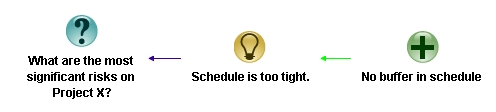
Figure 4: Map in progress
“That’s pretty cool,” said Helen from the other end of the table, “I like the notation, it makes reasoning explicit. Oh, and I have another point in support of Joe and Mike’s risk – the deadline was imposed by management before the project was planned.”
Rick began to enter the point…
“Oooh, I’m not sure we should put that down,” interjected Rob from compliance. “I mean, there’s not much we can do about that can we?”
…Rick finished the point as Rob was speaking.

Figure 5: Two pros for the idea
“I hear you Rob, but I think it is important we capture everything that is said,” said Helen.
“I disagree,” said Rob. “It will only annoy management.”
“Slow down guys,” said Rick, “I’m going to capture Rob’s objection as “this is a management imposed-constraint rather than risk. Are you OK with that, Rob?”
Rob nodded his assent.
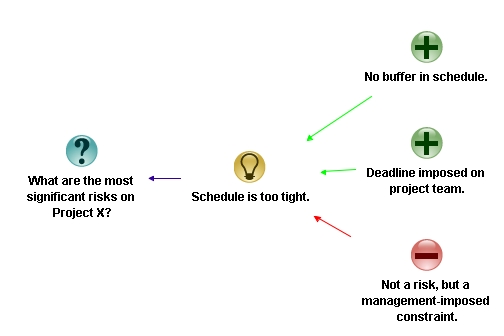
Fig 6: A con enters the picture
I think it is important we articulate what we really think, even if we can’t do anything about it,” continued Rick. There’s no point going through this exercise if we don’t say what we really think. I want to stress this point, so I’m going to add honesty and openness as ground rules for the discussion. Since ground rules apply to the entire discussion, they connect directly to the primary issue being discussed.”

Figure 7: A “criterion” that applies to the analysis of all risks
“OK, so any other points that anyone would like to add to the ones made so far?” Queried Rick as he finished typing.
He looked up. Most of the people seated round the table shook their heads indicating that there weren’t.
“We haven’t spoken about mitigation strategies. Any ideas?” Asked Rick, as he created a question node marked “Mitigation?” connecting to the risk.

Figure 8: Mitigating the risk
“Yeah well, we came up with one,” said Mike. “we think the only way to reduce the time pressure is to cut scope.”
“OK,” said Rick, entering the point as an idea connecting to the “Mitigation?” question. “Did you think about how you are going to do this? He entered the question “How?” connecting to Mike’s point.
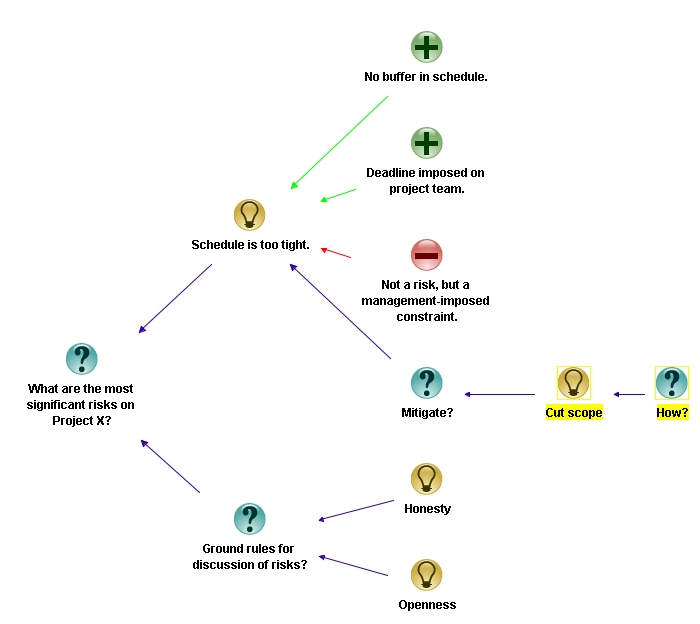
Figure 9: Mitigating the risk
“That’s the problem,” said Joe, “I don’t know how we can convince management to cut scope.”
“Hmmm…I have an idea,” said Helen slowly…
“We’re all ears,” said Rick.
“…Well…you see a large chunk of time has been allocated for building real-time interfaces to assorted systems – HR, ERP etc. I don’t think these need to be real-time – they could be done monthly…and if that’s the case, we could schedule a simple job or even do them manually for the first few months. We can push those interfaces to phase 2 of the project, well into next year.”
There was a silence in the room as everyone pondered this point.
“You know, I think that might actually work, and would give us an extra month…may be even six weeks for the more important upstream stuff,” said Mike. “Great idea, Helen!”
“Can I summarise this point as – identify interfaces that can be delayed to phase 2?” asked Rick, as he began to type it in as a mitigation strategy. “…and if you and Mike are OK with it, I’m going to combine it with the ‘Cut Scope’ idea to save space.”
“Yep, that’s fine,” said Helen. Mike nodded OK.
Rick deleted the “How?” node connecting to the “Cut scope” idea, and edited the latter to capture Helen’s point.

Figure 10: Mitigating the risk
“That’s great in theory, but who is going to talk to the affected departments? They will not be happy.” asserted Rob. One could always count on compliance to throw in a reality check.
“Good point,” said Rick as he typed that in as a con, “and I’ll take the responsibility of speaking to the department heads about this,” he continued entering the idea into the map and marking it as an action point for himself. “Is there anything else that Joe, Mike…or anyone else would like to add here,” he added, as he finished.

Figure 11: Completed discussion of first risk (click to view larger image)
“Nope,” said Mike, “I’m good with that.”
“Yeah me too,” said Helen.
“I don’t have anything else to say about this point,” said Rob, “ but it would be great if you could give us a tutorial on this technique. I think it could be useful to summarise the rationale behind our compliance regulations. Folks have been complaining that they don’t understand the reasoning behind some of our rules and regulations. ”
“I’d be interested in that too,” said Helen, “I could use it to clarify user requirements.”
“I’d be happy to do a session on the IBIS notation and dialogue mapping next week. I’ll check your availability and send an invite out… but for now, let’s focus on the task at hand.”
The discussion continued…but the fly on the wall was no longer there to record it.
—
Afterword
I hope this little vignette illustrates how IBIS and dialogue mapping can aid collaborative decision-making / problem solving by making diverse viewpoints explicit. That said, this is a story, and the problem with stories is that things go the way the author wants them to. In real life, conversations can go off on unexpected tangents, making them really hard to map. So, although it is important to gain expertise in using the software, it is far more important to practice mapping live conversations. The latter is an art that requires considerable practice. I recommend reading Paul Culmsee’s series on the practice of dialogue mapping or <advertisement> Chapter 14 of The Heretic’s Guide to Best Practices</advertisement> for more on this point.
That said, there are many other ways in which IBIS can be used, that do not require as much skill. Some of these include: mapping the central points in written arguments (what’s sometimes called issue mapping) and even decisions on personal matters.
To sum up: IBIS is a powerful means to clarify options and lay them out in an easy-to-follow visual format. Often this is all that is required to catalyse a group decision.


 Eight to Late