Scapegoats and systems: contrasting approaches to managing human error in organisations
Much can be learnt about an organization by observing what management does when things go wrong. One reaction is to hunt for a scapegoat, someone who can be held responsible for the mess. The other is to take a systemic view that focuses on finding the root cause of the issue and figuring out what can be done in order to prevent it from recurring. In a highly cited paper published in 2000, James Reason compared and contrasted the two approaches to error management in organisations. This post is an extensive summary of the paper.
The author gets to the point in the very first paragraph:
The human error problem can be viewed in two ways: the person approach and the system approach. Each has its model of error causation and each model gives rise to quite different philosophies of error management. Understanding these differences has important practical implications for coping with the ever present risk of mishaps in clinical practice.
Reason’s paper was published in the British Medical Journal and hence his focus on the practice of medicine. His arguments and conclusions, however, have a much wider relevance as evidenced by the diverse areas in which his paper has been cited.
The person approach – which, I think is more accurately called the scapegoat approach – is based on the belief that any errors can and should be traced back to an individual or a group, and that the party responsible should then be held to account for the error. This is the approach taken in organisations that are colloquially referred to as having a “blame culture.”
To an extent, looking around for a scapegoat is a natural emotional reaction to an error. The oft unstated reason behind scapegoating, however, is to avoid management responsibility. As the author tells us:
People are viewed as free agents capable of choosing between safe and unsafe modes of behaviour. If something goes wrong, it seems obvious that an individual (or group of individuals) must have been responsible. Seeking as far as possible to uncouple a person’s unsafe acts from any institutional responsibility is clearly in the interests of managers. It is also legally more convenient…
However, the scapegoat approach has a couple of serious problems that hinder effective risk management.
Firstly, an organization depends on its frontline staff to report any problems or lapses. Clearly, staff will do so only if they feel that it is safe to do so – something that is simply not possible in an organization that takes scapegoat approach. The author suggests that the Chernobyl disaster can be attributed to the lack of a “reporting culture” within the erstwhile Soviet Union.
Secondly, and perhaps more important, is that the focus on a scapegoat leaves the underlying cause of the error unaddressed. As the author puts it, “by focusing on the individual origins of error it [the scapegoat approach] isolates unsafe acts from their system context.” As a consequence, the scapegoat approach overlooks systemic features of errors – for example, the empirical fact that the same kinds of errors tend to recur within a given system.
The system approach accepts that human errors will happen. However, in contrast to the scapegoat approach, it views these errors as being triggered by factors that are built into the system. So, when something goes wrong, the system approach focuses on the procedures that were used rather than the people who were executing them. This difference from the scapegoat approach makes a world of difference.
The system approach looks for generic reasons why errors or accidents occur. Organisations usually have a series of measures in place to prevent errors – e.g. alarms, procedures, checklists, trained staff etc. Each of these measures can be looked upon as a “defensive layer” against error. However, as the author notes, each defensive layer has holes which can let errors “pass through” (more on how the holes arise a bit later). A good way to visualize this is as a series of slices of Swiss Cheese (see Figure 1).
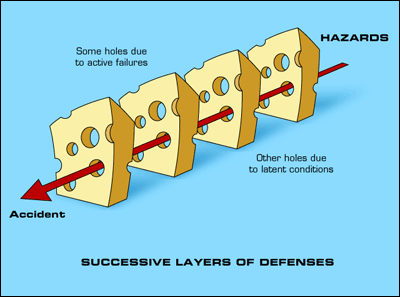
Figure 1: The Swiss cheese model (from: http://patientsafetyed.duhs.duke.edu/module_e/swiss_cheese.html)
The important point is that the holes on a given slice are not at a fixed position; they keep opening, closing and even shifting around, depending on the state of the organization. An error occurs when the ephemeral holes on different layers temporarily line up to “let an error through”.
There are two reasons why holes arise in defensive layers:
- Active errors: These are unsafe acts committed by individuals. Active errors could be violations of set procedures or momentary lapses. The scapegoat approach focuses on identifying the active error and the person responsible for it. However, as the author points out, active errors are almost always caused by conditions built into the system, which brings us to…
- Latent conditions: These are flaws that are built into the system. The author uses the term resident pathogens to describe these – a nice metaphor that I have explored in a paper review I wrote some years ago. These “pathogens” are usually baked into the system by poor design decisions and flawed procedures on the one hand, and ill-thought-out management decisions on the other. Manifestations of the former include faulty alarms, unrealistic or inconsistent procedures or poorly designed equipment; manifestations of the latter include things such as unrealistic targets, overworked staff and the lack of funding for appropriate equipment.
The important thing to note is that latent conditions can lie dormant for a long period before they are noticed. Typically a latent condition comes to light only when an error caused by it occurs…and only if the organization does a root cause analysis of the error – something that is simply not done in an organization takes a scapegoat approach.
The author draws a nice analogy that clarifies the link between active errors and latent conditions:
…active failures are like mosquitoes. They can be swatted one by one, but they still keep coming. The best remedies are to create more effective defences and to drain the swamps in which they breed. The swamps, in this case, are the ever present latent conditions.
“Draining the swamp” is not a simple task. The author draws upon studies of high performance organisations (combat units, nuclear power plants and air traffic control centres) to understand how they minimised active errors by reducing system flaws. He notes that these organisations:
- Accept that errors will occur despite standardised procedures, and train their staff to deal with and learn from them.
- Practice responses to known error scenarios and try to imagine new ones on a regular basis.
- Delegate responsibility and authority, especially in crisis situations.
- Do a root cause analysis of any error that occurs and address the underlying problem by changing the system if needed.
In contrast, an organisation that takes a scapegoat approach assumes that standardisation will eliminate errors, ignores the possibility of novel errors occurring, centralises control and, above all, focuses on finding scapegoats instead of fixing the system.
Acknowledgement:
Figure 1 was taken from the Patient Safety Education website of Duke University Hospital.
Further reading:
The Swiss Cheese model was first proposed in 1991. It has since been applied in many areas. Here are a couple of recent applications and extensions of the model to project management:
- Stephen Duffield and Jon Whitty use the Swiss Cheese model as a basis for their model of Systemic Lessons Learned and Knowledge Captured (SLLKC model) in projects.
- In this post, Paul Culmsee extends the SLLKC model to incorporate aspects relating to teams and collaboration.
The dilemmas of enterprise IT
Information technology (IT) is an integral part of any modern day business. Indeed, as Bill Gates once put it, “Information technology and business are becoming inextricably interwoven. I don’t think anybody can talk meaningfully about one without the talking about the other.” Although this is true, decision makers often display ambivalent, even contradictory attitudes towards enterprise IT. For example, depending on the context, an executive might view IT as a cost of doing business or as a strategic advantage: the former view is common when budgets are being drawn up whereas the latter may come to the fore when a bold new e-marketing initiative is being discussed.
In this post I discuss some of these dilemmas of IT and show how the opposing viewpoints embodied in them need to be managed rather than resolved. I illustrate my point by describing one way in which this can be done.
The dilemmas in brief
Many of the dilemmas of IT are consequences of conflicting views of what IT is and/or how it should be managed. I’ll describe some of these in brief below, leaving a discussion of their implications to the next section:
- IT as a cost of doing business versus IT as strategic asset: This distinction highlights the ambivalent attitudes that senior executives have towards IT. On the one hand, IT is seen as offering strategic advantages to the organization (for example a custom built application for customer segmentation). On the other, it is seen as an operational necessity (for example, core banking systems in the financial industry).
- Centralised IT versus Autonomous IT: This refers to the debate about whether an organisation’s IT environment should be tightly controlled from head office or whether subsidiaries should be given a degree of autonomy. This is essentially a debate between top-down versus bottom-up approaches to IT planning.
- Planning versus Improvisation: This refers to the tension between the structure offered by a plan and process-driven approach to IT and the necessity to step outside of plans and processes in order to come up with improvised solutions suited to the situation at hand. I have written about this paradox in a post on planning and improvisation.
There are other dilemmas – for example, technology driven IT versus business driven IT. However, for the purpose of this discussion the three listed above will suffice.
The poles of a dilemma
In his book entitled Polarity Management, Barry Johnson described how complex organizational issues can often be analysed in terms of their mutually contradictory facets. He termed these facets poles or polarities. In this and the next section, I elaborate on Johnson’s notion of polarity and show how it offers a means to understand and manage the dilemmas of enterprise IT.
The key features of poles are as follows:
Each pole has associated positives and negatives. For example, the up side of viewing IT as a cost is that the organisation focuses on IT efficiency and value for money; the downside is that exploration and experimentation that is necessary for IT innovation would likely be seen as risky. On the other hand, the positive side of IT as a strategic asset is that it is seen as a means to enable an organisation’s growth and development; the negative is that it can encourage unproven technologies (since new technologies are more likely to offer competitive advantages) and uncontrolled experimentation along with their attendant costs.
Most organisations oscillate between poles. At any given time the organisation will be “living” in one pole. In such situations, some stakeholders will perceive the negatives of that pole strongly and will thus see the other pole as being more desirable (the “grass is greener on the other” side syndrome). Johnson labels such stakeholders crusaders” – those who want to rush off into the new world. On the other hand, there are tradition bearers, those who want to stay put. When an organisation has spent a fair bit of time in one pole, the influence of crusaders tends wax while that of the tradition bearers weakens because the negatives become apparent to more and more people.
A concrete example may help clarify this point:
Consider a situation where all subsidiaries of a multinational have autonomous IT units (and have had these for a while). The main benefits of such a model are responsiveness and relevance: local IT units will able to respond quickly to local needs and will also be able to deliver solutions that are tailored to the specific needs of the local business. However, this model has many negative aspects: for example, high costs, duplication of effort, massive software portfolio and attendant costs, high cost of interfacing between subsidiaries etc.
When the model has been in operation for a while, it is quite likely that IT decision makers will perceive the negatives of this pole more clearly than they see the positives. They will then initiate a reform to centralize IT because they perceive the positives of that pole –i.e. low costs, centralization of services etc. – as being worth striving for. However, when the new world is in place and has been operating for a while, the organisation will begin to see its downside: bureaucracy, lack of flexibility, applications that don’t meet specific local business needs etc. They will then start to delegate responsibility back to the subsidiaries…and thus goes the polarity merry-go-round.
Managing enterprise IT dilemmas
As discussed above, any option will have its supporters and detractors. For example, finance folks may see IT as a cost of doing business whereas those in IT will consider it to be a strategic asset. What’s important, however, is that most organisations “resolve” such contradictions by taking sides. That is, one side “wins” and their point of view gets implemented as a “solution.” The concerns of the “losing” side are overlooked entirely.
Although such a “solution” appears to solve the problem, it does not take long for the negative aspects of the other pole to manifest itself; the rumbles of discontent from those whose concerns have been ignored grow louder with time. In this sense, issues that can be defined in terms of polarities are wicked problems – they are perceived in different ways by different stakeholders and so are difficult to define, let alone solve.
As we have seen above, however, the poles of a dilemma are but different facets of a single reality. Hence, the first step towards managing a dilemma lies in realizing that it cannot be resolved definitively; regardless of the path chosen, there will always be a group whose concerns remain unaddressed. The best one can do is to be aware of the positives and negatives of each pole and ensure that the entire spectrum of stakeholders is aware of these. A shared awareness can help the group in figuring out ways to mitigate the worst effects of the negatives.
One which this can be done is via a facilitated session, involving people who represent the two sides of the issue. To begin with, the facilitator helps the group identify the poles. She then helps the group create a polarity map which shows the contradictory aspects of the issue along with their positives and negatives. A rudimentary polarity map for the autonomous/centralized IT dilemma is shown in Figure 1 below.

Figure 1: Polarity map for centralised / autonomous IT dilemma
To ensure completeness of the map, the group must include stakeholders who represent both sides of the dilemma (and also those who hold views that lie between).
As mentioned in the previous section, organisations are not static, they oscillate between poles. Moreover, Johnson claimed that they follow a specific path in the map. Quoting from the book I wrote with Paul Culmsee:
According to Johnson, organisations tended to oscillate between poles. If you accept the notion of a wicked problem as a polarity, the overall pattern traced as one moves between these poles resembles an infinity symbol. The typical path is L- to R+, to R-, across to L+ and Johnson argued that the trajectory could not be avoided. All we can do is focus on minimizing our time spent in the lower quadrants.
Again, it is worth emphasizing that the conflict between the two groups of stakeholders cannot be resolved definitively. The best one can do is to get the two sides to understand each other’s’ point of view and hence attempt to minimize the downsides of each option.
Finally, polarity management is but one way to manage the dilemmas associate with enterprise IT or any other organizational decision. There are many others – and I highly recommend my book if you’re interested in finding out more about these . In the end, though, the point I wished to make in this post is less about any particular technique and more about the need to air and acknowledge differing perspectives on issues pertaining to enterprise IT or any other decision with organization-wide implications.
Wrapping up
The dilemmas of enterprise IT are essentially consequences of mutually contradictory, yet equally valid perspectives. Is IT a cost of doing business or is it a strategic asset? The answer depends on the perspective one takes…and there is no objectively right or wrong answer. Given this, it is important to be aware of both the up and down side of each perspective (or pole) before one makes a decision. Unfortunately, most often decisions are made on the basis of the up side of one option and the down side of the other. As should be evident now, a decision that is based on such a selective consideration of viewpoints invariably invites conflict and leads to undesirable outcomes.
Making sense of sensemaking – a conversation with Paul Culmsee
Introduction
Welcome to the second post in my conversations series. This time around I chat with my friend and long-time collaborator Paul Culmsee who, among many other things, is a skilled facilitator and a master of the craft of dialogue mapping (more on that below).
In an hour-long conversation recorded a couple of weeks ago, Paul and I talked about the art of sensemaking. (Editor’s note: the conversation has been lightly edited for clarity)
What is sensemaking?
KA: Hi Paul, in this conversation I wanted to focus on sensemaking. From our association over the years, I know that’s a specialty of yours. Incidentally, I checked out your LinkedIn profile and saw that you announce yourself as an IT veteran of many years and a sensemaker. So, to begin with, could you tell us what sensemaking is?
PC: [Laughs] First up, thanks for stalking me on LinkedIn. Well the “IT veteran” part is easy – it’s is what I’ve been doing ever since I left university in 1989. Sensemaking came a while later.
In a nutshell, sensemaking is about helping groups make sense of complex situations that might otherwise lead them into tense or adversarial conditions. A lot of projects exhibit such situations from time to time. Sensemaking seeks to help groups develop a shared understanding of these sorts of situations.
KA: OK, so what I’m hearing is that it is about helping people get clarity on an ambiguous situation or may be, even define what the problem is.
PC: Yeah absolutely…and we alluded to this in our Heretic’s book. It is staggering when one realizes how many teams and individuals (in teams and in organisations) spend a stack of money and time without being aligned on the problem that they’re solving. Often this lack of alignment becomes evident only in the wash, long after anything can be done. In some ways it beggars belief that that could happen; that a project or initiative could go on for long without alignment, but it does happen quite often. Sensemaking seeks to eliminate that up front.
There are various tools, techniques and collaborative approaches that one can use to bring people together to air and reconcile different viewpoints. Of course, this assumes that people genuinely want to see things improve, and in my experience this is often the case. A lot of the time, therefore, sensemaking is simply about helping groups reach a shared understanding so that subsequent actions can be taken with full commitment from everybody concerned.
KA: All that sounds very reasonable, even obvious. Why do you think this has been neglected for so long? Why have people overlooked this?
PC: Mate, I’m glad we’re having beers as we talk about this [takes a swig].
Look I think it is often seen as an excuse to have a talk-fest, and I think that criticism is actually quite fair. I think organisations…or, rather, the people within them…tend to have a very strong drive to move to action. The idea of stopping and thinking is seen as not being a particularly productive use of time.
Actually, if you delve into it, sensemaking has been around for years and years. In fact, pretty much anyone who is a facilitator is a sensemaker as well in that he or she seeks to help people [overcome an issue that they’re facing as a group]. The problem is that a lot of the techniques used in sensemaking are rooted in theories or philosophies that aren’t seen as being particularly practical. To a certain extent, the theories themselves are to blame. For example, the first time I heard about soft systems theory, I had no idea what the person was talking about. (Editor’s note: a theory that underlies many facilitation techniques)
KA: Yes, that’s absolutely right. Systems theory itself has been around for a long time….since the 1950s I think. It’s also been resurrected in various guises ever since, but has always had this reputation (perhaps unfair) of being somewhat impractical. So, I’m curious as to how you actually get around that. How do you sell what you do? (Editor’s note: Systems theory is the precursor of soft systems theory)
PC: By example. It’s really as simple as that. If you take the example of dialogue mapping, which is a practical facilitation approach involving the visual capture of rationale using a graphical notation. Even that…which is a practical tool…is much easier to show by example than to explain conceptually. If I were to try to explain what it is in words, I’d have to say something like “I sit in a room and get paid to draw maps. I map the conversations and facilitate at the same time.” People might then say, “What’s that? Is it like mind mapping?” Then I have no choice but to say, “Well, yeah…but there’s a lot more to it than that.”
So I’ve long since given up on explaining it to people conceptually; it’s much easier to just show them. Moreover, in a lot of the situations where I do engagements for clients, I discourage the sponsor from making a big deal about the technique. I’d rather just let the technique “sell itself”.
KA: Yeah that rings true. You know, I was trying to write a blog post once on dialogue mapping, and realized it would be much better to tell it through a story (Editor’s note: …and the result was this post).
OK, so you’ve told us a bit about dialogue mapping, and I know it is a mainstay of your practice. Could you tell us a bit about how you came to it and what it has done for you?
PC: Oh, it’s changed my career. In terms of what it’s done for me – well, where I am now is a direct result of my taking up that craft. And I call it a craft because it took a damn lot of practice. It is not something where you can read a book and go “Oh that makes sense,” and then expect to facilitate a group of twenty people or anything like that.
How I came to it was as follows: I had come off a large failed project and was asking myself what I could have done differently. In hindsight, the problem was pretty obvious: there were times when things were said by certain stakeholders and I should have gone, “Right, stop!” But I didn’t. Of course, such mistakes are part of a learning journey. I subsequently did some research on techniques that might have helped resolve such issues and came to dialogue mapping directly as a result of that research.
Then, through sheer luck I got to apply the technique in areas other than my discipline. As I said earlier, I’m an IT guy and have been in IT for a long time, but I was lucky to get an early opportunity to use dialogue mapping in an area that was very different from IT (Urban planning to be precise). I sucked at it completely in that first engagement, but did enough that the client got value out of it and asked me back.
That engagement was a sink or swim situation, and I managed to do just enough to stay afloat. I should also say that the group I worked with really wanted to succeed: even though they were deadlocked, the group as a whole had a genuine intent to address the problem. Fortunately we were able to make a small breakthrough in the first session. We ended up doing six more sessions and had a really good outcome for the organisation.
Framing questions
KA: That’s interesting…but also a little bit scary. A lot of people would find a situation like that quite daunting to facilitate. In particular, when you walk into a situation where you know a group has been grappling with a problem for a long time, you first need to make sense of it yourself. How do you do that?
PC: Yeah, well as you do it more of it, you gain experience of different situations and domains – for example, not-for-profit organizations, executives of a business, public sector or what have you. You then begin to notice that the patterns behind complex problems are actually quite similar across different areas. Although I can’t quite put my finger on what exactly I do, I would say that it is largely about “listening to the situation” and “asking the right questions”.
When Jeff Conklin teaches dialogue mapping, he talks about the seven different question types (Editor’s note: Jeff Conklin is the inventor of dialogue mapping. See this post for more on his question types). He really gets you to think about the questions you’re going to ask. It took me a while to realize just how important that is: the power of asking questions in the right way or framing them appropriately. Indeed, the real learning for me began when I realized this, and it happened long after I had mastered the notation.
The fact is: each situation is unique. I approach strategic planning, team development or business analysis in completely different ways. I can’t give you a generic answer on the approach, but certainly nowadays when I’m presented with a scenario, I find that there is not much that is unfamiliar. I’ve seen most of the territory now, perhaps.
KA: So it’s almost like you’ve got a “library” of patterns which you can find a match to the situation you’re in
PC: Yes that’s right…and I should also mention that the guys I worked with in my early days of using the craft were also sensitive to this, even though they did not practice dialogue mapping. One of my earliest gigs was to develop a procurement strategy for a major infrastructure project. We spent half a day – from 8:30 in the morning to 1:00 in the afternoon – just trying to figure out what the first question should be. It’s conversations like that in the early days, followed by trial and error in actual facilitation scenarios that aided my learning.
KA: That’s interesting, and I’d like to pick up on what you said earlier about the power of asking the right questions. Jeff Conklin has his seven question types which he elaborates at length in his book (and we also talk about them in the Heretic’s Guide). However, since then, I know that your thinking on this has advanced considerably. Could you tell us a bit more about this?
PC: Yeah, if we ever do a second edition of the Heretic’s Guide, I’ll definitely be covering this kind of stuff. But, let me try to explain some of the ideas here in brief.
To set the context, I’ll start with one of Jeff’s question types. An important question type is the deontic question, which is a question that a lot of maps start with. A deontic question asks “What ought to be done?” – for example, “What should we do about X?” The aim of such a question is to open up a conversation.
However, deontic questions can be poorly framed. To take a concrete example, say if one were to ask, “What should we do about increasing X?” – well such a question implicitly suggests a course of action – i.e. one that increases X. A well framed deontic question doesn’t do that. It solicits information in a neutral or open way. (Editor’s Note: For example, a well-framed alternative to the foregoing question would be, “What should we do about X?”)
All that is well and good, and is something I teach in my dialogue mapping courses as does Jeff in his. However, I once taught dialogue mapping to a bunch of business analysts, and of course told them about the importance of asking deontic questions. Some of the guys told me that they intended to use it at work the following week. Well, I saw them again a few weeks later and naturally asked, “So how did it go?” They said, “Hey that the deontic question just didn’t work!”
I kind of realized then, and in fact I had mentioned to them (but may be not stressed it enough), that questions need to be framed to suit the situation. You can ask an open deontic question in a really bad way… or even lead at the wrong time with the wrong question.
The more I thought about it, the more I realized that there are patterns to [framing] questions. In other words, there are ways of asking questions that will lead to better outcomes. As an example, a deontic question might be, “What should our success indicators be on this project?” This is a perfectly valid open question (as per Conklin’s question types). However, in a workshop setting this is probably not a good question to ask because the conversation will go all over the place without reaching any consensus. Moreover, people who don’t have tolerance for ambiguity would be uncomfortable with a question like that.
A better option would be to reframe the question and ask something like, “If this initiative were highly successful and we look back on it after, say 2 years, how would things be different to now?” With that question what you’re saying to people is: let’s not even worry about problem definition, context, criteria and all that stuff that comes with a deontic question; instead you’re asking them to tell you about the difference between now and an aspirational future. This is easier to answer. A lot of people will say things like – we’ll have more of X and less of Y and so on.
On a related note, if you want to understand the long-term implications of “more of X” or “less of Y”, it is not helpful to ask a question like, “What do you think will happen in the long-term?” People won’t intuitively understand that, so you won’t get a useful answer. Instead it is better to ask a question like, “What behaviours do you think will change if we do all this sort of stuff?” Now, if you think about it, the immediate outcomes of projects are things like “increased awareness of something “or “better access to something”, but over time you’re looking for changes in behaviours because that’s when you know that the changes wrought by an initiative have really taken root.
Subtle reframings of this kind yield richer answers that are more meaningful to people. Moreover, when you solicit responses from a group in this manner, you’ll start to see common themes emerge. These are the sorts of subtleties I have come to understand and appreciate through my practice of sensemaking.
Obliquity
KA: That’s fascinating. So what you’re saying is that rather than asking a direct question it is better to ask an oblique one. Is that right?
PC: Yes, and I think that point is worth elaborating. You used the word “oblique” and I know you’re using it deliberately because we’ve talked about this in the past. Essentially I think the “law of asking questions” is that the more direct question, the less likely it is that you will get a useful answer.
Seriously, asking a question like “What should our vision be?” is a completely brainless way of getting to a vision. You’re more likely to get a useful answer from a question like “What would our organization look like three years from now, if we achieved all we are setting out to do?” The themes that come out of the answers to these kinds of question help in answering the direct question.
I’ve learnt that the question that everyone wants answered is never the one you start with. If you start with the direct question, the conversation will meander over all kinds of weird places.
I came across the notion of obliquity in an article (…and I think it was one of the rare times I sent you something instead of the other way around). In the article, the author (John Kay) made the observation that organisations that chased KPIs like earnings per share (for example) generally did not do as well as organisations that had a more holistic vision (Editor’s note: I also recommend Kay’s book on obliquity). One example Kay gives is that of Microsoft whose objective in the 90s wanted “a PC on every desk in the world.” Microsoft achieved the earnings per share alright, but it was pursued via an oblique goal.
Organisations that chase earnings per share or other financial metrics tend to be like the folks who “seek happiness” directly instead of trying to find it by, say, immersing themselves in activities that they enjoy. I guess I observed that the principle of obliquity – that things are best achieved indirectly – also applies to the art of asking questions.
KA: That makes a lot of sense. Indeed, after we exchanged notes on the article and Kay’s book, I’ve noticed this idea of obliquity popping up in all different kinds of contexts. I’m not sure why this is, but I think it has something to do with the fact that we don’t really know how the future is going to unfold, and obliquity helps open our minds up to possibilities that we would overlook if we took a “straight line from A to B” kind of approach.
PC: Yep, and that brings up an interesting aspect to oblique questions as well. You know, some people – especially those trained in a standard business school curriculum will be surprised if you ask them an oblique question because it seemingly makes no sense. They might say, “Well, why would you ask that? What we really want to answer is this”
Well, I’ve found a way to deal with this, and I learnt this from working with a facilitator who is a professor at one of the business schools here (in Perth). This was in a strategic planning workshop that we co-facilitated. Before starting, she walked up to the whiteboard and sketched out a very simple strategic planning model – literally a diagram that said here’s our vision, and the vision leads to a mission, which leads to areas of focus which, in turn, lead to processes…a simple causal diagram with a few boxes connected by arrows.
She spent only a minute or so explaining this model; she didn’t do it in any detail. Then she pointed to a particular box and said, “We’re going to talk about this particular one now.” And I don’t know why this is, but when you present a little model like that (which is familiar to the audience) and say that you’re going to focus on a particular aspect of it, people seem to become more receptive to ambiguity, and you can then get as oblique as you like. Perhaps this is because the narrative is then aligned with a mental model that is familiar to them.
What I’ve learnt, in effect, is that you can’t talk about the wonders of complex systems theory to a bunch of rational project managers. Conversely, when I’m dealing with a group of facilitators (who love all that systems theory stuff) I would never draw a management model going from vision to mission to execution. But when dealing with the corporate world, I will often use a model like that. Not to educate them – they already know the model – but purely to reduce their anxiety. After that I can ask them the questions I really want to ask. It’s a subtle trick: you put things in a familiar frame and then, once you have done that, you can get as oblique as you like.
Tying this back to a question you asked earlier about how I prepare for a facilitation session. Well, I usually try to figure out audience first. If I’m dealing with the public sector I might set the stage by talking about wicked problems, whereas with corporate clients I might start with a Strategic Planning 101 sort of presentation. Either way, I find a frame that is familiar to them and then – almost like a sleight of hand – I switch to the questions I really want to ask. Does that make sense?
KA: Yeah, so to summarise: you give them a security blanket and then scare the hell out of them [laughs]
PC: That’s actually pretty well summarized [laughs]; I like where you’re going with that…but I’d put it slightly differently. It’s actually a bit like when you’re trying to get little kids to eat something they don’t want to eat – you go, “see here’s the choo-choo train” or something like that, and then get them to have a spoonful while their focusing on that. In a way it’s like creating a distraction. But the aim is really to couch things in such a ways as to get to a point where you can start to have a productive dialogue. And the dialogue itself is driven by powerful questions.
From obliquity to directness
KA: By powerful, I guess you mean oblique…
PC: Yeah, the oblique aspect of questions is a common thread that runs through much of what I do now. Mind you, I don’t stay oblique all the way through a session. I start obliquely because I want to unpack a problem. Eventually, though, as people start to get insights and themes begin to emerge, I become more direct; I start to ask things such as who, when etc…putting names and dates down on the map.
KA: So you get more direct in your questioning as the group starts to reach a common understanding of a problem.
PC: That’s exactly right. But there’s the other side to it (and by the way, you should have a conversation with my colleague Neil on this kind of stuff): you typically have a mixed audience, the “left-brainers” who are rational engineer types as well as the “hippies” (the so-called “right-brainers”) who want to stay out in conceptual-land. Both groups like to stay in their comfort zone: the engineers don’t like moving to conceptual-land because they see it as a waste of time; on the other hand conceptual people don’t like moving to action because the conceptual world feels safer to them. So I sort of trick the engineers into doing conceptual stuff while also pushing conceptual guys into answering more direct questions.
Other techniques and skills
KA: Interesting. Let’s talk a bit about techniques – I know dialogue mapping is a mainstay of much of what you do. What are some of the other techniques you use [to draw people out of their comfort zones]? You mentioned soft systems theory and a few others; you seem to have quite a tool-chest of techniques to draw upon.
PC: Yeah well, when I got into mapping, I also looked at other techniques. I was interested in what else you could do, so I looked at various gamestorming techniques, graphic facilitation and, of course, many methods based on the principles of soft systems and related theories.
I use techniques from both the right-brained and left-brained ends of the spectrum…and by the way, I apologize to any neuroscientists who might be reading/listening to this because I know they hate the term left/right brained. However, I do find it useful sometimes.
Anyway, a popular technique on the right-brained end of the spectrum is Open Space, which operates almost entirely in conceptual-land. It relies on the wisdom of the crowd; there is no preset agenda, just a theme. People sit in a circle, there’s a Tibetan bell…an on the surface it all seems quite hippy. However, I’ve actually done it in construction projects where you have folks who have come off a building site, dressed in their safety gear – hard hats and all – and participated in such situations. And it does work, despite its touchy-feely, hippy image.
On the other hand, once you’ve conceptualized a project you need to get down to hard work of getting stuff done. One of the first questions that comes up is, “How do we measure success?” This usually boils down to defining KPIs. Now, I would never dialogue map or open space a conversation on KPIs. You might get a few themes from dialogue mapping, but definitely not enough detail. Instead, one of the things I often do is go to an online KPI library (like http://kpilibrary.com which has over 7000 KPIs) in which you can find KPIs relating to any area you can think of, ranging from project management to customer service to quality or sustainability. I’ll then print relevant ones on cards and then use a card-sorting technique in which I put people in different groups and ask them to look at specific focus areas [that emerged from the conceptualization phase], and figure out which KPIs are relevant to it.
Why do I do that? Not because I think they will find the KPI. They probably won’t. It’s more because such a process avoids those inevitable epic arguments on what a KPI actually is.
A very effective technique is to spend half a day unpacking a problem via dialogue mapping and get key themes to emerge. This “conceptualization phase” is done with the whole group. Then, when you want to drill down into detailed actions action, it helps to use a divide and conquer approach. This is why I split people up into smaller groups and get them to go off and work on themes that emerged from the conceptualization phase. The aim is to get them to come up with concrete KPIs or even actions. If I’m feeling really evil, when there’s only 10 minutes left, I’ll tell them that they can present only their top four actions or KPIs. This forces them to prioritise things according to value. It’s a bit like a Delphi technique really. Finally, the groups come back together and present all their findings, which I then dialogue map. Once that is done, the larger group (together) will turn to the map and synthesise the outputs of what the smaller groups have done. This example is quite typical of the kind of stuff that I do.
Another example: I did some strategic planning work for local government – this was in the area of urban planning. Now, we did not want them to just copy someone else’s community development plan and “cookie cutter” it. So the very first thing we did was a dialogue mapping session geared towards answering a couple of questions: 1) if the community development plan for this organization was highly successful, how would things be different from how they are now? And, 2) what is unique about this particular area (shire)?
Then, in the second workshop we got some of the best community development plans from around Australia and put each one at a different table. We split people up into groups and got them to spend time at each table. Their job was to note down, on flipcharts, the pros and cons of each plan. The first iteration took about half an hour – presumably because this was the first time many of them were reading a development plan. Once the first iteration was done, people moved to the next table and so on, in round robin fashion.
By the end of that exercise, everyone was a world expert in reading community development plans. By the time people got to their third plan, they were flicking through the pages pretty fast, noting down the things they agreed or disagreed with. Then they came back together and did a synthesis of the common themes were – what was good, what was bad and so on.
Finally, we dialogue mapped again, and this time the question was, “Given what we have seen in all of the other plans, what are we going to do differently to mitigate the issues we have seen with some of them?” That pretty much nailed what they were going to do with their plan.
The need to improvise
KA: From what you’re saying it seems that almost every situation you walk into is different, and you almost have to design your approach as you go along. I suppose you would make a guess or some tentative plans based on your knowledge of the make-up of the audience, but wouldn’t you also have to adjust a lot on-the-fly?
PC: Oh yeah, all the time. And in fact, that is more a help than a hindrance. I’ll tell you why…by example again.
Often groups will tell you what they aspire to do. They might say, “as a general principle, we will do this” or something along those lines. For me that’s gold because I can use it on them [laughs].
In fact, I did this a couple days ago in a workshop. Earlier in the workshop they had said, “It’s OK to make mistakes as long as we are honest with each other and upfront about it.” I totally used that on them towards the end of the workshop when I said, “Given that you guys are honest with each other, the question I’d like you to answer is – what keeps you up at night with this project?”
My colleague uses the phrase, “hang them by their own petard” when we do this kind of stuff [laughter]. I guess what we’re doing, though, is calling them out on what they espouse, and getting them to live it. If you can do that in a workshop, it is brilliant. So I’m always on the lookout for opportunities to improvise like that, particularly when it is a matter of (espoused) principle.
There are many times when I’ve been in workshops where the corporate values are hanging on a wall – in a boardroom, right – and I’m witnessing them get completely trashed in the conversation that’s happening. So I like to hold people to account to what’s stated…and these are sneaky little subtle ways in which one can do that.
KA: I’m sure you come across situations where a certain approach doesn’t go down very well – may be people start to get defensive or even question the approach. Does that happen, and how do you deal with that?
PC: I’ve never had a situation where people question the approach I use. I guess that’s because we’re able to deal with that as it happens. For example, if I’m going a bit too “hippie” on a group and I see that they need more structure then I’ll change my approach to suit the group and then gently nudge them back to where I want them to be.
I also co-facilitate with other people…and sometimes they’re the ones who design the workshops, or I co-design it with them. Often it is their tolerance for ambiguity that can be a roadblock. One facilitator I work with loves emergence. This is my crass generalization, but anyone who thinks complex systems theory is just it will be happy to let a group get mired in ambiguity. The group might be struggling, but as far as the facilitator is concerned that’s OK because he or she believes that ambiguity is necessary for an emergent outcome. What they forget is that not everyone has the same level of tolerance for ambiguity.
On the other hand, I also work with highly structured facilitators who follow a set path – “we’ll do this, then we’ll do that and so on”. This approach might not go so well with people who prefer more open-ended approaches.
These sorts of experiences have been handy. When designing my own workshops, I’m the ultimate bower bird: I cherry pick whatever I need and improvise on the fly. So I tend not to worry about the risks of people not finding the workshop of value. That probably comes from a level of confidence too: we’re reasonably confident that we know our craft and have enough experience to deal with unexpected situations.
Coda – capturing organisational knowledge
KA: Thanks for the insights into sensemaking. Now, if you don’t mind, I’d like to switch tack and talk about something that your organization – Seven Sigma – is currently involved in. I know you guys started out as a SharePoint outfit, and you’ve been doing some interesting things in SharePoint relating to knowledge management. Could you tell us a bit about that before we wrap up?
PC: Sure. To begin with, dialogue maps are a pretty good knowledge artifact. Anyone who has used the Compendium software will know this (Editor’s note: Compendium is a free software tool that can be used for dialogue mapping). I’ve used it extensively for the last five years and have an “encyclopedia of conversations” that I have mapped. When I go and look at them, they’re as vivid to me as on the day I mapped them. So I’ve always been fascinated by the power of dialogue maps as a visceral way to capture the wisdom of a group at a point in time.
Now SharePoint is a collaborative platform that’s often used for intranets, project portals, knowledge management portal and so forth. It’s a fairly versatile platform. The Compendium software on the other hand, is not a multi-user, collaborative platform. It’s more like Photoshop or Word in that you use it to create an artefact – a map – but if someone else wants to see the map then he or she has to install Compendium. And it can be a bit of a pain in the butt to install Compendium as it is a freebie, open source product that doesn’t really fit in an enterprise environment. We’ve therefore always wanted to have the ability to import maps into SharePoint and my colleague Chris [Tomich] had already started writing some code to do that around the time we first got into dialogue mapping.
However, my own Aha moment came later; and come to think of it, the fact that we’re having beers in this conversation is relevant to this story…
I was dialogue mapping a group of executives about 4-5 years ago; it was a team-building exercise built around a lessons learned workshop. The purpose of the workshop was to improve the collaborative and team maturity of this group. [As a part of this exercise] the group was reviewing some old projects, doing a sort of retrospective lessons learned. We got to this one project, and someone complained about an organisational policy that had caused an issue on the project. Now as it happened, there was this guy in the group who knew how this policy had come about (I knew this guy, by the way, and I also knew that he was about to retire). He said, “Oh yeah, well that happened about 30 years ago, and it was on so-and-so project.” He then proceeded to elaborate on it.
Well, I knew this guy was about to retire. I also knew that the organization does this “phased retirement” thing, where people who are about to retire write documentation about what they do, mentor their successors etc. before they leave. I remember thinking to myself, “there’s no way in hell that he would have written that down in his documentation.” I just knew it: he had to be in that particular conversation for him to have remembered this.
Then my next thought…and as I’m mapping, I’m having this thought … “man, someone just ought to give him a beer, sit him down, and ask him about these kinds of old projects. I could map that video…how hard could that be? If one can map live conversations then surely one can map videos.” In fact, videos should be simpler because you can pause them, which is something you can’t do with live conversations.
So that was literally the little spark. It started with me thinking about how great it would be if this guy could spend even half his time recording his reflections…and this could take different forms, may be it could be a grad asking him questions in a mentoring scenario, or it could be another person he has worked with for years and they could reminisce over various projects. The possibilities were endless. But the basic idea was simple: it was to try to capture those sorts of water cooler or pub conversations, or those that you have in conferences. That’s where we get many of our insights – it’s the stories, the war stories through which we learn. That kind of stuff never gets into the manuals or knowledge-base articles.
Indeed, stories are the key to those unwritten insights about, say, when it is OK to break the rules. That kind of stuff can never be captured in the processes, manuals or procedures. One of your pieces highlights this beautifully – it’s one of the parables you’ve written I think, where an experienced project manager suggested to the novice that he should be listening to the stories rather than focusing on the body of knowledge he was studying. And that is completely true.
So that was, to coin a pun, the “glimmer of an idea” – because the product is called Glyma. The idea was to capture expert knowledge by mapping it and storing the map in SharePoint. SharePoint has a great search engine and we already knew that dialogue maps are a great way to capture conversations in a way that makes it easy to understand and navigate rationale (or the logic of a conversation). If we could do dialogue maps live, then we sure as hell could map videos. Moreover SharePoint also offers the possibility of tagging, adding feeds etc. – the kinds of things that portals these days are good at. It occurred to us that no one had really done that before.
Sure, there are plenty of story captures, say where people capture reflections on video. But because the resulting videos tend to be quite big, they are usually edited down to 15 minute “elevator pitch” type presentation. But then all the good stuff is gone; indeed, you and I have had many of these brief conversations where you’re summarising something terrific you’ve read and I’ll go, “Yeah well, that doesn’t sound so interesting to me.” The point is: you can’t compress insight into a convenient 10 minute video with nice music. So our idea was – well, don’t do that; take the video as it is and map it. Then, if you click on a node – say an idea node or a question node –Glyma will play the video from the point in time where the idea or question came up. You don’t have to sit through the entire thing. Moreover, when you do a search and get a series of results, you can click on a result and it plays that bit straight away.
So that was really the inspiration for Glyma…and it will see the light of day very soon.
Actually we’ll be putting a beta site out early next week (Editor’s note: the site has since gone live; I urge you to check it out). By the way, Glyma has been four years in the making. One of last things on our bucket list of things to do while running a consultancy was to put an innovative new product out and to see if people like it. So that’s where we are going with that.
KA: That’s sounds very interesting. The timing should work out well because this conversation will be posted out in a week or two as well. I wish you luck with Glyma; I’ve seen some early versions of it and it looks really good. I look forward to seeing how it does in the market place and what sort of reception it receives. I certainly hope it gets the reception it deserves because it is a tremendous idea.
PC: Well thank you; I appreciate your saying that…and we’ll see if you still say that once you’ve mapped this video because that might be your homework. [laughs]
KA: [laughs] Alright, great mate. Well, thanks for your time. I think that’s been a really interesting conversation. We’ll chat about Glyma further after it’s been out for a while.
PC: Yeah absolutely.
KA: Cheers mate.
PC: See ya.


 Eight to Late