Posts Tagged ‘Change Management’
On the velocity of organisational change
Introduction
Management consultants and gurus emphasise the need for organisations to adapt to an ever-changing environment. Although this advice is generally sound, change initiatives continue to falter, stumble and even fail outright. There are many reasons for this. One is that the unintended consequences of change may overshadow its anticipated benefits, a point that gurus/consultants are careful to hide when selling their trademarked change formulas. Another is that a proposed change may be ill-conceived (though it must be admitted that this often becomes clear only after a change has been implemented). That said, many changes initiatives that are well thought through still end up failing. In this post I discuss one of the main reasons why this happens and what one can do to address it.
Change velocity
Let’s begin with a two dimensional grid as in Figure 1, with time on the horizontal axis and the state of the organisation along vertical axis (before going any further I should also mention that this model is grossly simplified – among other things it assumes that the state of the organisation can be defined by a single variable). We can represent the current state of a hypothetical organisation by the point marked as the “Initial state” in Figure 1.
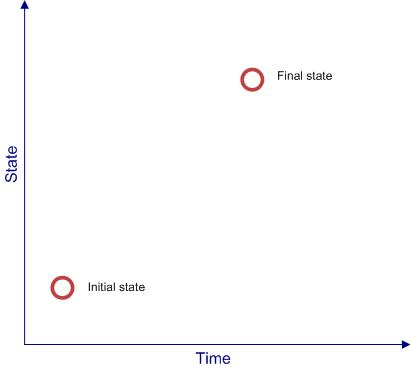
Figure 1: Initial and final states of change.
Now imagine that the powers that be have decided that the organisation needs to change. Further, let’s imagine (…and this is hard) that they have good advisors who know what the organisation should look like after the change. This tells us the position of the final state along the vertical axis.
To plot the final state of the organisation on our grid we also need to fix its position along the horizontal (time) dimension- that is, we need to know by when the change will be implemented. The powers that be are so delighted by the consultants’ advice that they want the changes to be rolled out asap (sound familiar?). Plucking a deadline out of thin air, they decree it must be done by within a certain fixed (short!) period of time.
The end state of the organisation is thus represented by the point marked as the final state in Figure 1.
Let’s now consider some of the paths that by which the organisation can get from initial to the final state. Figure 2 shows some possible change paths – a concave curve (top), a straight line (middle) and a convex curve (bottom).
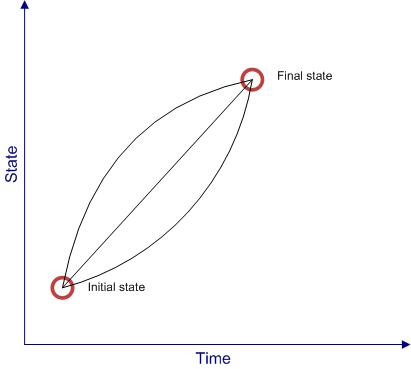
Figure 2: Three change paths
Insofar as this discussion is concerned, the important difference between these three curves is that each them describes a different “rate of change of change.” This is a rather clumsy and confusing term because the word change is used in two different senses. To simplify matters and avoid confusion, I will henceforth refer to it as the velocity of organisational change or simply, the velocity of change. The important point to note is that the velocity of change at any point along a change path is given by the steepness of the curve at that point.
Now for the paths shown in Figure 2:
- The concave path describes a situation in which the velocity of change is greatest at the start and then decreases as time goes on (i.e. the path is steepest at the start and then flattens out)
- The straight line path describes a situation in which the velocity of change is constant (i.e. the steepness is constant)
- The convex path describes a situation in which the velocity of change is smallest at the start and then increases with time. (i.e. the path starts out flat and then becomes steeper as the end state is approached)
To keep things simple I’ll assume that the change in our fictitious organisation happens at a constant velocity – i.e it can be described by the straight line. This is an oversimplification, of course, but not one that materially affects the conclusion.
What is clear is that by mandating the end date, the powers be have committed the organisation to a particular velocity of change. The key question is whether the required velocity is achievable and, more important, sustainable over the entire period in which the change is to be implemented.
An achievable and sustainable change velocity
Figuring out an achievable and sustainable velocity of change is no easy matter. It requires a deep understanding of how the organisation works at a detailed level. This knowledge is held by key people who work at the coalface of the organisation, and it is only by identifying and talking to them that management can get a good understanding of how long their proposed changes may take to implement and thus the actual path (i.e. curve) from the initial to the final state. Problem is, this is rarely done.
The foregoing discussion suggests a rather obvious way to address the issue –reduce the velocity of change or, to put it in simple terms, slow the pace of change. There are two benefits that come from doing this:
- First, the obvious one – a slower pace means that it is less likely that people will be overwhelmed by the work involved in making the change happen.
- The organisation can make changes incrementally, observe its effects and decide on next steps based on actual observations rather than wishful thinking.
- The organisation has enough time to absorb and digest the changes before the next instalment comes through. Implementing changes too fast will only result in organisational indigestion.
Problem is, the only way to do this is to allow a longer time for the change to be implemented (see Figure 3). The longer the time allotted, the lower the velocity of change (or steepness) and the more likely it is that the velocity will be achievable and sustainable.

Figure 3: Increasing allotted time reduces change velocity
Of course, there is nothing radical or new about this, It is intuitively obvious that the more time one allows for a change to be implemented, the more likely it is to be successful. Proponents of iterative and incremental change have been saying this for years – Barbara Czarniawska’s wonderful book, A Theory of Organizing, for example.
Summarising
Many well-intentioned organisational change initiatives fail because they are implemented in too short a time. When changes are implemented are too fast, there is no time to reflect on what’s happening and/or fix problems. The way to avoid this is clear: slow down. As in a real journey, this will give you time to appreciate the scenery and, more important, you’ll be better placed to deal with unforeseen events and hazards.
The paradoxes of organisational change
Introduction
It is a truism that organisations are in a constant state of change. It seems that those who run organisations are rarely satisfied with the status quo, and their unending quest to improve products, performance, sales or whatever makes change an inescapable fact of organizational life.
Many decision makers and managers who implement change take a somewhat naïve view of the process: they focus on what they want rather than all the things that could happen. This is understandable because change projects are initiated and plans made when all the nitty-gritty details that may cause problems are not yet in view. Given that it is impossible to surface all significant details at the start. is there anything that decision-makers and managers can do to address the inevitable ambiguity of change?
One of the underappreciated facets of organizational change is that it is inherently paradoxical. For example, although it is well known that such changes inevitably have unintended consequences that are harmful, most organisations continue to implement change initiatives in a manner that assumes complete controllability with the certainty of achieving solely beneficial outcomes.
It is my contention that an understanding of the paradoxes that operate in the day-to-day work of change might help managers in developing a more realistic picture of how a change initiative might unfold and some of the problems that they might encounter. In this post, I look at the paradoxes of organizational change drawing on a paper entitled, The social construction of organizational change paradoxes.
Paradoxes are social constructs
More often than not, the success of an organizational change hinges on the willingness of people to change their attitudes, behaviour and work practices. In view of this it is no surprise that many of the difficulties of organizational change have social origins.
Change makes conflicting demands on people: for example, managerial rhetoric about the need to improve efficiency is often accompanied by actions that actually decrease it. As a result, many of the obstacles to change arise from elements that seem sensible when considered individually, but are conflicting and contradictory when taken together. This results in paradox. As the authors of the paper state:
We propose that paradox is constructed when elements of our thoughts, actions and emotions that seemed logical when considered in isolation, are juxtaposed, appearing mutually exclusive. The result is often an experience of absurdity or paralysis.
Again it is important to note that change-related paradoxes have social origins – they are caused by the actions of certain individual or groups and their effects or perceived effects on others.
Paradoxes of organizational change
The authors describe three paradoxes of organizational change: paradoxes of performing, belonging and organizing. I describe each of these below, but before I do so, it is worth noting that paradoxes are often exacerbated by people’s reactions to them. In particular, those affected by a change tend to interpret it using frames of reference that accentuate negative effects. For example, employees may view a change initiative as a threat rather than an opportunity to improve performance. Paradoxically, their perceptions may become a self-fulfilling reality because their (negative) reactions to the change may reinforce its undesirable effects.
That said let’s look at the three paradoxes of organizational change as described in the paper.
Paradoxes of performing
A change initiative is invariably accompanied by restructuring that results in wholesale changes in roles and responsibilities across the organisation. Moreover, since large-scale changes take a long time to implement, there is a longish transition period in which employees are required to perform tasks and activities associated with their old and new roles. During this period, employees may have to deal with competing, even conflicting demands. This, quite naturally, causes stress and anxiety.
Paradoxes of performing relate to contradictions in employees’ self understanding of their identities and roles within the organisation. As such, these paradoxes are characterized by mixed messages from management. As the authors state, people faced with such paradoxes often express feelings of rising frustration with/distrust of management, doubt (inability to choose) or nihilism (futility of choice). This paradox isparticularly common when organisations transition from a traditional (functional) management hierarchy to a matrix structure.
Paradoxes of belonging
Another consequence of organizational restructuring is that old hierarchies and workgroups are replaced by new ones. Adjusting to this requires employees to shift allegiances and develop new work relationships. Leaving the safety of a known group can be extremely stressful. Moreover, since the new structures are rarely defined in detail, at least at the start, there is a great deal of ambiguity as to what it really stands for. It is no surprise, therefore, that some employees attempt to maintain the status quo or even leave while others benefit from the change.
At the heart of this paradox is a double bind where a desire to maintain existing relationships competes with the realization that it is necessary to develop new ones. People react to this differently, depending on their values, motivations and (above all) their ability to deal with ambiguity. Inevitably, such situations are characterized by antagonistic attitudes that accentuate differences and/or peoples’ defensive attitudes that provoke defensiveness in others.
Paradoxes of organizing
The fact that organisations consist of people who have diverse backgrounds, motivations and interests suggests that the process of organizing – which, among things, involves drawing distinctions between groups of people based on their skills – is inherently paradoxical. The authors quote a couple of studies that support this contention. One study described how, “friendly banter in meetings and formal documentation [promoted] front-stage harmony, while more intimate conversations and unit meetings [intensified] backstage conflict.” Another spoke of a situation in which, “…change efforts aimed at increasing employee participation [can highlight] conflicting practices of empowerment and control. In particular, the rhetoric of participation may contradict engrained organizational practices such as limited access to information and hierarchical authority for decision making…”
As illustrated by the two examples quoted in the prior paragraph, a manifestation of a paradox of organizing is that the (new) groups created through the process of organizing can accentuate differences that would not otherwise have mattered. These differences can undermine the new structures and hence, the process of organizing itself.
As the authors suggest, paradoxes of organizing are an inevitable side effects of the process of organizing. The best (and perhaps the only) solution lies in learning to live with ambiguity.
Conclusion
In the end, the paradoxes discussed above arise because change evokes feelings of fear, uncertainty and doubt within individuals and groups. When such emotions dominate, it is natural that people will not be entirely open with each other and may do things that undermine the aims of the change, often even unconsciously.
An awareness of the paradoxes of organizing may tempt one to look for solutions. For example, one might think that they might be resolved by “better communication” or “more clarity regarding expectations and roles.” This is exactly what professional “Change Managers” have (supposedly) been doing for years. Yet these paradoxes remain, which suggests that they are natural consequences of change that cannot be “managed away”; those who must undergo the process of change must also suffer the angst and anxiety that comes with it. If this is so, the advice offered by the authors in the final lines of the paper is perhaps apposite. Quoting from Mihalyi Czikszentmihalyi’s book Finding Flow, they state:
Act always as if the future of the universe depended on what you did, while laughing at yourself for thinking that whatever you do makes any difference . . . It is this serious playfulness, this combination of concern and humility, that makes it possible to be both engaged and carefree at the same time.
…and that is perhaps the best advice I have heard in a long time.
On the unintended consequences of organisational change
Introduction
Change, as the cliché goes, is the only constant. At any given time, most organisations are either planning or implementing changes of some kind. Perhaps because of its ubiquity, the rationale and results of change are not questioned as deeply as they ought to be. In this post I describe some unintended effects of organisational change, drawing on Barbara Czarniawska’s book, A Theory of Organizing and other sources. I also briefly discuss some ways in which these side effects can be avoided.
I’ll begin with a few words about terminology. In this article planned changes (also referred to as reforms) are changes instituted in order to achieve specific goals. The goals of reforms are referred to as planned effects – that is, planned effects are intended results of change. As I discuss below, although planned effects may eventually be achieved, change initiatives have a host of unforeseen but significant consequences. These are referred to as unplanned, unintended or side effects.
This article is organised as follows: I’ll begin by describing some of the positive and negative side effects of change, following which I’ll discuss why side effects come about and how they can be managed.
Advantageous side effects of change
Although, the term side effect has a negative connotation, some side effects of change can actually be advantageous. These include:
- Questioning of the status quo: In most organisations, processes and structures are taken for granted, rarely is the status quo questioned. Organisational change presents an opportunity to pose those “How can we do this better?” type questions that challenge the way things are done. Such questioning is unplanned in that it generally occurs spontaneously.
- Opportunities for reflection: This is a consequence of the previous point: questioning the status quo can cause people to reflect on how things can be done better. Again, this is an unintended consequence of a reform, not part of its planned goals. Also, it should be noted that although opportunities for reflection arise often, they are generally ignored because of time pressures.
- Spontaneous inventions: Finally, questioning of and reflecting on the status quo can trigger ideas for improvement.
Most people would agree that the above points are indeed Good Things that ought to be encouraged. However, the important point is that people who are in the throes of a planned change seldom have the time or motivation to pursue these opportunities.
Harmful side effects of change
The negative side effects of planned changes are insidious because they tend to occur as a result of inaction – i.e. by not taking corrective actions to counter the detrimental effects of change. The following side effects serve to illustrate this point:
- The aims of reform become cast in stone: The objectives of a change initiative are formulated based on an understanding of a situation as it exists at a particular point in time. Problem is, as time evolves the original objectives maybecome irrelevant or obsolete. Yet, in many (most?) change initiatives, objectives are rarely reviewed and adjusted.
- The means get confused with the ends: Following from the previous point, a change initiative becomes pointless when its objectives are no longer relevant. However, a common reaction in such situations is to continue the initiative, justifying it as a worthwhile end in itself. For example, if the benefits of, say, a restructuring initiative become moot, the restructuring itself becomes the objective rather than the benefits that were supposed to flow from it. This helps save face as the project can be declared a success once the restructuring is completed, regardless of whether or not the promised benefits are realised.
- Improvisations and spontaneous inventions are suppressed: As I have discussed at length in this post, planning and improvisation are complementary but contradictory aspects of organizational work. A negative aspect of planned change initiatives is that they are inimical to improvisations: those responsible for overseeing the change tend to ignore, even suppress any improvisations that arise because they are seen as getting in the way of achieving the objectives of the primary change.
Planned change initiatives are generally implemented through programs or projects. In fact, most major projects in organisations – restructurings, enterprise system implementations etc – are aimed at implementing reforms of some kind. However, although the raison d’etre of such projects is to achieve the planned objectives, many suffer from the negative side effects mentioned above. In her book Czarniawska states, “Planned change rarely, if ever, leads to planned effects.” Although this claim may be a tad exaggerated, the significant proportion of large projects that fail suggests there is at least a whiff of truth about it.
In the next two sections I take a brief look at why planned changes fail and what can be done about it.
The origin of the side effects of change
Most structures and processes within organisations have a complex, path-dependent history. Among other things, they develop in ways that are unique to an organisation and are often deeply intertwined with each other. As a result, it is impossible to be certain about the consequences of changing processes or structures – there are just too many variables and dependencies involved.
There are two related points that flow from this:
Firstly, those who plan changes need to have a good understanding of legacy: the history of the issues that the change aims to fix and those that it may create in the future. The problem is most of the people involved in planning, initiating and executing reforms have little appreciation of such issues.
Secondly, most major changes are conceived by a small number of people who hold positions of authority within organisations. These folks have a tendency to gloss over complexities, and often fail to involve those who have a detailed knowledge of the affected processes and structures. Consequently, their plans overlook dependencies and possible knock-on effects that can arise from them. This results in the negative side effects discussed in the previous section.
..and what can be done about them
Czarniawska recommends the following informal rules for successful change:
- Be willing to modify the objectives of the change and your path to get there as your understanding of it evolves.
- Implement lightweight processes, avoid bureaucratic procedures.
- Be open to improvisations.
This is good advice as it goes, but how exactly does one use it?
In our recently published book, The Heretic’s Guide to Best Practices, Paul Culmsee and I discuss how issues of legacy and lack of inclusiveness can be addressed.
Firstly, we suggest that apart from time, cost and scope (the classic iron triangle), project decision-makers would be well served by considering legacy as a separate variable in projects (also see this post on Paul’s blog for more on this point). More importantly, we describe techniques that can be used to surface hidden assumptions and aspects of history that could have a bearing on the project and those that might cause problems in the future.
Secondly, we discuss how one can work towards creating an environment in which a diverse group of stakeholders can air and reconcile their viewpoints. Such a discussion is a prerequisite to creating a plan that: a) considers as many viewpoints (variables) as possible and b) has the support of all stakeholders. Without this, any implementation is bound to have side-effects because of overlooked variables and/or the actions (or non-actions) of stakeholders who do not support the plan.
Of course, inclusiveness sounds great but it can be difficult in practice, especially in large organisations. What can decision-makers do in such cases? The answer comes from a slightly different, if rather obvious direction.
In his very illuminating book on decision-making, James March notes that organisations face messy and inconsistent environments. Given this, decisions made and implemented at lower levels have a better chance of success than those made in rarefied air of board-rooms. Paraphrasing a statement from his book:
Since knowledge of local conditions and specialized competencies are both essential and more readily found in decentralized units, control over the details of policy implementation and adaptation of general policies to local conditions are [best] delegated to local units. From the standpoint of general management, the strategy is usually seen as one of gaining the informational and motivational advantages of using people with local involvement, [but] at the cost of accentuating problems of central coordination and control.
Indeed, most of the nasty side effects of planned change arise from over-centralisation of coordination and control. The solution is to devolve control and decision-making authority down to the level at which the changes are to be implemented.
Conclusion
Planned change fails to achieve its goals because planners cannot foresee all the consequences of change or even know which factors may be important in determining these. Moreover, individuals will view changes through the lens of their background, biases and interests. Since organisations consist of many individuals with different views, managing change is essentially a wicked problem.
To sum up, those who initiate large-scale changes should keep in mind the law of unintended consequences: any planned action will have consequences that are not intended, or even foreseen. These consequences can be managed by getting a better appreciation of the factors that affect the processes and the structures to be changed. One can gain an understanding of these factors through a consideration of legacy and/or via dialogue involving all those who work with the processes and structures that are to be changed. The simplest way to achieve both is by delegating decision making and implementation authority down to where it belongs – with the people who work at the coalface of the organisation.


 Eight to Late