The Shot Tower – reflections on surprise and serendipity
A year on from my walk to the elusive arch, I found myself on another trail in Tasmania with my friend Daniel. This time around, we decided to do a more leisurely walk, with no particular destination or distance in mind. He suggested taking the Alum Cliffs Trail, a moderate grade coastal walk close to Hobart. As expected, there were some spectacular views along the way but the real surprise was the curious structure shown below:
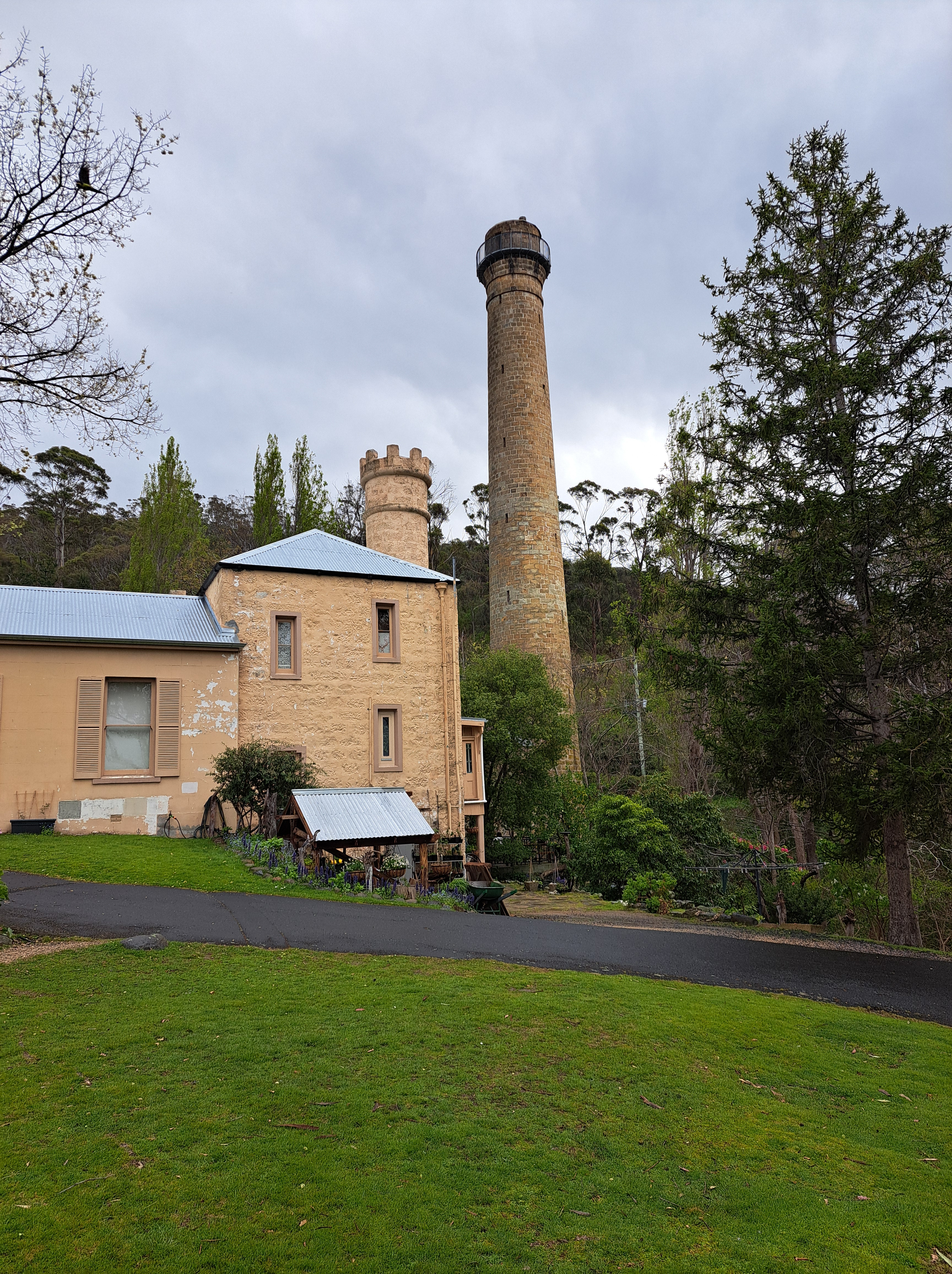
“What’s that?” I asked, pointing at the tower.
“Oh, that’s the shot tower, ” replied Daniel.
That sounded vaguely familiar but I couldn’t be sure. “What’s it for?”
“No idea,” came the reply.
As we got closer, we saw that it was open.
We stepped in.
–x–
Science concerns itself with explanation. However, although explanations tell us why phenomena or events occur as they do, narratives tell us how they unfold. Both are concerned with sequences of events, but there is a world of difference in their aims – explanations are intended to be conclusive whereas narratives open up new possibilities. As James Carse noted in his book Finite and Infinite Games,
“Explanations settle issues, showing that matters must end as they have. Narratives raise issues, showing that matters do not end as they must but as they do. Explanation sets the need for further inquiry aside; narrative invites us to rethink what we thought we knew.”
If this is true, then science is [or ought to be] more about crafting narratives that provoke questions than finding explanations that resolve them. One of the dirty secrets of science is that no one really knows where good hypotheses come from. When asked, great scientists offer responses like the one below:
“The supreme task of the physicist is to arrive at those universal elementary laws from which the cosmos can be built up by pure deduction. There is no logical path to these laws; only intuition, resting on sympathetic understanding of experience, can reach them.”
These lines are from a 1918 lecture by Einstein.
–x–
Stepping into the shot tower was a step back in time, to thirty years ago when I had just started a PhD in Chemical Engineering.
Given my math and physics background, I gravitated towards the mathematically-oriented field of fluid dynamics, but I had a lot of reading and learning to do. I spent a few months trying to define a decent research problem but made little progress.
After about a year my supervisor decided to push. He suggested that I work on a practical problem linked to his consulting work. It had to do with improving a shot-making process for a mining company. Incidentally, shot is a term used to refer to spherical metal pellets.
In the 18th and 19th centuries, shot was commonly used as ammunition in various firearms. Ideally, shot pellets should be perfectly spherical. The key problem faced by shot-makers in the 18th century was the design of a manufacturing process that would enable the production of shot of acceptable quality (uniform size and sphericity) at scale.
William Watts solved this problem in the late 18th century using an ingenious idea: let uniformly sized drops of molten metal to free-fall from a height. While falling they will tend to form spheres due to the effect of surface tension (the force that the interior metal atoms exert on the surface atoms). Why spheres? Answer: because the most energetically favourable shape for a metal drop of a fixed volume is one that minimizes the surface area, and the 3d shape that has the smallest surface area for a given volume is a sphere.
This reasoning is what led Watts to add a three storey tower to his own house in the 1780s and start producing shot from his home factory.
–x–
As we made our way up the tower, the kids started asking questions.
“Why is there big bucket down there? Asked one, peering down the central shaft as we made our way up the narrow spiral stairway.

“What’s with the stove at the top – it’s a terrible place for a kitchen? Asked the other when we got to the top.
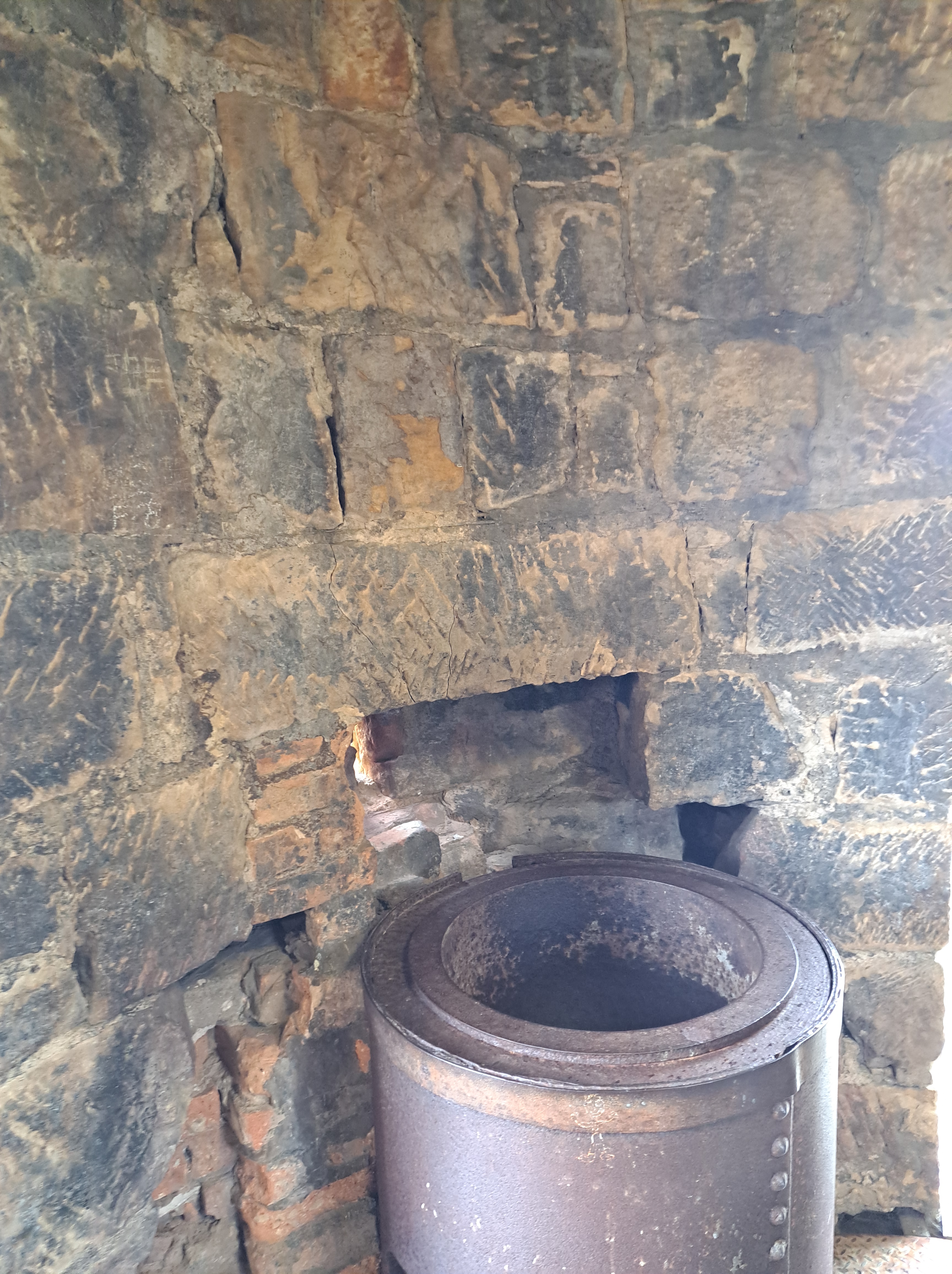
I was surprised at how their questions and observations reminded me of what I once knew well but had since forgotten:
“Molten lead would be dropped from the top of the tower. Like most liquids, surface tension makes drops of molten lead become near-spherical as they fall. When the tower is high enough, the lead droplets will solidify during the fall and thus retain their spherical form. Water is usually placed at the bottom of the tower, cooling the lead immediately upon landing.” – from the Wikipedia article on shot
And so on. There are several engineering challenges around ensuring uniform drop sizes. For example, as the shot size increases, the drops of molten metal needs to be released from a greater height.
On our way out, we spent some time browsing the photographs and artefacts in the small museum at the base of the tower. I launched into an impromptu lecture on the physics of jet breakup, again surprised at how much I could recall.
“Interesting,” said Daniel politely, “so is this what your Phd was about? Shot-making?”
“No,” I said, “I ended up working on another related problem, and that’s another story.”
And as I said that, I realised the unforeseen and unplanned turn my research took thirty odd years ago was not so different from what had happened on our walk that day.
–x–
One October evening 1995, about a year into my shot-making project, I was washing up after dinner when I noticed a curious wave-like structure on the thin jet that emerged from the kitchen sink tap and fell onto a plate an inch or two below the tap (the dishes had piled up that day). The wave pattern was stationary and rather striking.
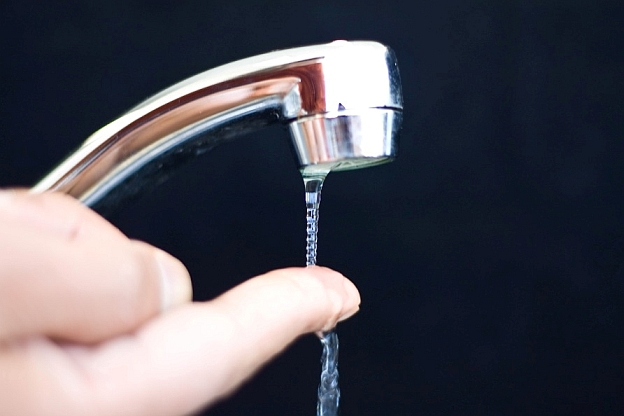
The phenomenon is one that countless folks have seen. Indeed, I had noticed it before but never paid it much attention until that October evening when I saw the phenomenon with new eyes. Being familiar with the physics of jet breakup, I realised, at once, that the pattern had the same underlying cause. Wondering if anyone had published papers on it, I dashed off to the library to do a literature search (Google Scholar and decent search engines were still a few years away). Within a few hours I knew I’d stumbled on a phenomenon that would change the direction of my research.
The next day, I told my supervisor about it. He was just as excited about it as I was and was more than happy for me to switch topics. I worked feverishly on the problem and within a few months had a theory that related the wavelength of the waves to jet velocity and properties of the fluid. The work was not a major innovation, but it was novel enough to get me a degree and a couple of papers.
–x–
Here’s the thing, though. I came upon the phenomenon by accident. There was nothing planned about it, neither was there anything in my training that prepared me for it.
Much is made of the importance of having well-defined goals, both in scientific research and business. You know the spiel: without goals there can be no plans; to map out a route, you must know the destination etc.
However, it is all too easy to become fixated on achieving goals or arriving at a destination to the point where one ceases to pay attention to the journey. Much of the fun and learning is not in reaching one’s goal but in the events and encounters along the way. If we’d been fixated on the walk, we might have missed the opportunity to explore the tower.
As they say, it is the journey that matters, not the destination. Carse put it beautifully when he wrote,
“Copernicus was a traveler who…[dared] to look again at all that is familiar in the hope of vision. What we hear in this account is the ancient saga of the solitary wanderer… who risks anything for the sake of surprise. True, at a certain point he stopped to look and may have ended his journey…But what resounds most deeply in the life of Copernicus is the journey that made knowledge possible and not the knowledge that made the journey successful.”
A journey that seeks surprise necessarily involves taking paths to destinations unknown in preference to those that have been mapped out clearly. Our visit to the shot tower was not planned- indeed, I didn’t even know of its existence before that morning – but the half hour we spent there is what made our walk interesting and memorable.
–x–
A final word before I go, once again prompted by Carse:
“To be prepared against surprise is to be trained. To be prepared for surprise is to be educated. Education discovers an increasing richness in the past, because it sees what is unfinished there. Training regards the past as finished and the future as to be finished. Education leads toward a continuing self-discovery; training leads toward a final self-definition. Training repeats a completed past in the future. Education continues an unfinished past into the future.”
If Carse is right – and I think he is – our education system is all about training, not education. The many years I spent at universities taught me skills I could use to solve problems that were given to me, but not how to look at the world in wonder and find problems of my own. It was only towards the end of my time in university that I learnt the latter, and the irony is that I did so serendipitously.
–x–x–



 Eight to Late
Love the final Carse quote. The quest has been ongoing since Aristotle but we continue to stumble and toil away repeating a “completed past” like a piece of loved and endlessly repeated classical music. What we need are leaps of improvisation born of intuition.
LikeLiked by 1 person
brisklyresilient6646b34b02
December 3, 2024 at 6:42 am