Author Archive
On the elusive notion of leadership
Introduction
In a post entitled, Macrovisions and Micromanagement, I discussed some of the reasons for the gap between the espoused view of leadership and its actual practice in organisations. The post is based on a research study in which managers in an organization were asked what their jobs entailed. Their responses revolved around themes of leadership – things such as strategy formulation, setting direction and generally acting as enablers rather than administrators. However, when asked to elaborate via examples, most managers spoke of administrative and bureaucratic activities rather than those that involved leadership.
There are many possible reasons for this gap. Some of these include:
- Pressure to display leader-like behaviour: Management literature and education tends to place leadership at the pinnacle of managerial practice. Consequently, there is considerable pressure on managers at the middle and senior levels to display leadership qualities (as defined in management texts).
- The issue of identity: Most managers would like to view themselves as being leaders. As a result, they may unconsciously describe what they do in the flattering language of leadership.
- Gap between job description and actual job: Managers are expected to display leader-like behaviour. However, at the same time, they are held responsible for specific and very tangible results. There is thus a continual pressure to get involved in low-level detail while maintaining the illusion of being a leader.
In the present post I delve further into the question of leadership. Specifically, I explore the possibility that the concept of leadership promoted by management literature is flawed. My discussion is based on a brilliant paper by Lesley Prince entitled, Eating the Menu Rather than the Dinner: Tao and Leadership.
To those who may be rolling their eyes at the reference to religion- stay with me, I think you will find that the content and conclusions of the paper merit serious consideration.
Background and context
The author begins by noting that much of management theorising about leadership is based on the following fundamental assumptions:
- The notion that hierarchies are an inevitable within groups, and that those on the top of the heap must exert control to avoid chaos and anarchy.
- Leadership is a well-defined, independent concept that can be codified and can be the subject of inquiry. In other words, it is possible to formulate principles of leadership that are independent of environment and the actual practice of these principles can be studied.
The above assumptions flow from a western view of management. One of the tenets of such a view is that it is possible to formulate general principles of leadership, independent of the environment in which it is practiced. Indeed this is the very basis of mass education in management: business school curricula would be largely empty if there were no general, environment-independent management principles.
On the other hand, in certain eastern philosophies (Taoism and Zen in particular), the focus is not so much on following prescribed principles or exerting control, but on dealing with circumstances as they are. The latter is a interesting perspective from which to analyse leadership because it emphasises that leadership is a social skill, best learnt through experience rather than theory. The paper is essentially a discussion of how certain precepts of Taoism can aid our understanding of leadership as an experience-based skill.
Taoism and its relevance to understanding leadership
Taoism has mystical connotations in western society because it is often associated with alternative lifestyles and counter-culture groups. However, in reality it is a practical way of life that teaches one to embrace direct experience, avoiding filters of presumption or analysis. The author stresses that it is neither a religion nor a philosophy in the conventional sense. Above all, it emphasises the danger of dogma and the importance of keeping an open mind. As the author puts it:
…it is sufficient to note that the point of Taoist practice is the relatively uncontroversial claim that our habitual understandings and modes of thought, often little more than unexamined assumptions, have a tendency to hijack our ability to apprehend the world, interfere with our perceptions, and often lead us to see what we think we ought (or want) to see rather than what is actually there.
This point highlights the relevance of Taoism in our quest to understand the concept of leadership: perhaps the answer lies in observing how people relate to each other in real-life rather than attempting to force-fit theoretical or empirical models of leadership to situations as advocated by management researchers.
At this point readers may be asking: how can we understand a concept without developing mental models or representations of it? Indeed, it is one of the paradoxes of Taoism that one can understand something without necessarily being able to articulate it. In the same way, the paper is an attempt to get an understanding of the concept of leadership by looking at some of its paradoxical aspects. In the next few sections, we’ll look at some of the seemingly self-contradictory aspects of leadership that are explored in the paper.
The difficulty with definitions
Taoism alludes to the difficulty of using words to describe the essence of Taoism. As the author puts it:
According to Taoism grasping the Tao in mere words is a futile undertaking, like trying to explain the experience of an orange to someone who has never encountered one. In one sense the ideas are pure simplicity, but apt to become complex and nebulous when expressed in words…
He suggests that the same difficulty arises when trying to describe any aspect of social reality: there are so many different variables at play that pinning down the aspect of interest is virtually impossible. Indeed, as the author points out, there are a number of definitions of leadership, each emphasising a different facet of the concept.
Perhaps then, it is futile to attempt to capture the concept in words. However, that does not mean that is impossible to understand it. As the author states, quoting from Keith Grint (a well-known scholar of leadership):
…before I began to study leadership in a serious manner, my knowledge of it was complete. I knew basically all there was to know and I had already spent over a decade practising it.
This insightful line suggests that it is possible to understand what leadership is and what it isn’t, without having to define it. I would hazard an opinion that successful leaders don’t over-think what they do, they simply lead as required by the situations they encounter.
The hidden effect of language
The author highlights some important differences between ancient Chinese (the language in which the original Taoist texts were written) and western languages such as English. One of the most important of these is that Chinese is a verb-based language whereas English is noun-based. An implicit consequence of this is that Chinese emphasises action and relationships between objects whereas English emphasises objects. The relevance of this observation to leadership is as follows: instead of attempting to objectify the concept of leadership, it may be more helpful to understand it in terms of actions and relationships. Once again, this suggests that we should shift our focus on the actions of leadership rather than the words (platitudes?) that define it.
Theological origins
The author makes the interesting suggestion that the dominant view of leadership may have theological origins. This is not as far-fetched as it sounds. Monotheistic religions are based on the notion of an omnipotent being who is essentially responsible for the world as we know it and is, in a sense, in charge. This view suggests that hierarchies are natural and ought to be the way groups are organised which, in turn, leads to the view of a leader as someone who wields power by virtue of their position in the hierarchy. In contrast, in Taoism (in its pure form) there are no omnipotent gods as in the monotheistic religions. It is thus perfectly natural to see the asymmetric distribution of power not as a consequence of hierarchy but as a fact of human existence.
Understanding leadership vs. knowing it
One of the central teachings of Taoism is to seek direct experience, free from preconceptions of any kind. This principle is in direct conflict with the way in which researchers attempt to study and understand concepts such as leadership. Typically, researchers make hypotheses, build models and test them against reality. They objectify the thing to be studied and analyse it through the lens of their pre-existing knowledge. Instead a case-study based approach that focuses on the actual experience of leadership may be more fruitful. As the author put it:
The conceptual tangles and contradictions in leadership that seem to be an inevitable part of the models derived from the empirical and quasi-empirical methods of the western tradition often cause more confusion than clarity when people try to apply them. In contrast an approach derived from the theoretical naivete (but conceptual sophistication) of Taoism generates powerful insights that are often difficult to express in words. Part of the key here, perhaps, is to consider leadership not as a set of intellectual principles, but much more as a set of experientially located and responsive relational skills-in-process…
A couple of lines later, he goes,
…there seems to be a stubborn adherence to an old-fashioned objectivism, particularly in the persistence of the subject-object dichotomy. This inevitably excludes the felt and experienced realities of power, influence and involvement in the leadership relation, and this has generated some of the more intractable problems we face when studying leadership. If our models are to have any value they must speak to and from experience, even if this seems messy and inchoate at times.
Although it may be difficult to capture in words, leadership is far from a fuzzy notion: given a situation, most people just know if leadership is being displayed (or not). We understand leadership because we know it when we see it.
Labels do not make a leader
Although it is generally recognised that calling someone a leader doesn’t make them one, most organisations still conflate leadership with positions and titles. The fact that high level management roles are often termed “leadership positions” is proof that this misconception is rife.
Moreover, as the author states:
…the conflation of `leader’ with any of the available position labels, makes the definition of `leadership’ and `leader’ completely superfluous – all one needs is a specification of position within a hierarchy, and all else follows. Except of course that it doesn’t, because we should still have to explain why some leaders by such a definition come to be regarded as fools, idiots, incompetents and charlatans.
Perhaps the most insidious feature of the confusion between position and leadership is that it devalues the work of those who are in subordinate roles by presuming that they are somehow unable to display leadership qualities. They are considered passive players whose job it is to follow. Ronald Heifetz’s brilliant work on leadership speaks to this very issue. As he states in this interview:
In our society, we carry a common notion of the leader as the person with the vision, who then gets people to buy in, to align themselves with that vision. This notion is bankrupt and dangerous, because the leaders who have done good for their communities and organizations are not the ones who came up with the vision. If we picture them as the conductor of an orchestra, they are good at embodying the soul of the music. These leaders are good at articulating the transcendent values of the organization or community. But it’s not their vision.
The leader is an enabler, not an oracle who has all the answers.
Doing by non-doing
Another central teaching of Taoism is the concept of non-doing. Just to be clear, this should not be interpreted as inaction. Rather, it is effortless action. In the context of leadership, there are two aspects of non-doing that are particularly relevant. They are:
- Acting without any preconceived ideas of what leadership is. That is, acting in a manner that is most appropriate to the situation at hand, without worrying about what convention might deem as leader-like behaviour.
- Creating a work environment in which people can operate autonomously and, where required, collaborate spontaneously. Instead of attempting to control events and people, the emphasis is on creating the conditions that are conducive to high quality work.
As the author puts it, “non-interference as an essential quality of leadership”
Unconventional leadership
In essence, the teachings of Taoism urge us to experience things as they are. However, this is not the same as accepting standard conventions or interpretations of how things are. The failure to appreciate the difference is the reason why many people dismiss much of this as mystical claptrap. Further, it should be emphasised that one does not have to be a revolutionary: the point is not to do battle with the system or overturn convention; it is not to be a prisoner of convention, to be able to step outside of it when the situation demands.
Conclusion
I have to say, this is one of the most delightful and stimulating papers I have ever read. Although it has been published in a research journal, there are some brilliant insights in it for managers, leaders and those who don’t know the difference between the two.
The author quotes from Alan Watts at the end of the paper, and I can think of no better way to end this review:
I have associated and studied with the `objective observers’ and am convinced that, for all their virtues, they invariably miss the point and eat the menu instead of the dinner. I have also been on the inside of a traditional hierarchy . . . and am equally convinced that from this position one does not know what dinner is being eaten. In such a position one becomes technically `idiotic’, which is to say, out of communication with those who do not belong to the fold.
The central message of the paper is nicely summarised in its title which, though intended to take a gentle dig at scholars of leadership, applies rather well to many who claim to be leaders. Indeed, many so-called leaders act according to what books, gurus and consultants tell them rather than respond to the situation at hand. In this sense they do indeed eat the menu rather than the dinner
Models and messes in management – from best practices to appropriate practices
Scientific models and management
Physicists build mathematical models that represent selected aspects of reality. These models are based on a mix of existing knowledge, observations, intuition and mathematical virtuosity. A good example of such a model is Newton’s law of gravity according to which the gravitational force between two objects (planets, apples or whatever) varies in inverse proportion to the square of the distance between them. The model was a brilliant generalization based on observations made by Newton and others (Johannes Kepler, in particular), supplemented by Newton’s insight that the force that keeps the planets revolving round the sun is the same as the one that made that mythical apple fall to earth. In essence Newton’s law tells us that planetary motions are caused by gravity and it tells us – very precisely – the effects of the cause. In short: it embodies a cause-effect relationship.
[Aside: The validity of a physical model depends on how well it stands up to the test of reality. Newton’s law of gravitation is remarkably successful in this regard: among many other things, it is the basis of orbital calculations for all space missions. The mathematical model expressed by Newton’s law is thus an established scientific principle. That said, it should be noted that models of the physical world are always subject to revision in the light of new information. For example, Newton’s law of gravity has been superseded by Einstein’s general theory of relativity. Nevertheless for most practical applications it remains perfectly adequate.]
Given the spectacular success of modeling in the physical and natural sciences, it is perhaps unsurprising that early management theorists attempted to follow the same approach. Fredrick Taylor stated this point of view quite clearly in the introduction to his classic monograph, The Principles of Scientific Management. Here are the relevant lines:
This paper has been written…to prove that the best management is a true science, resting upon clearly defined laws, rules and principles, as a foundation. And further to show that the fundamental principles of scientific management are applicable to all human activities, from our simplest individual activities to the work of great corporations, which call for the most elaborate cooperation. And briefly, through a series of illustrations, to convince the reader that whenever these principles are correctly applied, results must follow which are truly astounding…
From this it appears that Taylor’s intent was to prove that management could be reduced to a set of principles that govern all aspects of work in organizations.
The question is: how well did it work?
The origin of best practices
Over time, Taylor’s words were used to justify the imposition of one-size-fits-all management practices that ignored human individuality and uniqueness of organisations. Although, Taylor was aware of these factors, he believed commonalities were more important than differences. This thinking is well and alive to this day: although Taylor’s principles are no longer treated as gospel, their spirit lives on in the notion of standardized best practices.
There are now a plethora of standards or best practices for just about any area of management. They are often sold using scientific language, terms such as principles and proof. Consider the following passage taken from from the Official PRINCE2 site:
Because PRINCE2 is generic and based on proven principles, organisations adopting the method as a standard can substantially improve their organisational capability and maturity across multiple areas of business activity – business change, construction, IT, mergers and acquisitions, research, product development and so on.
There are a couple of other things worth noting in the above passage. First, there is an implied cause-effect relationship between the “proven principles” and improvements in “organizational capability and maturity across multiple areas of business activity.” Second, as alluded to above, the human factor is all but factored out – there is an implication that this generic standard can be implemented by anyone anywhere and the results will inevitably be as “truly astounding” as Taylor claimed.
Why best practices are not the best
There are a number of problems with the notion of a best practice. I discuss these briefly below.
First, every organisation is unique. Yes, much is made of commonalities between organisations, but it is the differences that make them unique. Arguably, it is also the differences that give organisations their edge. As Stanley Deetz mentioned in his 2003 Becker lecture:
In today’s world unless you have exceptionally low labor costs, competitive advantage comes from high creativity, highly committed employees and the ability to customize products. All require a highly involved, participating workforce. Creativity requires letting differences make a difference. Most high-end companies are more dependent on the social and intellectual capital possessed by employees than financial investment.
Thoughtless standardization through the use of best practices is a sure way to lose those differences that could make a difference.
Second, in their paper entitled, De-Contextualising Competence: Can Business Best Practice be Bundled and Sold, Jonathan Wareham and Han Gerrits pointed out that organisations operate in vastly varying cultural and social environments. It is difficult to see how best practice approaches with their one-and-a-half-size –fits-all approach would work.
Third , Wareham and Gerrits also pointed out that best practice is often tacit and socially embedded. This invalidates the notion that it can be transferred from an organization in which it works and to another without substantial change. Context is all important.
Lastly, best practices are generally implemented in response to a perceived problem. However, they often address the symptoms rather than the root cause of the problem. For example, a project management process may attempt to improve delivery by better estimation and planning. However, the underlying cause – which may be poor communication or a dysfunctional relationship between users and the IT department –remains unaddressed.
In his 2003 Becker lecture, Stanley Deetz illustrated this point via the following fable:
… about a company formed by very short people. Since they were all short and they wanted to be highly efficient and cut costs, they chose to build their ceiling short and the doorways shorter so that they could have more work space in the same building. And, they were in fact very successful. As they became more and more successful, however, it became necessary for them to start hiring taller people. And, as they hired more and more tall people, they came to realize that tall people were at a disadvantage at this company because they had to walk around stooped over. They had to duck to go through the doorways and so forth. Of course, they hired organizational consultants to help them with the problem.
Initially they had time-and-motion experts come in. These experts taught teams of people how to walk carefully. Tall members learned to duck in stride so that going through the short doors was minimally inconvenient. And they became more efficient by learning how to walk more properly for their environment. Later, because this wasn’t working so well, they hired psychological consultants. These experts taught greater sensitivity to the difficulties of tall members of the organization. Long-term short members learned tolerance knowing that the tall people would come later to meetings, would be somewhat less able to perform their work well. They provided for tall people networks for support…
The parable is an excellent illustration of how best practices can end up addressing symptoms rather than causes.
Ambiguity + the human factor = a mess
Many organisational problems are ambiguous in that cause-effect relationships are unclear. Consequently, different stakeholders can have wildly different opinions as to what the root cause of a problem is. Moreover, there is no way to conclusively establish the validity of a particular point of view. For example, executives may see a delay in a project as being due to poor project management whereas the project manager might see it as being a consequence of poor scope definition or unreasonable timelines. The cause depends on who you ask and there is no way to establish who is right! Unlike problems in physics, organisational problems have a social dimension.
The visionary Horst Rittel coined the evocative term wicked problem to describe problems that involve many stakeholder groups with diverse and often conflicting perspectives. This makes such problems messy. Indeed, Russell Ackoff referred to wicked problems as messes. In his words, “every problem interacts with other problems and is therefore part of a set of interrelated problems, a system of problems…. I choose to call such a system a mess”
Consider an example that is quite common in organisations: the question of how to improve efficiency. Management may frame this issue in terms of tighter managerial control and launch a solution that involves greater oversight. In contrast, a workgroup within the organisation may see their efficiency being impeded by bureaucratic control that results from increased oversight, and thus may believe that the road to efficiency lies in giving workgroups greater autonomy. In this case there is a clear difference between the aims of management (to exert greater control) and those of workgroups (to work autonomously). Ideally, the two ought to talk it over and come up with a commonly agreed approach. Unfortunately they seldom do. The power structure in organisations being what it is, management’s solution usually prevails and, as a consequence, workgroup morale plummets. See this post for an interesting case study on one such situation.
Summing up: a need for appropriate practice, not best practice
The great attraction of best practices, and one of the key reasons for their popularity, is that they offer apparently straightforward solutions to complex problems. However, such problems typically have a social dimension because they affect different stakeholders in different ways. They are messes whose definition depends on who you ask. So there is no agreement on what the problem is, let alone its solution. This fact by itself limits the utility of the best practice approach to organisational problem solving. Purveyors of best practices may use terms like “proven”, “established”, “measurable” etc. to lend an air of scientific respectability to their wares, but the truth is that unless all stakeholders have a shared understanding of the problem and a shared commitment to solving it, the practice will fail.
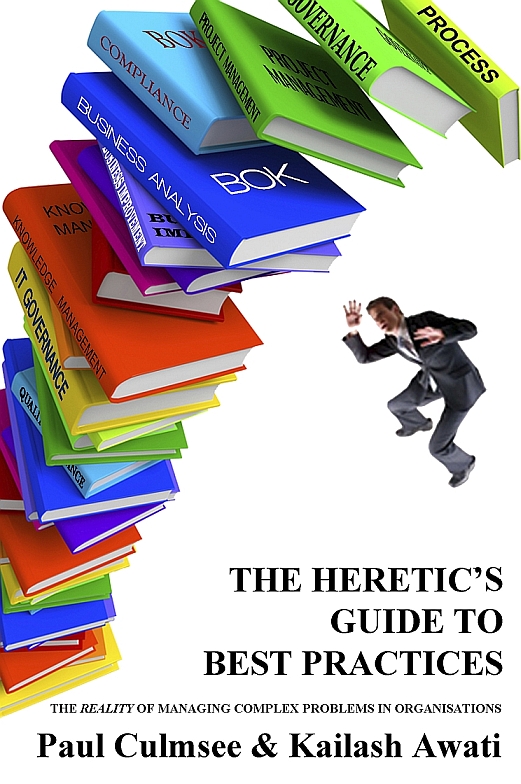
In our recently published book entitled, The Heretic’s Guide to Best Practices, Paul Culmsee and I describe in detail the issues with the best practice approach to organisational problem-solving. More important, we provide a practical approach that can help you work with stakeholders to achieve a shared understanding of a problem and a shared commitment to a commonly agreed course of action. The methods we discuss can be used in small settings or larger one, so you will find the book useful regardless of where you sit in your organisation’s hierarchy. In essence our book is a manifesto for replacing the concept of best practice with that of appropriate practice – practice with a human face that is appropriate for you in your organisation and particular situation.
Book Announcement: The Heretic’s Guide to Best Practices
After two years of chewing up most of my free time, I’m delighted and relieved (in about equal measure) to announce that the book I’ve written with Paul Culmsee is finally out: The Heretics Guide to Best Practices is now available through Amazon (also on Kindle) and iUniverse.
In this post I present the first couple of paragraphs from the book to give you a flavour of the content and style. I also include some quotes from reviewers who read drafts of the book.
The first few paragraphs
The following lines are taken from the start of the book:
Have you ever noticed that infomercials trying to sell you the latest ab-sculpting, fat burning, home fitness device with three easy credit card payments, always start with questions designed in such a way that the answer is invariably “Yes”? We have too—so as a tribute to these infomercials, we are starting this book with some seriously loaded questions.
- Have you ever had the feeling that something is not quite right in your workplace, yet you cannot articulate why?
- Are you required to perform tasks that you instinctively feel are of questionable value?
- Have you ever questioned an approach, only to be told that it is a best practice and therefore cannot be questioned?
- Have you ever sighed and blamed the ills of your organisation on “culture” or “that’s just the way things are done here”?
- Have you ever lamented to others that “If only we got ourselves organised”, we would stop chasing our tails and being so reactive?
If you answered “No” to these questions then, seriously—you are holding the wrong book. What’s more, if you manage staff and you answered ”No” to these questions, then chances are your staff gave you this book to read in the hope that you might learn a few home truths.
For those who said a hopefully emphatic “Yes!”—and we are hoping that’s a fair chunk of our readers—this book might offer you some answers and put some names to some of the things that make your organisational “spider senses” tingle. Bear in mind, you are not going to get any glib “Seven Steps to Organisational Nirvana” type stuff here. Instead, you are about to undertake a varied and, at times, heretical journey into the fun-filled world of organisational problem solving. Not only will this book provide you with some juicy ammunition in relation to organisational debates about the validity of best practices, but the practical tools and approaches that we cover might also give you some insights in how to improve things.
Quotes from reviewers
Here are some pre-publication quotes from reviewers who read draft versions of the book:
“In Paul and Kailash I have found kindred spirits who understand how messed up most organizations are, and how urgent it is that organizations discover what Buddhists call ‘expedient means’—not more ‘best practices’ or better change management for the enterprise, but transparent methods and theories that are simple to learn and apply, and that foster organizational intelligence as a natural expression of individual intelligence. This book is a bold step forward on that path, and it has the wonderful quality, like a walk at dawn through a beautiful park, of presenting profound insights with humor, precision, and clarity.”
—Jeff Conklin, Director, Cognexus Institute
—
“Hugely enjoyable, deeply reflective, and intensely practical. This book is about weaving human artistry and improvisation, with appropriate methods and technologies, in order to pool collective intelligence and wisdom under pressure.”
—Simon Buckingham Shum, Knowledge Media Institute, The Open University, UK.
—
“This is a terrific piece of work: important, insightful, and very entertaining. Culmsee and Awati have produced a refreshing take on the problems that plague organisations, the problems that plague attempts to fix organisations, and what can be done to make things better. If you’re trying to deal with wicked problems in your organisation, then drop everything and read this book.”
—Tim Van Gelder, Principal Consultant, Austhink Consulting
—
“This book has been a brilliantly fun read. Paul and Kailash interweave forty years of management theory using entertaining and engaging personal stories. These guys know their stuff and demonstrate how it can be used via real world examples.
As a long time blogger, lecturer and consultant/practitioner I have always been served well by contrarian approaches, and have sought stories and case studies to understand the reasons why my methods have worked. This book has helped me understand why I have been effective in dealing with complex business problems. Moreover, it has encouraged me to delve into the foundations of various management practices…”
—Craig Brown, Director, Evaluator
—
“Paul and Kailash have written a book that largely mirrors what I have learned through my own (sometimes painful) experience: at the foundation of every technical solution there should be a clear understanding of the business problem. It amazes me how many projects proceed without this basic planning building block, and yet the percentage of projects that fail remains fairly constant. This book provides an informative and entertaining look at the role of the business analyst, with guidance on how to improve your problem-solving skills.”
—Christian Buckley, Director, Product Evangelism at Axceler
—
“Paul and Kailash have done a fantastic job of pulling together many areas of research and presenting this in an accessible and compelling way. They walk you through their discovery process, helping you gain a real understanding of way things work but more importantly why things work, and then apply these in the real world. If you have ever been told something is a best practice, you owe it to yourself to read this book.”
—Andrew Woodward, Founder and CEO, 21Apps
—
We think there is something is the book for most professionals, regardless of where they sit in their organisation’s hierarchy. But in the end it is your opinion that counts. We would love to know what you think of our effort, and look forward to hearing from you – either via a comment on our blogs or a review on bookseller websites.
Note (added on 31 Jan 2012):
Check out the customer reviews on Amazon.


 Eight to Late